

Couples Date Night Ideas: A Follow-Through Checklist


Key Takeaways
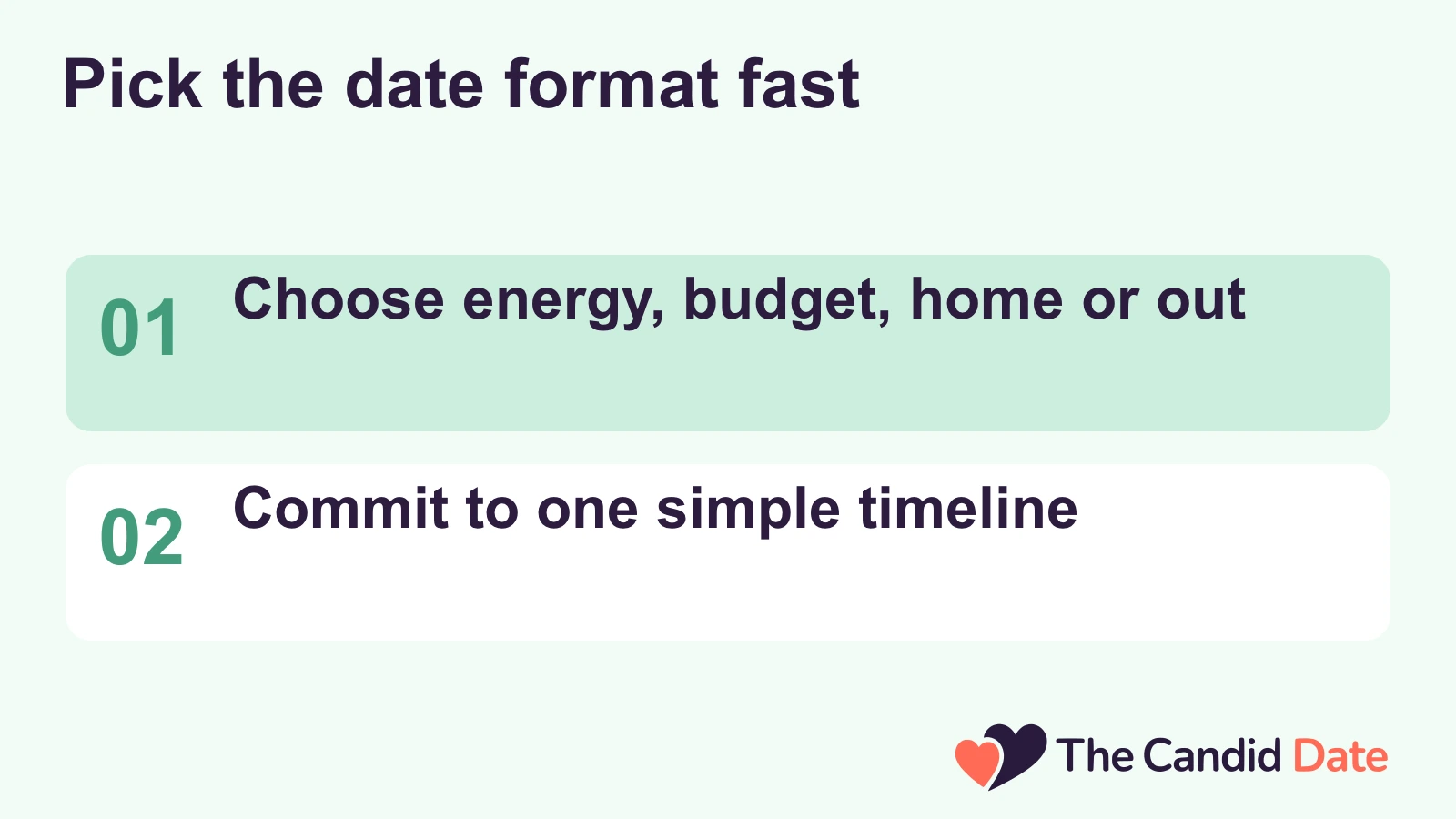
Pick one format by deciding energy, budget, and home versus out before you debate ideas.
Use a day-before and day-of checklist with named owners so one partner is not the default planner.
Treat stalls, flops, and tiredness as normal branches to manage, not verdicts on compatibility.
Close with a five-minute debrief and schedule the next date while the memory is fresh.
If you keep searching for couples date night ideas but the actual evening dissolves into takeout, scrolling, or a tense who-picks standoff, the missing piece is probably not inspiration. It is follow-through. This guide assumes both of you are adults who want regular time together and need a way to run one date night from decision to cleanup without making it a second job.
You will get a ten-minute format picker, a shared planning script, a timed checklist, in-the-moment fixes, a short debrief, and a rotation that keeps the habit alive. The goal is not a perfect date. The goal is a repeatable evening that feels intentional, affordable enough to repeat, and flexible enough to survive work fatigue.
Pick one format in ten minutes
Start by choosing the container, not the exact activity. Set a timer for ten minutes and answer three forks. First, energy: are you both depleted and need low effort, or do you have enough bandwidth for novelty?
Second, budget tier: pick a planning ceiling such as a hypothetical thirty-dollar total, a moderate splurge, or an at-home no-spend night, and treat that number as a limit you chose, not a market price. Third, location: home, nearby out, or somewhere that needs transit and reservations. If you disagree, let the lower-energy partner set the floor and the higher-energy partner add one optional upgrade.
Do not collect twenty ideas; commit to one shape.
Here is a hypothetical weeknight shape you can copy before any details: meet at the kitchen table at 6:30, phones in a drawer, cook one simple recipe together by 7:15, eat by 7:45, take a fifteen-minute walk around the block, then choose a fifteen-minute dessert or show episode. End by 9:15 so a work night does not become a sleep debt problem. Notice the structure: one main activity, one optional stop, a clear finish.
If your plan cannot fit inside that shape on a Thursday, move it to Saturday instead of squeezing romance into exhaustion.
- Low energy plus low budget means at home, simple food, early ending.
- High energy plus low budget means a walk, free event, picnic, or bookstore browse.
- Low energy plus higher budget means pickup food and one comfortable upgrade.
- High energy plus transit means reserve only one timed thing and keep the rest flexible.
Outdoor Date Ideas: 12 Easy Plans for a First or Second Date
Have the planning conversation without a default organizer
The fastest way to kill momentum is for one partner to carry the invisible labor while the other says they are fine with anything. Before calendars open, say this plainly: we are choosing together, and ownership rotates. A useful script is: what are you craving more of right now, comfort or surprise; what is your hard no; what would make the night easier; and what part do you want to own?
Listen for preferences hidden inside complaints. If someone says dinner and a movie again, the need may be predictability, rest, or not being asked to perform enthusiasm.
Split ownership by function rather than by personality. One person can own logistics such as timing, reservations, weather, and cleanup. The other can own mood such as playlist, lighting, conversation prompts, and the small detail that signals effort.
If the same person always owns logistics, resentment builds even when dates are good. Put both names in the calendar invite. If a plan needs childcare, pet care, transit, or dietary checks, name the owner out loud before the day arrives.
Ambiguity is not spontaneity; it is deferred disappointment.
Build the timed checklist: day before and day of
A checklist only helps if it is timed and assigned. The day before, confirm the plan in one sentence and write it where both people can see it. Check weather and have an indoor swap that requires no new money.
Make reservations only if the place truly needs them; otherwise leave room to leave. Buy ingredients or confirm pickup, charge anything that needs charging, decide the phone rule, and clear the space that will greet you when you come home. If there are kids, elders, pets, or roommates in the picture, confirm coverage now rather than negotiating at 5:55.
- Day before, owner one: confirm time, location, backup, tickets, transit, and cleanup plan.
- Day before, owner two: prepare music, candles, charged speaker, blanket, game, or prompt cards.
- Day of, both: eat enough that hunger does not impersonate irritation, dress for the real temperature, and leave margin for parking or delays.
- Thirty minutes before: phones face down, notifications silenced, argument topics shelved, and the first transition started.
- Hard rule: if preparation takes longer than the activity, simplify the activity.
The phone rule deserves its own line because it changes the entire texture of the evening. You do not need a vow of silence; you need a container. Try a basket by the door, Do Not Disturb for one hour, or a single shared photo rule that lets you capture the moment without disappearing into it.
If one partner uses the phone for work emergencies, agree on what counts as an emergency before the date. Vague rules invite testing. Specific rules free attention.
How to Plan a Date Night That Goes Well
Set the budget tier and keep it cheap without looking cheap
Cheap fails when it looks like neglect. Inexpensive works when it looks chosen. Decide the tier early so money stops ambushing the mood.
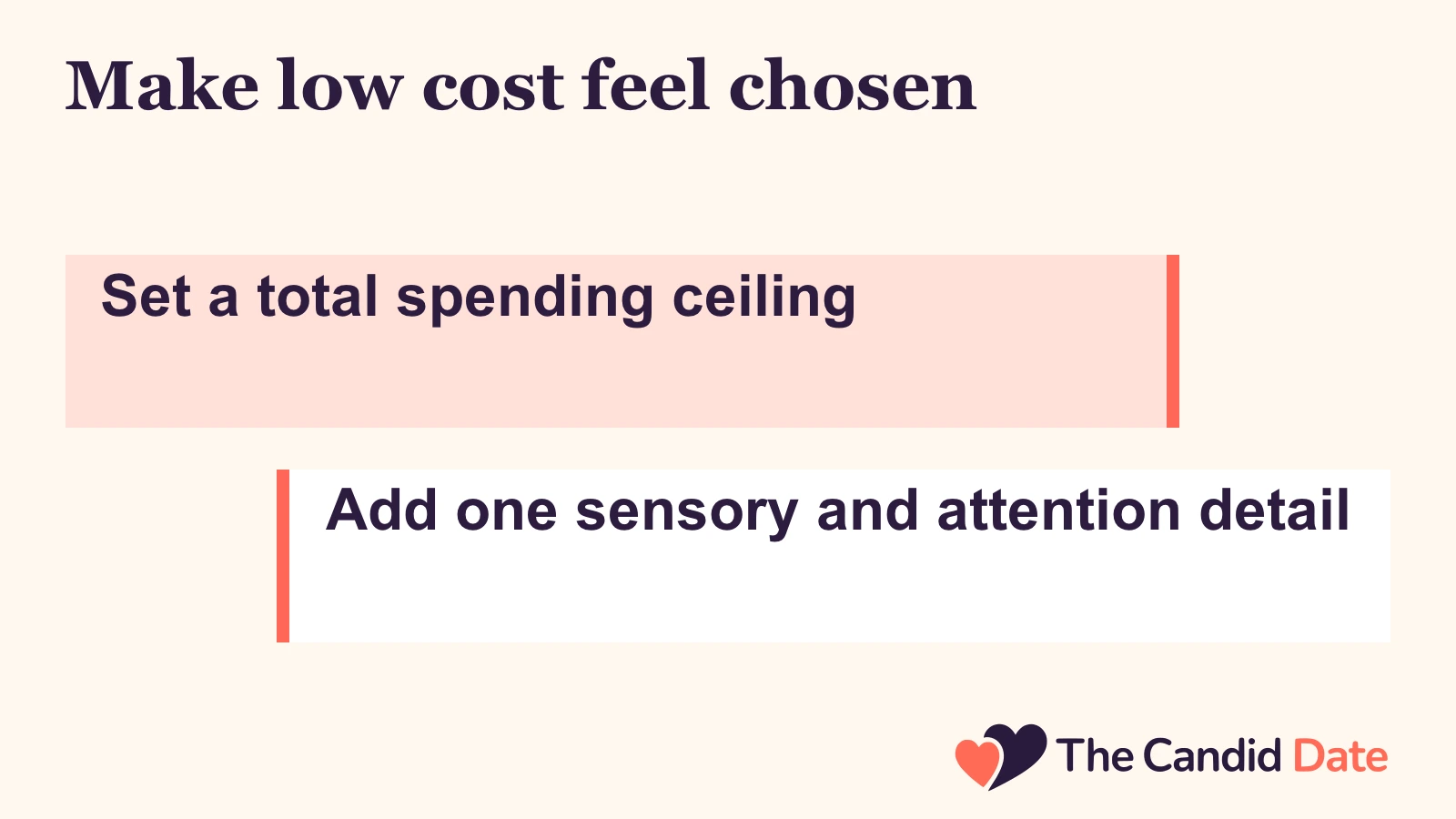
A useful frame is total cost, not item cost: a hypothetical thirty-dollar planning cap can cover groceries for cooking, gas to a viewpoint, one dessert, and a dollar-store candle if the night is mostly at home. The point is not the number; the point is that both people know the ceiling before anyone starts suggesting additions. If one partner keeps upgrading, ask which value the upgrade serves: comfort, novelty, privacy, or memory.
Make low cost feel deliberate by adding one sensory detail and one point of attention. The sensory detail can be a playlist, a picnic cloth, warm drinks in travel mugs, or a familiar dessert from a bakery you already love. The attention point can be a question each person answers fully, a toast to something specific from the past month, or a plan to watch the sunset from a bench.
A grocery meal becomes intimate when the kitchen is clean before you start and the last ten minutes are protected from cleanup. Cheap plus rushed feels careless; cheap plus presence feels tailored.
14 Low-Key, Low-Cost Date Ideas
Run the night with branching fixes
Even a good plan meets reality. Treat the night like a route with branches, not a performance. If conversation stalls, do not panic and do not interview each other.
Lower the stakes with a specific prompt: what is one thing you want more of this month, what made you laugh recently, or what would you repeat from our last good date? If the activity flops, name it early and pivot without a trial: this is not working for me, can we walk, get dessert, or go home and watch the thing we saved? A fast honest pivot is more romantic than enduring boredom to prove commitment.
If one partner is checked out, look for the cause before taking it personally. Hunger, a bad work message, social fatigue, or feeling like an audience to the other person's plan can all read as rejection. Try a repair move that does not demand instant intimacy: sit side by side, lower the noise, ask whether they need quiet, food, or a shorter night.
If the timing runs long, cut the optional second stop first. Ending well matters more than completing the itinerary. A graceful early finish keeps the next date possible; a heroic finish can make both people dread repeating it.
- Conversation stalls: ask one concrete question and answer it yourself first.
- Partner is checked out: check hunger, fatigue, phone residue, and ownership imbalance.
- Activity flops: admit it kindly, keep one salvageable element, and switch within ten minutes.
- Night runs long: drop dessert, skip the shop, and protect sleep with a named end time.
- Old argument surfaces: park it with a phrase and a real follow-up time, not a fake promise.
Keep it special but not exhausting on a work night
Length is a design choice. For most working adults, a satisfying weeknight date has a beginning, a peak, and an ending inside two to three hours. Longer is not automatically better; longer often means logistics, alcohol, spending, and a next-day cost nobody budgeted for emotionally.
Protect the ending by cleaning before you leave or agreeing that cleanup happens tomorrow before coffee. Choose activities that can be shortened without shame: a park loop can become half a loop, a movie can become one episode, a cooking project can become assembly rather than mastery. The feeling of specialness comes from attention, not duration.
Match the night to the calendar you actually have. If Friday is recovery, make Friday gentle and move novelty to Saturday. If one of you wakes early, do not pretend a midnight ending is neutral.
The best recurring date is the one your future tired selves can say yes to again. Build in a landing ritual: lights lowered, bags unpacked, water poured, one sentence about the best moment. Small landings tell the nervous system that pleasure has a place in the week and that this relationship is not always squeezing joy into leftover minutes.
Debrief in five minutes without hurt feelings
Do the debrief before the glow hardens into mythology or the flop hardens into blame. Same night is fine if you are both awake and kind; next morning is often better after a work-night date. Keep it to five minutes with three prompts: what was the best ten minutes, what should we delete, and what is the one adjustment for next time?
Speak in specifics. Say the walk after dinner saved the night, not you never try. Say I want less phone checking during the meal, not you are addicted.
The aim is information, not a courtroom.
If the date was disappointing, separate the relationship from the prototype. A bad recipe does not mean you cannot cook together. A crowded venue does not mean you dislike each other.
A quiet mood does not prove the spark is gone. Ask what variable failed: energy, timing, ownership, budget, weather, or fit. Change one variable next time rather than declaring the whole category dead.
If a sensitive topic appeared, thank the person for risking it and choose a calmer container later. Debriefing is how one attempt becomes data instead of a story about who failed.
Turn one date into a repeating rotation
The follow-through loop is simple: schedule the next date before this one is fully over, rotate the lead, and keep a shared idea list that both people can edit. Frequency should fit your real life: weekly if it is easy, every other week if work is heavy, monthly only if you also build smaller rituals between dates. Rotation does not require identical styles.
One person may plan cozy and familiar; the other may plan exploratory and odd. The rule is that the planner owns the decision and the partner gives honest feedback without seizing control halfway through.
Keep a running list with three columns: repeat, repair, and retire. Repeat holds the walk-and-dessert night, the bookstore browse, the home cooking ritual. Repair holds the almost-good ideas that need better timing or lower cost.
Retire holds the things that consistently cost too much energy for the return. Once a month, skim the list together for five minutes and star one idea per person. That tiny habit prevents the blank-calendar panic that sends couples back to dinner and a movie by default.
Date night becomes a practice, not a rescue mission.
Sponsor note for adults: Victoria Milan markets dating to married or attached people. This advertisement is separate from the date-planning advice. It is not a solution for relationship conflict. Review the current payment and privacy conditions, respect any commitments, and do not assume an advertised privacy feature guarantees anonymity.
Be wary of anyone asking for money or gifts before meeting in person.
Sponsored placement

A separate choice for married or attached adults
Victoria Milan markets dating for married or attached adults. Consider its relationship category and payment conditions carefully; advertised privacy tools do not guarantee anonymity or establish a partner’s consent.
- Built for married or attached adults
- Free registration advertised
- Review privacy and paid access before subscribing
| User Base | Today’s Deal |
|---|---|
| Adults considering an affair-oriented service | Free registration; check current paid optionsFree registration does not establish free messaging. Read current checkout, renewal and cancellation terms. Privacy features cannot guarantee anonymity. |
Frequently Asked Questions
How far ahead should we plan a date night?
Plan far enough ahead to remove friction, not so far that the plan becomes rigid. For a weeknight, confirm the format two or three days before and handle reservations, groceries, backup weather, and phone rules the day before. For a bigger out-of-the-house night, one week is usually enough unless tickets, travel, childcare, or a special reservation require more.
The key milestone is not distance from the event; it is whether both people can see the plan, know who owns what, and can still change one variable without drama.
What if our first planned date night flops?
A flop is information, not a verdict. Within a day, name what actually failed: the idea, the timing, the energy, the ownership split, the weather, or the expectation hidden inside it. Change one variable and try again soon rather than waiting months and letting the failed version become the story.
Keep one element that worked, even if it was small, such as the walk, the playlist, or the dessert. If the same problem repeats, slow down and choose easier formats until success feels normal again. Compatibility is built through repair, not through never missing.
Who should plan it if one of us is better at organizing?
Let skill shape support, not erase rotation. The naturally organized partner can own templates, reminders, and logistics while the other owns mood, research, surprises, and cleanup. Rotate the final decision so the less organized partner still practices choosing and the more organized partner practices receiving.
If control is the real issue, set a rule that the planner gets one veto-free choice and the partner gives feedback only after the date unless safety, money, or calendar constraints are involved. Skill should make the habit easier, not make one person the permanent producer.
What to Do Next
The best couples date night ideas are not the ones that look impressive in a list; they are the ones your actual life can repeat. Pick a format quickly, split ownership clearly, prepare the day before, protect attention during the night, repair stalls without panic, debrief with specifics, and schedule the next attempt while the lesson is still warm. Start with one low-pressure version inside the next seven days.
Keep what worked, change one thing that did not, and let consistency do what grand gestures cannot. Romance becomes steadier when effort stops being a surprise.
About the Author
By: Penelope Torres
Advice Editor
Penelope Torres edits the advice desk at thecandiddate.com and answers reader questions about first dates and texting.
Share the Knowledge!
Our dating experts work hard to show you the best dating sites. Want to show your appreciation? Share this page!