

How to tell a first date went well (without overthinking it)


Key Takeaways
Two of three signals means the date went well: time stretched, questions ran both ways, or a next step came up naturally.
Texting speed, who paid, and goodbye wording are weak evidence; judge the date itself, not the aftermath.
If the signals were there, send one short, specific message within 24 hours, then stop analyzing.
You are home, shoes off, replaying the night like game tape. Here is the short version: you have a useful reason to propose another date if at least two of three things happened. This is an editorial checklist, not a validated test of attraction.
Time stretched. Questions went both ways. A next step came up naturally.
Everything else, the hug length, the exact goodbye wording, how fast they texted, is mostly noise. This article keeps that simple rule and gives it teeth. Each signal below gets real examples plus the edge cases that make it unreliable, so you can score your evening in about two minutes.
Then you will learn which details to ignore, what to do within the next 24 hours, and how to move on when the honest answer is no.
Start With the Two-of-Three Rule
Here is the whole framework in one sentence. This practical checklist looks for at least two of three signals: the date ran longer than planned without either of you clock-watching, the questions flowed in both directions, and a future plan of some kind came up without being forced. Two out of three is a reason to consider a follow-up, if you also want one.
One signal is a maybe, worth at most one low-effort follow-up. Zero gives you little positive evidence from that evening; you can choose not to pursue a second meeting.
Why these three? Because they focus on things you actually observed. Politeness can produce a nice dinner, a friendly hug and a warm goodbye, but a warm interaction does not prove attraction.
Look for sustained engagement rather than relying on a friendly goodbye alone. Each signal measures engagement during the date itself, which is the only part you actually witnessed. The sections below give you concrete examples of each one, plus the conditions where a signal can mislead you, so your two-minute verdict rests on evidence instead of vibes.
Score each signal honestly as yes or no, add them up, and only then start thinking about what to do next.
Signal One: Did Time Stretch or Drag?
The clearest version of this signal looks like this: you planned one drink, and three hours later the staff is stacking chairs. Neither of you reached for a phone. One of you said something like, wait, it is already ten?
When time stretches like that, both people were choosing to stay, minute by minute, and that repeated choice is the signal. Still, staying late is not proof of attraction: practical constraints or difficulty ending a conversation can also keep someone there.
Now the edge case. A long date is only meaningful if it flew by. Sometimes a date runs long because one person is too polite to end it, or because the restaurant was slow, or because neither of you had anywhere else to be.
The giveaway is texture. In a dragging date, topics get recycled, silences stretch, and someone keeps glancing at the door or the check. In a stretching date, new topics keep appearing on their own, and the energy at hour two looks a lot like the energy at minute twenty.
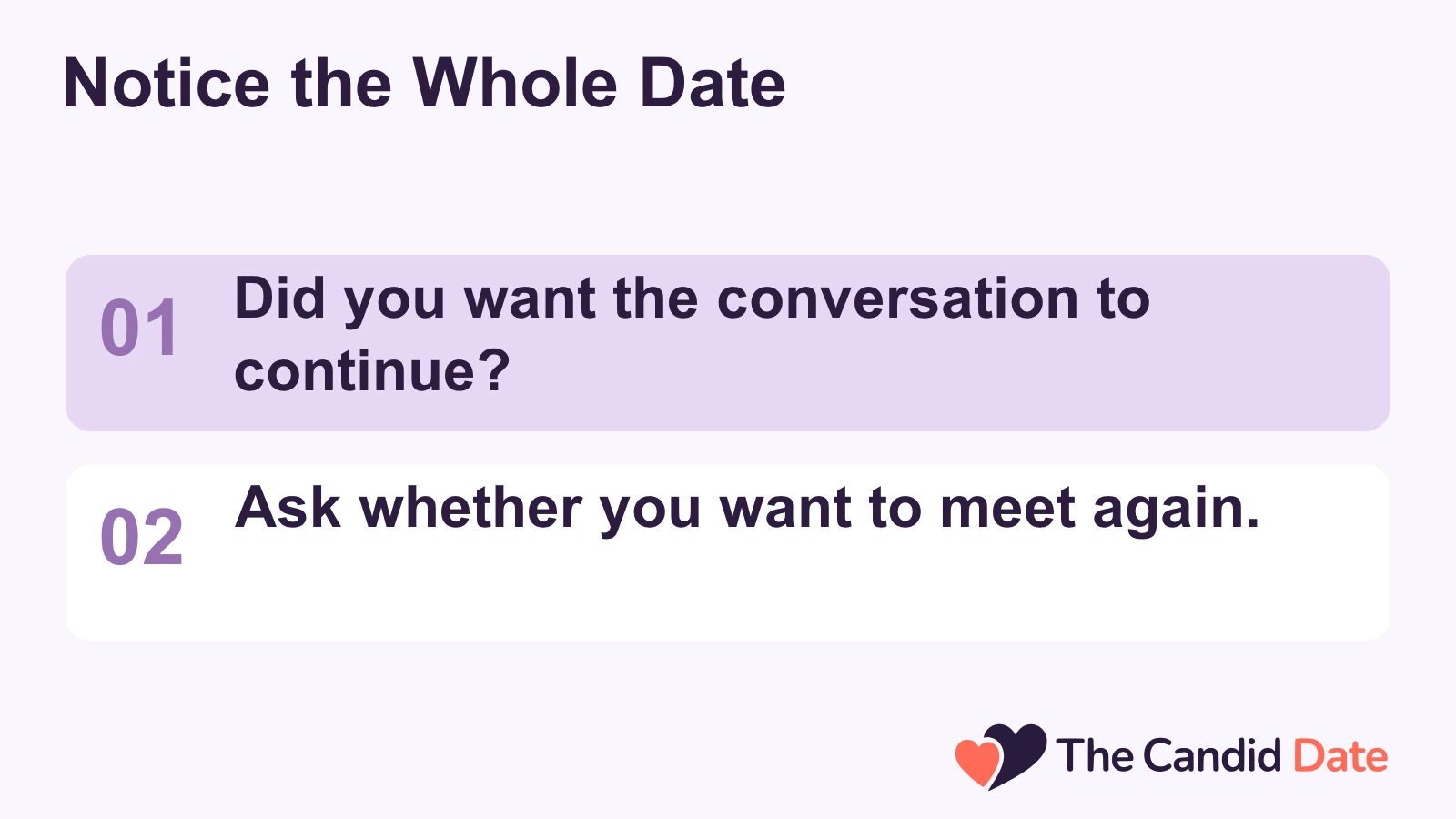
- You both seemed genuinely surprised when you finally checked the time
- One of you extended the date: another round, dessert, a walk after
- The last thirty minutes felt as lively as the first thirty
- Neither of you was watching the room, the clock or the door
Signal Two: Was the Conversation Two-Sided?
Think back over the conversation and ask one question: who did the work? On a good date, curiosity runs in both directions. They asked follow-up questions instead of just waiting for their turn to talk.
They remembered something you said early on and circled back to it an hour later. You were not performing a one-person show to keep the silence away, and you were not sitting through a lecture either.
Two edge cases matter here. First, nervous talkers. Some people chatter when anxious, and a monologue can feel like connection in the moment.
The test is not how many words were spoken but how many questions came back at you. Second, quiet people. A reserved date might talk less but still listen hard, react, and ask the occasional sharp question that proves they were tracking you.
That counts. Curiosity shows up in attention, not volume. If you want to prepare for the next meeting, our first-date guide explains open-ended questions, listening to an answer and sharing a relevant story of your own.
preparing for a first date and keeping conversation balanced
Signal Three: Did a Next Step Come Up on Its Own?
The third signal is any unprompted mention of a future that includes you. The strongest version is specific: you mentioned loving ramen, and they said there is a place downtown you have to try, we should go next week. Specificity is what makes it a signal, because it shows they were mentally placing you into a future plan while still sitting across from you.
A concrete suggestion is worth following up on, though it is not a commitment until you both agree.
Weaker versions still count, but discount them. We should do this again sometime is genuine but vague; people say it the way they say let's get lunch to a coworker. Even weaker is pure enthusiasm with no future in it, like this was so fun, said once at the door.
Treat enthusiasm as supporting evidence, not a signal by itself. Timing matters too: a plan mentioned early and never revisited is lighter evidence than one that resurfaces at the end of the night. And if no next step came up at all, do not panic.
Some people never make plans mid-date, even when they are interested. A missing third signal only decides things when the other two are also missing.
How Much Should an Awkward Goodbye Matter?
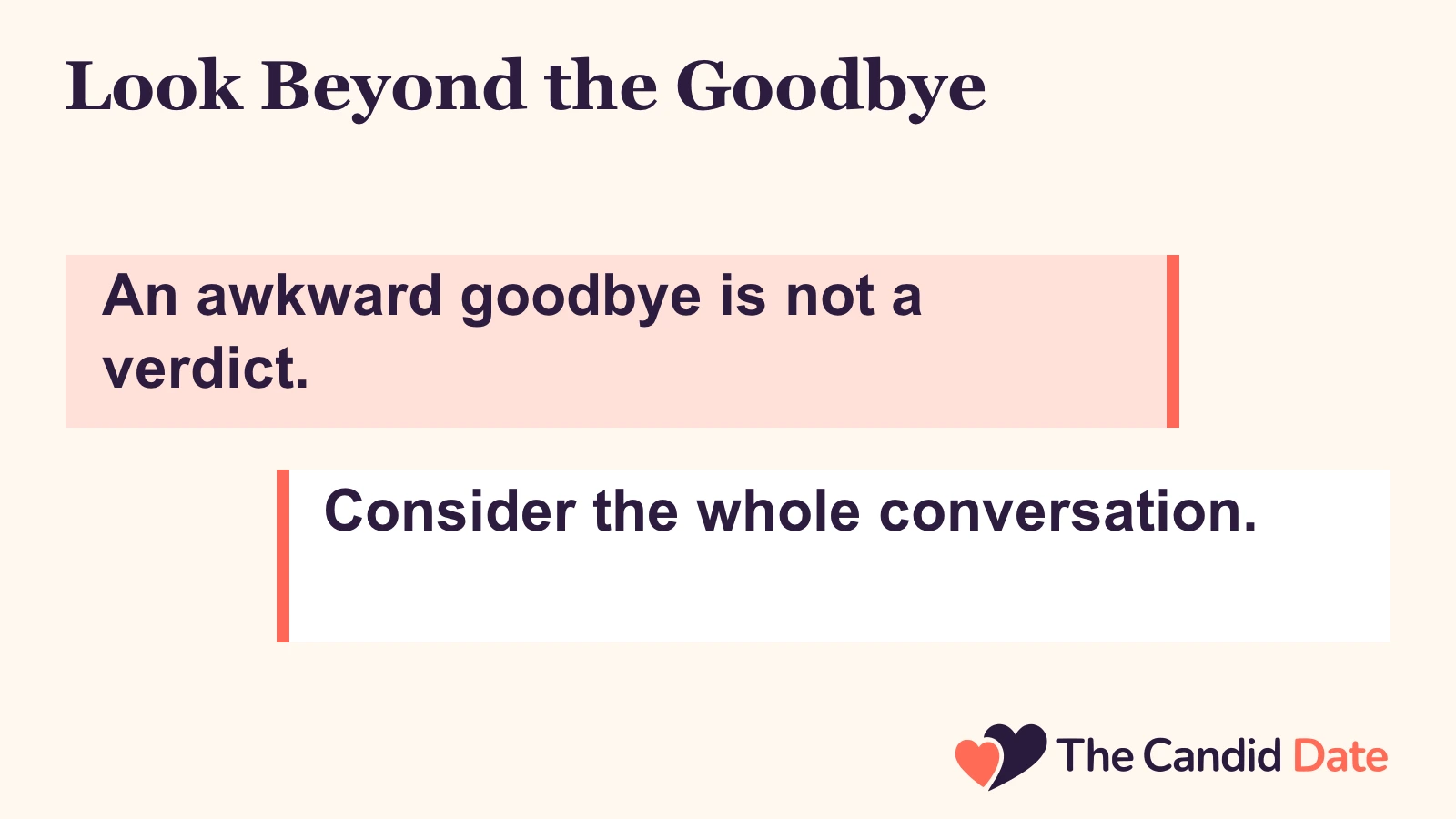
Here is a scenario that wrecks a lot of post-date analysis: the date hit two signals, but the goodbye was stiff. A half-hug, a weird pause, a mumbled thanks-again, and now you are re-grading the whole evening. Do not.
Goodbyes can be awkward because people have different expectations about a hug, a kiss or simply leaving. One uncomfortable moment is not enough to explain how either person felt. If the goodbye felt awkward, weigh it alongside the rest of the date rather than treating it as a verdict.
Weight the goodbye the way you would weight one rough minute in a three-hour movie. If time stretched and the conversation ran both ways, a clumsy farewell changes nothing; there may have been nerves or uncertainty, and you cannot know the reason without asking. The reverse rule applies too.
A warm, lingering goodbye cannot rescue a date where none of the signals appeared. The opening and goodbye can involve familiar social routines, so consider them alongside the longer conversation. Judge the unscripted middle.
If you keep scoring dates by their endings, you will keep misreading them and discarding evenings that actually went well.
The Noise: Evidence That Does Not Mean Much
Now for the noise, the stuff that feels like evidence and is not. First, texting speed. A reply in twenty minutes and a reply in twenty hours can both come from interested people.
Jobs, sleep schedules, phone habits and plain distraction all move that number around, and none of them measure how the date itself went. The original rule holds: judge the date, not the aftermath.
Second, who paid. Splitting, treating or taking turns says something about budgets and habits, not attraction. Third, the exact wording of the goodbye or the follow-up text.
I had a great time and I had a great time with an exclamation point carry the same meaning with different typing styles. Fourth, watching their social media for activity while they have not replied to you yet. Being online and being ready to write a thoughtful message are different states.
Each of these details feels concrete, which is exactly why it hijacks your attention at midnight. But they are all aftermath. You witnessed the date.
You did not witness their evening, their workload or their state of mind, so stop grading things you cannot see.
Sponsored placement


Looking for adults who share your casual intent?
AdultFriendFinder is an optional adult-focused service for casual connections. Check the available profiles and paid communication limits before deciding whether to subscribe; local availability has not been verified.
- Adult-focused casual connections
- Basic free access; paid communication tools
- Check the current subscription conditions
| User Base | Today’s Deal |
|---|---|
| Adults with explicit casual or sexual dating intent | Free basic access; communication upgrades cost extraCheck the current total charge, auto-renewal and any add-ons before subscribing. A membership does not guarantee a meeting. |
When None of the Signals Showed Up
If you ran the checklist and came up empty, that is a result, not a failure. A flat date means you spent one evening learning that this particular pairing has no momentum, which is exactly what first dates are for. You did not lose anything; you got your answer early and cheap, and you are free to spend the next evening elsewhere.
The healthy move is a clean close. If they reach out, a short, kind message is enough: I enjoyed meeting you, but I did not feel the connection I am looking for. Wishing you the best.
If nobody reaches out, silence does the job for both of you. What you should not do is re-audit the night for hidden positives or send a probing text to test the water. And if flat dates keep stacking up, fix the input rather than the analysis.
Sharpening how you screen matches before you agree to meet, with a few deliberate questions in the messaging stage, gives you a more deliberate starting point than repeatedly analyzing an evening that is already over.
screening matches before the first date
Your One Move Within 24 Hours
If two or three signals showed up, do exactly one thing in the next 24 hours: send one message. Keep it short, warm and specific. Mention something real from the date, then propose a next one.
For example: I am still thinking about that story you told about your road trip. I had a great time. Want to try that ramen place next week?
Specific beats clever every time. You are not writing to impress them; you are confirming the signal and offering a plan.
A few rules keep this clean. Send it within a day, because waiting three days to look casual mostly creates confusion. Send it once.
If they reply warmly, make the plan and stop analyzing. If they repeatedly avoid a concrete plan or plainly decline, stop pursuing it. A slow response by itself does not settle the question; allow room for their schedule and send at most one gentle follow-up after several days.
If only one signal showed up, you can still send a lighter version of the message, but hold your expectations accordingly. And if the roles are reversed and you are the one waiting, remember that early dating runs on momentum, not mind-reading. Our guide to flirting distinguishes playful interest from pressure; if your invitation is not welcomed, accept that answer rather than intensifying it.
flirting and respecting whether interest is returned
Frequently Asked Questions
What if I enjoyed the date but cannot judge these signals?
You do not have to finish an attraction assessment before deciding what you want. Ask yourself whether you felt comfortable, whether your boundaries were respected and whether another short meeting sounds appealing. If so, propose one specific plan.
You can say you enjoyed the conversation without declaring that it was mutual. If your uncertainty comes from feeling pressured or unsafe, decline rather than using a good score to override that concern. A second date is optional, even after a pleasant first one.
Should I ask my friends to analyze the date for me?
A quick sanity check is fine, but a full group investigation usually makes things worse. Your friends were not there, so they are judging screenshots and your retelling, which strips out tone, timing and chemistry. That is how a lukewarm date gets talked into a maybe, or a good one gets talked into a crisis.
Use the three signals instead; they come from the only person who attended, which is you. If you still want input, ask one grounded friend one focused question, then decide and move on.
Does a kiss at the end mean the date went well?
Not by itself. A kiss is encouraging, but it is also one of the most scripted moments of the night, and people kiss for many reasons: chemistry, momentum, politeness or habit. Treat it as a bonus on top of the real signals, never a substitute for them.
A date with stretched time, two-way questions and a mentioned next step went well even without a kiss. A date with a kiss and none of those signals is still an unknown. Score the evening, not the ending.
What to Do Next
You do not need a decoder ring for a first date, just three honest questions. Did time stretch? Did the questions run both ways?
Did a next step come up on its own? Two yeses gives you a reasonable starting point for a follow-up, if you want one: send a specific message and see whether a plan is reciprocated. One yes means a light follow-up at most.
Zero means you got a useful answer cheap. Whatever the score, act once and then stop. The replay loop in your head is not gathering new evidence; it is just burning the evening after the evening.
Score it, act, and give yourself the night off.
About the Author
By: Owen Campbell
Women's Dating Expert
Owen Campbell is a relationship writer and women's dating expert providing guides on thecandiddate.com.
Share the Knowledge!
Our dating experts work hard to show you the best dating sites. Want to show your appreciation? Share this page!