

Date Night Activities: A Follow-Through Plan for Adults


Key Takeaways
Pick one goal, one cap, and one activity before browsing ideas.
Use timeline checks from one week out through the morning after.
Debrief for five minutes, rotate choice, and adjust frequency instead of quitting.
This guide is for adults 18 and older who already know date night activities exist and still need help doing one. You may have saved lists, screenshot venues, and said we should really do that soon, then watched the week collapse into errands, work messages, budget worry, or the tired negotiation of who chooses. The gap is rarely imagination.
It is follow-through: a decision made early, labor shared fairly, logistics handled before momentum dies, and a calm way to improve after the first try. Treat this as a completion loop rather than a new idea dump. By the end, you should be able to move from vague intention to one finished evening, then decide whether it becomes weekly, monthly, occasional, or simply less stressful next time.
Decide the night in ten minutes
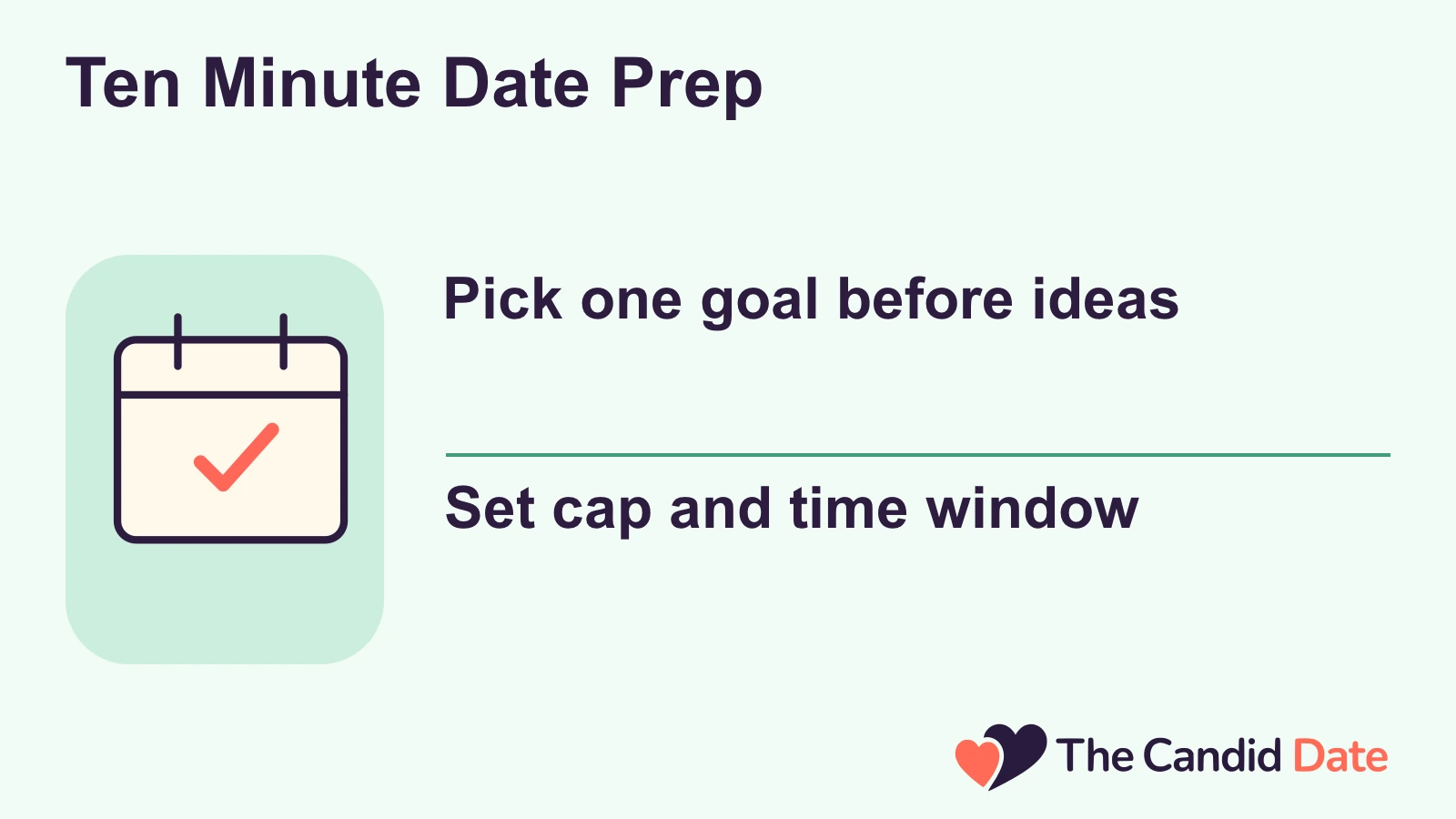
Set a timer and answer four questions out loud before anyone opens a reservations app. First, name the goal: connect, try something new, or relax. A couple who wants connection should not book the loudest room in town; a couple who wants novelty should not default to the same sofa dinner.
Second, set a real budget cap and a time window, because maybe is where plans go to die. Third, split the labor: one person owns booking and directions, the other owns timing, backup, and arrival mindset. Fourth, choose one activity matched to tonight's energy, not to impressiveness.
A hypothetical low-energy Tuesday pair with forty dollars might cook one new recipe and play cards; a high-energy Friday pair might do a beginner dance lesson, arcade, gallery opening, trivia, or live music. Write the answers where both of you can see them, because a decision that lives only in chat is easy to reopen.
- Say the goal in one sentence: tonight is for talking, novelty, or recovery.
- Set a money cap and a hard end time so the night has edges.
- Assign one owner for venue and one owner for flow, backup, and wrap-up.
- Match the plan to energy first, and treat novelty as a dial, not a requirement.
- Save the chosen plan somewhere visible so it does not get renegotiated hourly.
How to Plan a Date Night That Goes Well
Choose by tradeoffs, not by fantasy
The useful question is not what is the best date night activity, but which tradeoff fits this week. Use branches. Low budget and low energy: stay in, cook one dish neither of you has made, light candles, and put phones in another room.
Low budget and high energy: bike to a food truck area, photograph five colorful storefronts, window shop, and end with cheap dessert. Higher budget and low energy: book one reservation near home, keep the meal unhurried, and skip the second location. Higher budget and high energy: buy a class, show ticket, escape room, mini golf round, or sports outing, but protect a buffer afterward.
Novel versus familiar: choose novel when you want sparks, familiar when you want ease. If one of you loves the activity and the other tolerates it, trade turns rather than seeking a mythical perfect option.
- Going out earns stimulation and less cleanup; staying in earns control and lower cost.
- Familiar places reduce decision fatigue; new places create stories but need more planning.
- Booking time ahead can make a date easier to protect during a busy week. For spontaneous plans, check practical details before heading out.
- When preferences clash, pick two candidates and let the lower-energy partner choose this round.
- If alcohol is a question mark, choose a branch that works sober so the night does not depend on a drink to loosen up.
Dry Dating Explained: How the Sober Trend Is Changing Date Night
The one-week checklist that prevents collapse
A date starts before the date. One week out, put the evening on both calendars with a reminder, confirm the budget, and decide whether it is a go-out or stay-in night. Three days out, handle the piece most likely to block you: a reservation, tickets, childcare, pet care, transit, ingredients, or a firm start time.
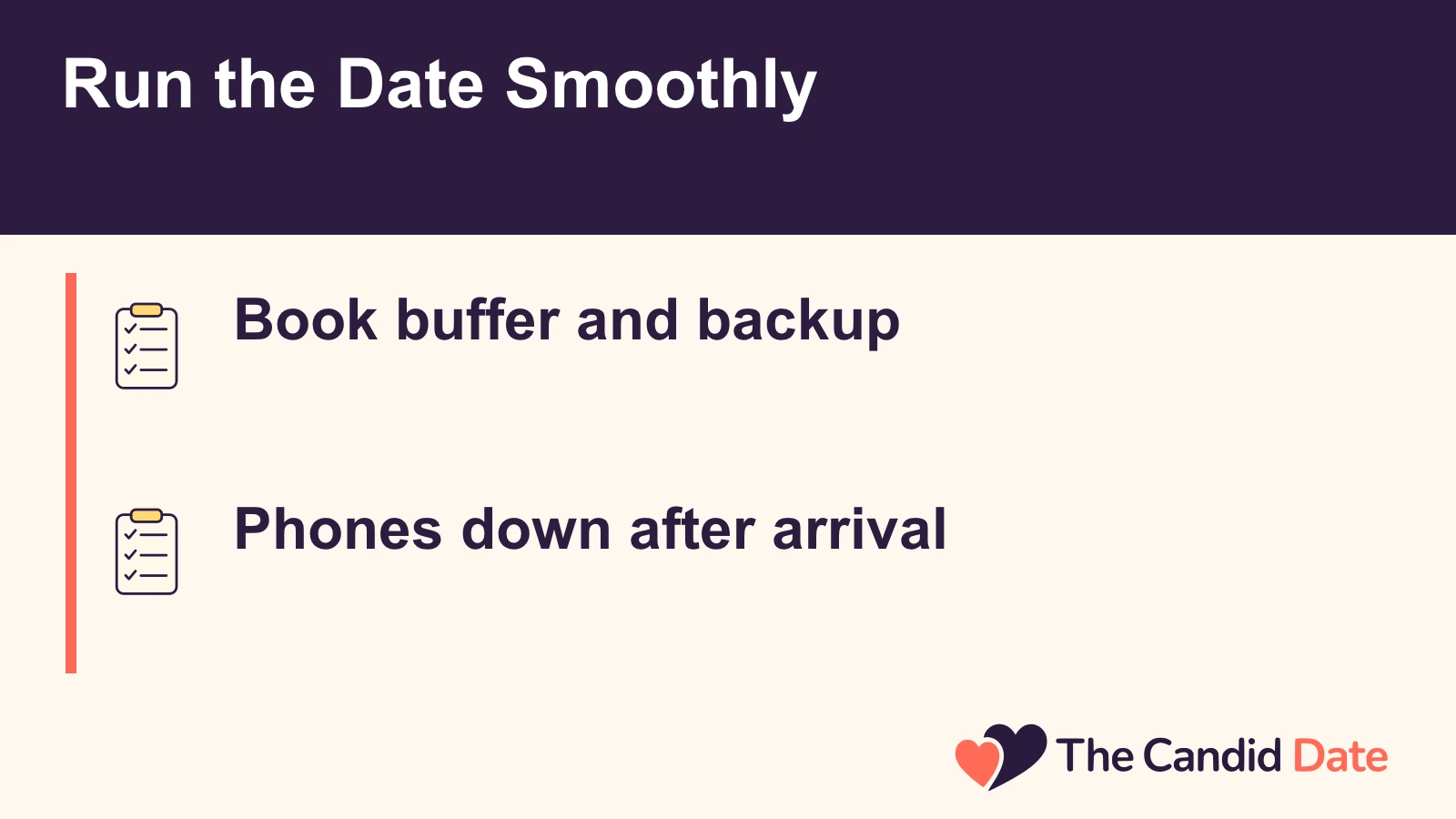
The day before, confirm the plan in one sentence, choose outfits that fit the weather, charge what needs charging, and agree that cancellation requires proposing a new slot immediately. On the day, leave a buffer for parking, lines, train delays, and the human tendency to leave late. During the first ten minutes, do one ritual that signals transition: put phones face down, order something shareable, toast to the fact that you showed up, or take a short walk before sitting.
If something fails, repair the smallest variable first: time, place, pace, or noise.
- One week out: calendar, budget cap, energy level, and go or stay decision.
- Three days out: reserve, buy tickets, arrange care, or buy ingredients.
- Day before: confirm start time, outfits, transport, weather, and backup plan.
- Day of: buffer the departure, silence notifications, and assign the wrap-up task.
- During: phones down, one shared item, no work logistics unless truly urgent.
- After: notes app line for what connected, what dragged, and one change.
Date Night at Vine Street Brewing Co, Missouri’s First Black-Owned Brewery
Keep phones and stress from taking the seat
The activity matters less than whether both people feel attended to. Make a phone rule that is specific enough to follow: no feeds during appetizers, no group chats unless the sitter texts, or a shared photo limit so documentation does not replace the moment. If one of you is on call for work or family, say so up front and define what counts as urgent.
Keep conversation easy by carrying three prompts: what felt good this month, what is draining you right now, and what small thing do you want more of. Do not use the date to solve the entire relationship. Park heavy conflict with a phrase like not tonight, and choose one lighter repair if the mood dips: change tables, take a lap around the block, switch from dinner to dessert, or shorten the plan gracefully instead of soldiering through.
Attention is the rare ingredient; protect it deliberately.
- Set a concrete phone boundary before arrival, not after the first scroll.
- Define urgent interruptions so normal life does not get a permanent invite.
- Use three prompts and stop before the date becomes a performance review.
- Build an exit ramp: shorten, move, snack, or call it a good attempt.
- Repair low mood with location, pace, food, or duration before assuming failure.
After the first attempt, debrief for five minutes
One flat evening should produce information, not a verdict. The next day, spend five minutes answering three questions while the memory is fresh: what felt connecting, what dragged, and what one change would improve round two. Keep it concrete.
Replace the food was boring with the line wait killed our mood, or replace you picked badly with I had no energy for a crowded place. Then rotate who chooses next time so the planner is not permanently the producer and the other person is not permanently the guest. Adjust frequency before abandoning: if weekly is impossible, try every other week, first Friday, or two dates per month with one planned and one flexible.
A schedule is a container, not a scoreboard; the win is returning to each other on purpose. If the first attempt was awkward, that is still useful proof that you can begin again.
- Write one sentence each: connect, drag, change.
- Rotate choice so fairness does not depend on memory.
- Scale frequency down before quitting entirely.
- Keep what worked as a default and retire only the part that failed.
- Treat awkwardness as data about fit, not as evidence against the habit.
When postponement or dislike keeps winning
If the date keeps slipping, treat the slot as movable but not erasable. The next action is not nagging; it is rescheduling within twenty-four hours with the same prep already done. Put a recurring hold on the calendar, make the first version small enough to survive a rough week, and choose a default plan that requires almost no decisions: same place, same time, low cost, ninety minutes.
If one partner dislikes the chosen activity, separate care from control. Say, I want to like this because you chose it, then state one condition that would help: shorter duration, a friend element, less noise, more movement, or food first. The chooser gets one full attempt without sulking; the non-chooser gives honest feedback without retroactive veto power.
Hypothetically, if salsa was a miss, the next round might be a beginner lesson at a low-pressure studio or a completely different pick. The goal is not to win the argument; it is to keep the channel open.
- Postponed date: reschedule within a day and keep the completed prep.
- Too busy: shrink the format before deleting the ritual.
- One-sided dislike: name one adjustment, not a global rejection.
- Planner fatigue: rotate ownership and keep a shared maybe list.
- Conflict spiral: lower the stakes and shorten the next attempt.
Make it repeatable under real-life constraints
Work shifts, parenting, limited cash, health needs, and long distance all change the definition of a successful night, not the need for intention. With children or unpredictable schedules, anchor a shorter window and keep a home backup: groceries for one favorite meal, a queued film neither has seen, a board game, or a backyard dessert break. With tight money, trade price for attention: library event, free museum evening, market samples, a photo walk, volunteering, dessert-only outing, or breakfast for dinner.
In long distance, count scheduled video calls with a shared activity as attempts, and protect rare in-person visits by planning one anchor reservation and leaving room for rest. Frequency should fit capacity: weekly for some, twice monthly for others, seasonal for long distance. Consistency beats intensity.
The pattern that lasts is usually smaller than the fantasy version, but it shows up.
- Shrink the slot before canceling the habit.
- Use free inputs: walks, libraries, parks, markets, community events.
- Keep a stay-in kit so bad weather cannot erase the plan.
- For distance, plan one anchor and one low-effort shared activity.
- Review monthly and change only one variable at a time.
Sponsored placement

A separate choice for married or attached adults
Victoria Milan markets dating for married or attached adults. Consider its relationship category and payment conditions carefully; advertised privacy tools do not guarantee anonymity or establish a partner’s consent.
- Built for married or attached adults
- Free registration advertised
- Review privacy and paid access before subscribing
| User Base | Today’s Deal |
|---|---|
| Adults considering an affair-oriented service | Free registration; check current paid optionsFree registration does not establish free messaging. Read current checkout, renewal and cancellation terms. Privacy features cannot guarantee anonymity. |
Optional adult note if you are not in a couple
Sponsor note for adults: Victoria Milan markets dating to married or attached people. This advertisement is separate from the date-planning advice. It is not a solution for relationship conflict. Review the current payment and privacy conditions, respect any commitments, and do not assume an advertised privacy feature guarantees anonymity.
No member sample was tested here and no meeting is promised. With any new online contact, meet in public and never send money or gifts to someone you have not met in person.
Frequently Asked Questions
How do we pick one activity when we both want different things?
Start with the goal of the night rather than the activity. If the goal is connection, eliminate options that make talking hard. If the goal is novelty, accept a little more friction.
Then use turns: each person brings two candidates that fit the budget and energy, the other vetoes only what would truly ruin the mood, and the lower-energy partner picks this round. Fair rotation matters more than finding a perfect compromise, because perfect often means nobody is fully satisfied and the plan stalls.
How much should we budget when money is tight this month?
Set a cap before choosing, then let the cap choose the category. A low-cash week can still be intentional: cook one recipe, split a dessert out, attend a free event, take a photo walk, or revisit the place where you first met without buying much. The mistake is treating budget as embarrassment instead of a design constraint.
Decide what not to spend on, such as drinks or transportation, and put the savings into one small touch: better ingredients, flowers, parking ease, or a sitter if that is the real blocker.
What should we do immediately after a mediocre first attempt?
Do not declare date nights dead from one data point. Within a day, each person names one moment that connected, one moment that dragged, and one specific change. Keep the connecting piece, change only the dragging piece, and schedule the next attempt before motivation fades.
If the activity failed, try a different category. If the timing failed, move it earlier or shorten it. If planning felt one-sided, swap ownership.
The habit is the repeated act of protecting time, not the perfection of any single evening.
What to Do Next
You do not need a longer list of date night activities; you need a loop that survives contact with real schedules. Decide the goal, cap, time window, and labor split in ten minutes. Choose through tradeoffs rather than fantasy.
Use the checklist one week out, the day before, the day of, during, and after. When postponement happens, reschedule instead of abandoning. When one person dislikes the plan, adjust the condition without killing the rotation.
Keep the first version small enough to complete, then let the debrief make the second one smarter. Completion is the confidence builder. Once one evening actually happens, repeatability stops being theory and becomes something you two can feel.
About the Author
By: Layla Rivera
Dating Coach
Layla Rivera is a relationship expert and dating coach for thecandiddate.com.
Share the Knowledge!
Our dating experts work hard to show you the best dating sites. Want to show your appreciation? Share this page!