

Date Night Near Me: A Follow-Through Plan That Actually Works


Key Takeaways
Put the date on the calendar before choosing any activity.
Agree on a budget and your tradeoffs before browsing options.
Run a two-day and same-day checklist so nothing is improvised.
Debrief after the first attempt and alternate planning duties.
Searching for date night near me is the easy part; following through is where most couples stall. This guide is built for the step between inspiration and action: choosing a time, setting a budget, weighing tradeoffs, packing a checklist, and knowing what to do after your first attempt lands somewhere between lovely and chaotic. Every example here is hypothetical, and every step assumes two consenting adults making decisions together.
You will not find a list of one hundred ideas. You will find a sequence you can repeat, a set of honest tradeoffs, and a short debrief habit that turns one decent evening into a tradition that actually lasts. Work through the sections in order the first time; after that, the checklist alone will carry most evenings.
Put the Date on the Calendar Before You Pick a Plan
The most reliable sequence for a date night near you starts with time, not ideas. Decide on a protected slot first, because open evenings get eaten by errands, overtime, and group chats. Pick a recurring window, perhaps every other Thursday, and treat it like an appointment neither of you cancels without a real conversation.
The tradeoff is real: a fixed slot can feel rigid, but spontaneity without structure usually becomes never. If your schedules clash, shorten the date rather than skipping it. Ninety unhurried minutes at a nearby dessert bar beats a cancelled three-course dinner every time.
Once the slot exists, the activity becomes a detail instead of a hurdle, and planning turns from a negotiation into a formality.
Agree on a start time and a hard stop, then build a small buffer on both ends for parking and goodbyes. Couples who set an end time argue less about leaving, because the evening has edges. If one of you is chronically late, shift the official start fifteen minutes later rather than turning lateness into a recurring opening scene.
How to Plan a Date Night That Goes Well
Set a Budget That Removes Money From the Mood
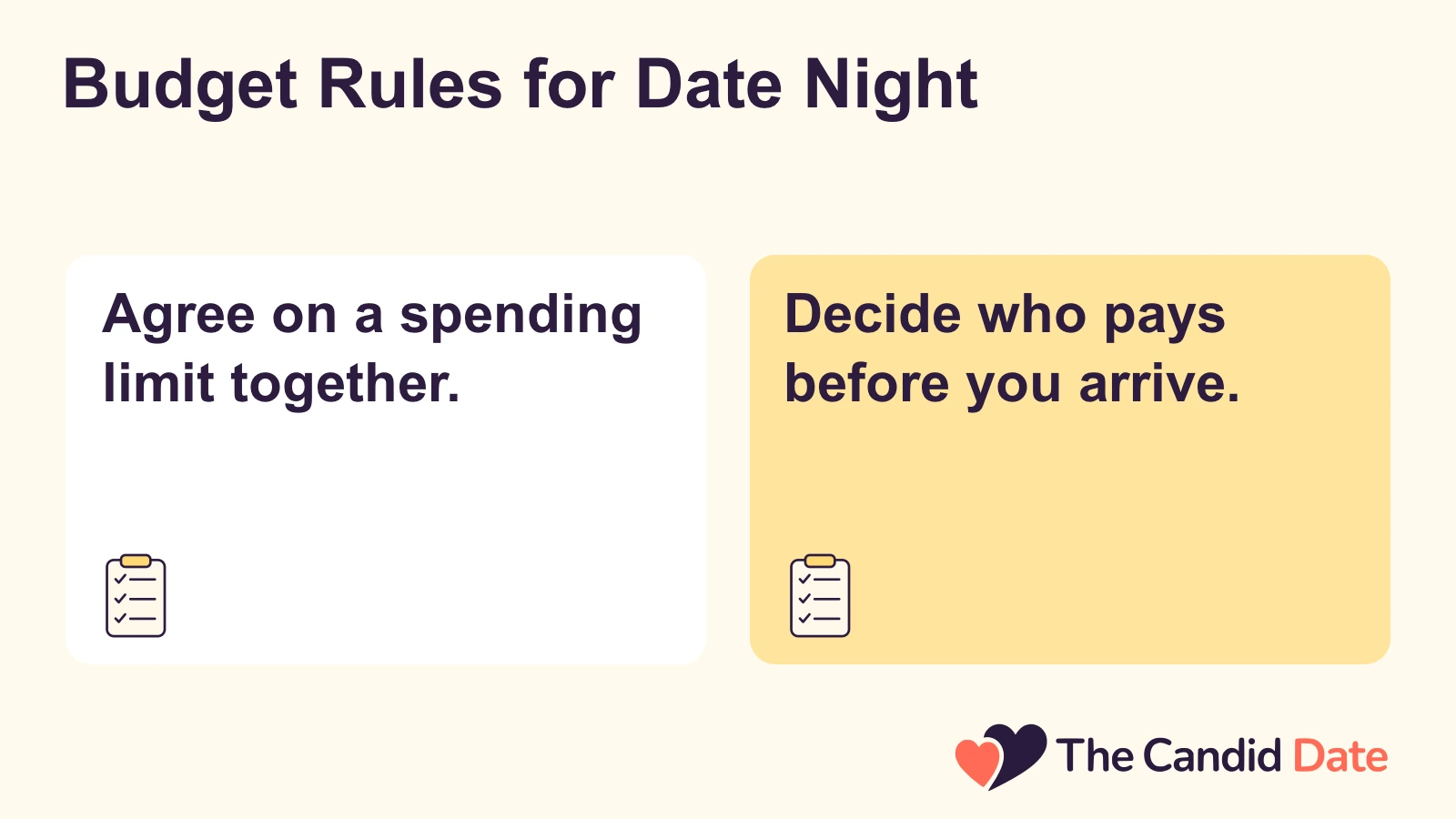
Money is the fastest way to sour a good plan, so agree on a spending range before anyone browses listings. Decide three numbers: a typical ceiling, a special-occasion ceiling, and a free-night default. Hypothetically, a couple might land on a modest dinner cap, double that for birthdays, and zero for gallery-walk nights.
The point is not frugality; it is predictability. When both partners know the range, choosing between a taco truck and a tasting menu becomes a style question, not a values fight. Tradeoff: a firm budget closes some doors, yet it also ends the quiet resentment that builds when one person always springs for the check.
Discuss who pays for what, whether you alternate or split, and settle it once, outside the restaurant.
Build a small fund for spontaneity, since the best local discoveries rarely appear in your price-comparison spreadsheet. If funds are tight, say so plainly and choose experiences that cost effort rather than cash: a homemade three-course meal, a sunset walk with takeout, a board-game rematch with a prize the winner picks next time.
Weigh the Tradeoffs Before You Commit
Every date format trades something for something. A restaurant gives you conversation and comfort but costs money and ends early. An activity, like a pottery class or a night hike, builds shared memories but leaves less room for deep talk.
Familiar places reduce decision fatigue; new places create stories. There is no correct answer, only an answer that fits this month. Sit down once and rank what you both need: conversation, novelty, relaxation, or adventure.
Hypothetically, a couple in a demanding work season might rank relaxation first and pick low-stakes repeats, while a couple feeling distant might choose novelty to generate fresh material. Write your two or three priorities on a note and let them veto options that fail all of them.
Also weigh energy, not just dollars. After long weeks, an ambitious plan can collapse under its own logistics. When energy is low, shrink the plan instead of cancelling: one cocktail, one shared appetizer, one block of walking, home by nine.
A small completed date teaches your brains that follow-through is easy, which matters more than any single grand evening.
Dry Dating Explained: How the Sober Trend Is Changing Date Night
Work the Preparation Checklist
A checklist converts good intentions into muscle memory. Run through it two days before, then again the morning of. Keep it on a shared note so either partner can own a step.
The goal is that, by departure time, nothing requires a decision; you simply execute. Customize these items, but resist deleting the boring ones, because the boring ones are where evenings quietly fall apart.
- Confirm reservations or tickets, and screenshot the confirmation so spotty service cannot strand you.
- Check the venue's hours, dress code, and parking or transit options, including the last train home.
- Glance at the weather and pre-pick an indoor backup within a few blocks of the original plan.
- Charge phones, then agree on where they live during the date, such as a bag or the car.
- Handle chores earlier in the day so nobody arrives carrying a mental to-do list.
- Set aside cash for tips and small vendors, plus one card as backup.
- Tell one friend your general plan and expected return, a quick safety habit worth keeping.
- Lay out outfits and keys the night before to remove the last ten minutes of friction.
Guard the Evening From Logistics
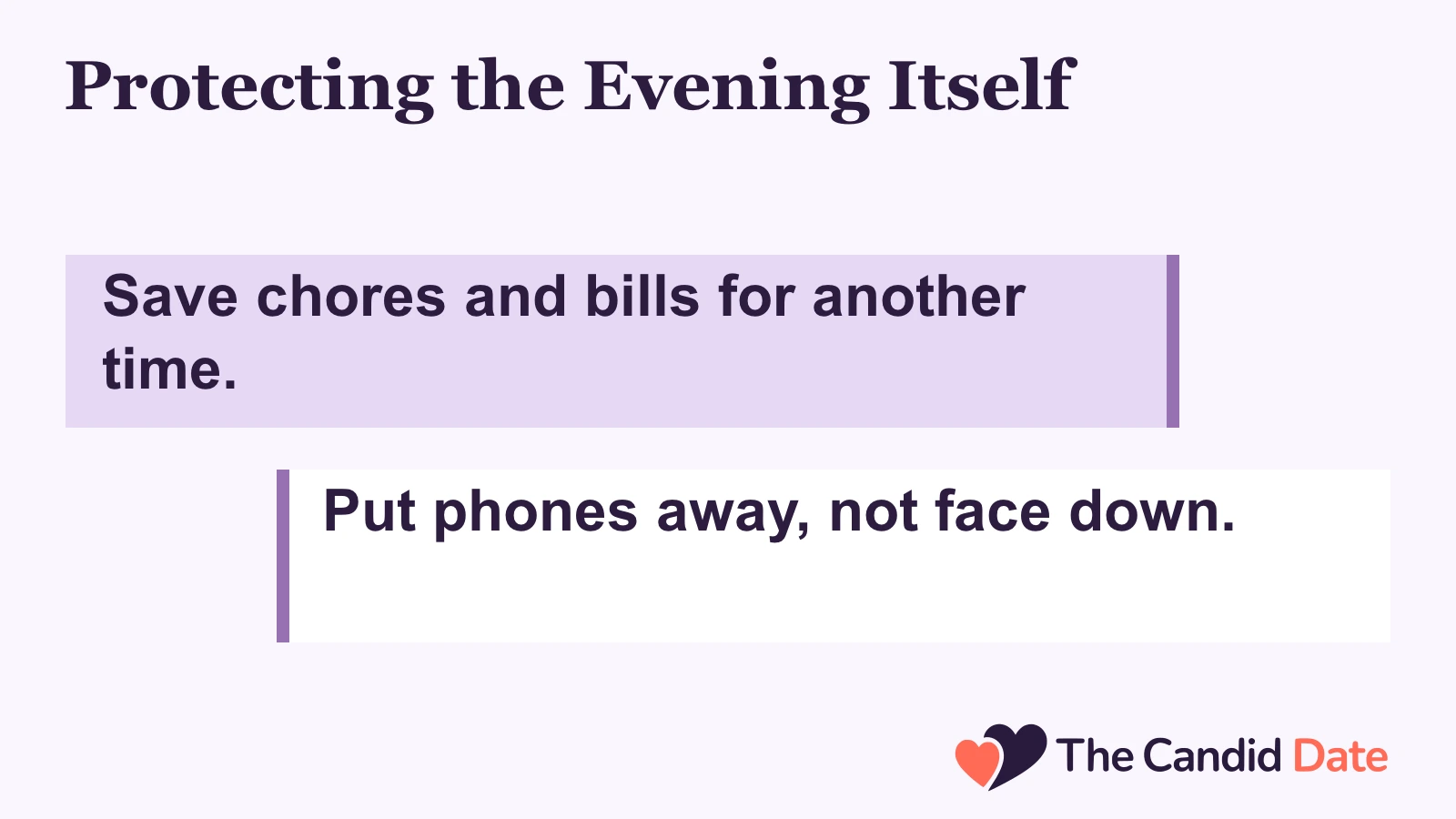
Once you arrive, the planning phase ends and a different skill begins: protecting the date from real life. Agree to park practical talk before the door closes. Bills, schedules, repairs, and family logistics can wait one evening; that restraint is the entire point of carving out time.
The tradeoff feels risky, because unfinished tasks nag, yet attention is the scarce resource you are both there to spend. Put phones physically away, not face down on the table, and notice how quickly the conversation deepens when neither of you can reflexively check a screen. If a genuinely urgent matter looms, decide beforehand who monitors it and what counts as urgent, so vigilance does not become a shared third guest.
Conversation needs a little scaffolding. Bring two or three open questions about dreams, memories, or plans for the next year, and take turns answering fully. Ask about the favorite moment later, too.
Hypothetically, one partner keeps a running list of questions in a phone note, swapped in weekly, so the talk never defaults to logistics or gossip about acquaintances.
Fix Problems in the Moment Without Derailing
Follow-through includes recovering when the plan breaks. The restaurant lost your table, the show sold out, the rain arrived early. The mistake couples make is treating a broken plan as a verdict on the evening.
Instead, agree on a simple rule: you get one audible sigh, then you pivot. Pivoting is easier when you prepared a backup in advance, which is why the checklist matters. Tradeoff: a rigid couple protects the itinerary, while a flexible couple protects the mood; only one of those is the point.
Keep a short mental list of nearby saves: a dessert spot, a walkable neighborhood, a bar with board games, a scenic overlook. Any of them can absorb a failed reservation without drama.
If one of you is simply not feeling it, name that early and downgrade together. Swap the ambitious plan for a diner breakfast at eight in the evening, or a convenience-store snack run eaten on a park bench. A humble plan completed warmly beats a grand plan completed resentfully, and the downgrade habit keeps honesty cheap the next time energy dips.
11 Lesbian Romance Films to Watch on Date Night
Debrief After the First Attempt
The first attempt will be imperfect, and that is information, not failure. Within a day or two, run a five-minute debrief while memories are fresh. Each partner answers three questions: what was your favorite moment, what would you change, and what should we repeat?
Keep tones curious rather than corrective; the debrief is a design tool, not a performance review. Tradeoff: reviewing a pleasant evening can feel overly managerial, yet skipping it means you repeat guesswork forever. Write the answers down.
After four or five dates, the notes reveal patterns: one of you hates crowds, both of you love walking venues, late starts always sour the mood. Those patterns are worth more than any list of generic ideas, because they describe your specific relationship.
Then alternate ownership. When the same person plans every date, the other becomes a passenger, and passengers disengage. Take turns being the planner of record, and let the planner's choices stand even when they differ from your taste.
Rotate the debrief questions too, so neither of you can coast. Over a season, this rotation distributes effort, surprise, and accountability evenly.
Turn One Date Into a Repeatable System
The end goal is not one perfect evening but a system that produces good evenings with minimal friction. Keep a running jar or shared note of ideas, each added only if both partners would genuinely try it. On planning weeks, pull one and commit within ten minutes, which ends the endless what-do-you-want-to-do loop.
Revisit frequency honestly: weekly dates work for some couples, while twice a month sustained beats weekly dates that collapse after a month. The right cadence is the one you can protect during busy seasons; scaling up later is easy. Protect the ritual during hard seasons, when connection needs maintenance most.
Finally, refresh the system quarterly: retire ideas that flopped, add two new ones, and adjust the budget to match real life, not aspirational life.
If you are single rather than coupled, the same follow-through principles apply to meeting people, with an extra layer of caution. Arrange first meetings in public places, tell a friend your plans, and never send money or gifts to someone you have not met in person, as safety guidance repeats. Keep personal details private until trust is earned face to face.
Date Night at Vine Street Brewing Co, Missouri's First Black-Owned Brewery
Sponsored placement

A separate choice for married or attached adults
Victoria Milan markets dating for married or attached adults. Consider its relationship category and payment conditions carefully; advertised privacy tools do not guarantee anonymity or establish a partner’s consent.
- Built for married or attached adults
- Free registration advertised
- Review privacy and paid access before subscribing
| User Base | Today’s Deal |
|---|---|
| Adults considering an affair-oriented service | Free registration; check current paid optionsFree registration does not establish free messaging. Read current checkout, renewal and cancellation terms. Privacy features cannot guarantee anonymity. |
Frequently Asked Questions
How far in advance should we plan a date night near us?
Lock the calendar slot at least a week ahead, even before you choose an activity, because open evenings evaporate. Two days out, run the checklist: reservations, hours, weather backup, transit. The morning of, confirm nothing changed.
If life explodes that week, downgrade instead of cancelling, and reschedule within forty-eight hours so the slot keeps its protected status. Planning farther ahead, say a month, works for tickets and seasonal events, but the recurring rhythm matters more than any single evening, so protect the pattern first.
What if one of us keeps cancelling or disengaging?
Treat it as information, not a character flaw. Ask what the date is costing that person: energy, money, decision fatigue, or something harder to name. Maybe the format is wrong, the timing is wrong, or the planning load is lopsided.
Experiment for a month with shorter, cheaper, alternating-ownership dates and see if follow-through improves. If disengagement persists across contexts beyond date night, that is a broader relationship conversation, and speaking with a licensed counselor can help; this guide is planning advice, not therapy. Stay curious; resentment recruits nobody.
Is it okay to repeat the same place every week?
Yes, if the repetition is chosen rather than defaulted. A beloved standby removes decision fatigue and lets you measure the relationship, not the venue. The risk is autopilot: the same table, the same conversation, the phones creeping back out.
Rotate one variable, like arriving by a new route, trying a different dish, or adding a walk afterward. Every third or fourth date, swap in something novel from your idea jar. Familiar and fresh are not enemies; a stable anchor plus occasional exploration gives you comfort without stagnation.
What to Do Next
Follow-through is a skill, not a personality trait, and it is built from small kept promises. Put the slot on the calendar before you pick a plan, settle the budget and the tradeoffs early, run the checklist without improvising, and debrief honestly after the first attempt. Expect the opening round to wobble; adjust the system, not your standards.
Within a few months, date night near you stops being a search query and becomes a standing appointment both of you protect, sometimes elegant, sometimes cereal at midnight, always yours. That is the entire trick.
About the Author
By: Layla Rivera
Dating Coach
Layla Rivera is a relationship expert and dating coach for thecandiddate.com.
Share the Knowledge!
Our dating experts work hard to show you the best dating sites. Want to show your appreciation? Share this page!