

Date Nite Ideas at Home: A Clear Decision Guide


Key Takeaways
Start with the problem, not a pile of activities: energy, budget, privacy, time, and mood decide what fits.
Use criteria to narrow choices before you buy supplies, cook, or send an invitation.
A one-page worksheet turns vague good intentions into a start time, one activity, and a clear ending.
For consenting adults who are single and seeking casual connection, keep adult platforms separate from couple repair goals.
Date nite ideas at home fail less from lack of imagination and more from vague preparation. Adults come home tired, open a streaming app, eat standing up, and call it a night because no decision was made before hunger and fatigue took over. This guide treats home dating as a practical decision, not a creativity contest.
You will define the exact problem you are solving, choose selection criteria, and use a worksheet that fits real schedules. The examples are hypothetical and adaptable. Every reader and partner referenced here is an adult aged 18 or older.
Whether you are coupled, casually dating, or planning a low-pressure evening with someone you already trust, the method is the same: clarify the need, constrain the options, then stage one simple shared experience.
Start With the Real Problem
The problem behind date nite ideas at home is rarely boredom by itself. It is usually one of four frictions: not enough energy, not enough money, not enough privacy, or not enough structure. A couple with demanding jobs may want closeness without a reservation.
New adults dating casually may want comfort without implying a big commitment. Long-term partners may need novelty without leaving the house. Write the problem in one plain sentence before choosing anything.
For example, hypothetical: We have ninety minutes, takeout energy only, and we keep drifting into phones. That sentence already rules out elaborate cooking and points toward a picnic on the floor, cards, or a dessert tasting. If the problem is privacy, do not plan a loud activity in a shared space.
If the problem is conflict, avoid competitive games and choose side-by-side cooking or a calm conversation prompt.
- Name the constraint in one sentence before opening Pinterest.
- Decide whether the night is for repair, novelty, rest, or playful flirtation.
- Set a realistic window, even if it is only twenty focused minutes.
- Agree who chooses the activity so planning does not become another negotiation.
Your At-Home Date Criteria
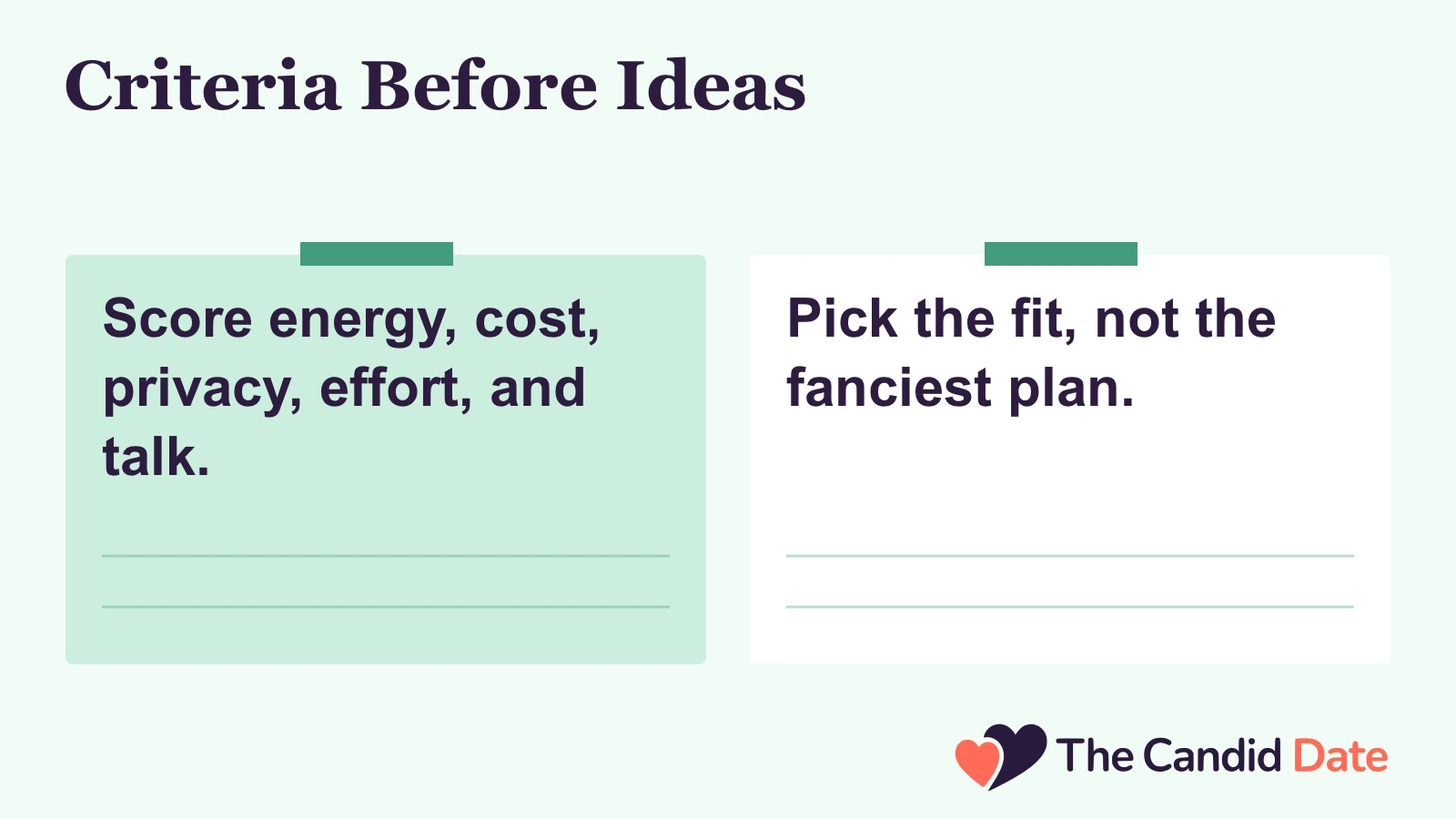
Criteria are the filter that keeps date nite ideas at home from becoming a ranked list of cute things. Choose five filters and score each idea quickly. Energy asks whether the plan matches the tiredness in the room.
Cost asks what you can spend without resentment. Privacy asks who can hear or interrupt you. Skill asks whether one person will secretly do all the work.
Connection asks whether the activity leaves space for personal conversation, not only logistics about chores or schedules. A blanket fort may score high on cost and play but low on privacy in a small apartment. A homemade tasting menu may score high on connection but low on energy after a long week.
The goal is not the perfect score; it is avoiding the mismatch that makes one adult feel unseen while the other feels like a project manager.
- Energy: does the plan match tonight's capacity?
- Cost: can both adults enjoy it without keeping score?
- Privacy: will roommates, kids, neighbors, or notifications intrude?
- Effort: is labor shared, sequenced, or removed?
- Talk: does it invite feelings, stories, humor, and desire?
Match the Idea to the Constraint
Once the problem and criteria are visible, ideas get easier because each one has a job. If the constraint is time, use a hard start and stop: one album, one cocktail or mocktail, one round of questions. If the constraint is money, choose atmosphere over stuff, such as candles, a playlist, water with citrus, and a shared dessert split carefully.
If the constraint is space, move the date to the smallest workable area, clear one surface, and make that surface feel intentional. If the constraint is attention, put phones in another room, not face down, because the quick check is the real rival. Hypothetical examples: a car date with takeout parked safely near home can feel like leaving without the logistics; a living-room vacation can pick one destination and borrow its music, snack, and conversation; a spa night can stay simple with towels, lotion, and consent-first massage rather than pressure.
- Low energy: floor picnic, bath, dessert-only menu, short walk around the block.
- Low budget: pantry cook-off, board game tournament, stargazing from a blanket.
- Low privacy: quiet headphones dance, dessert in the kitchen, notes left in a shared spot.
- High restlessness: cook a new recipe, build a fort, rearrange one shelf, then admire it.
Build a One-Page Worksheet
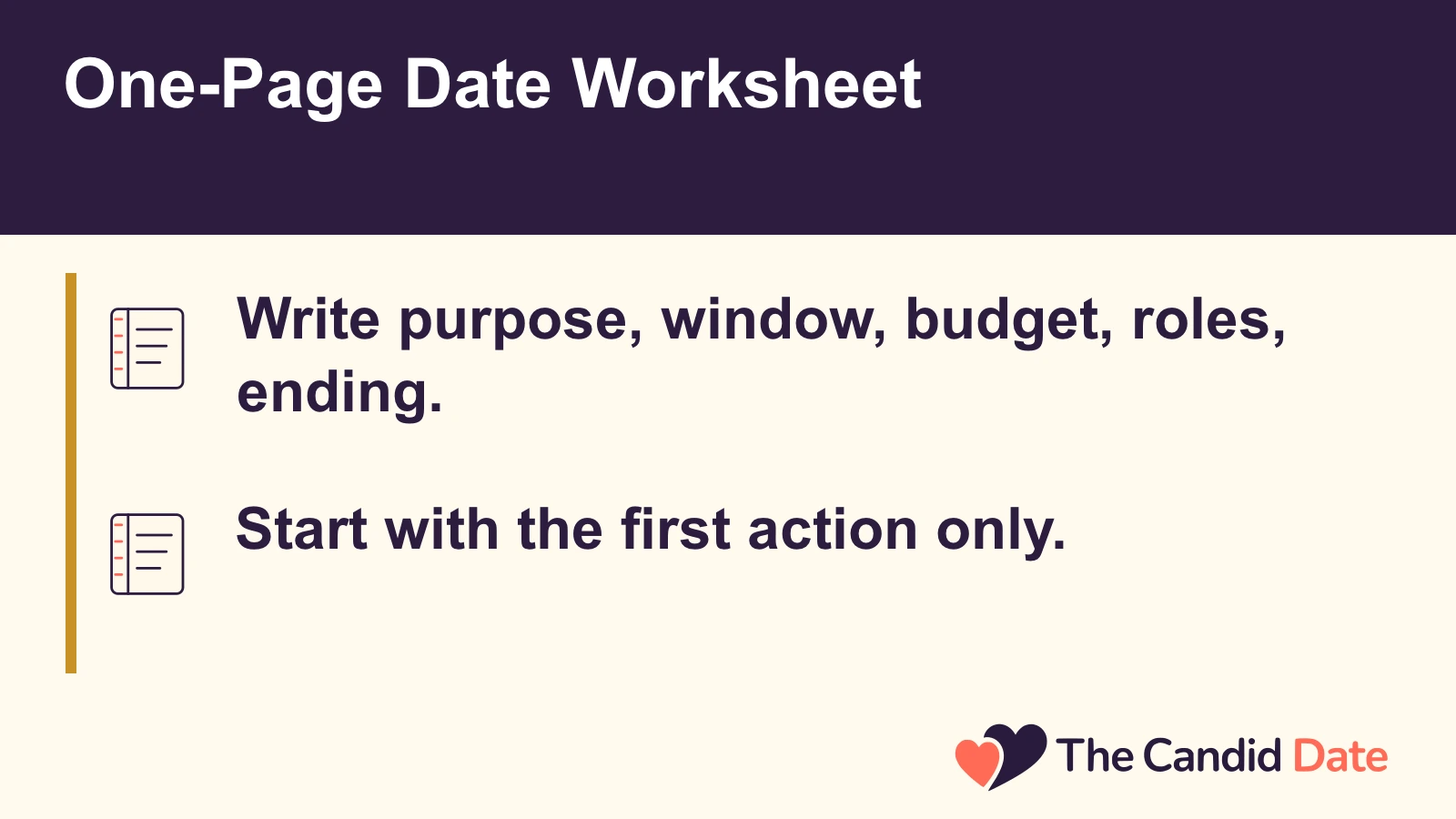
A worksheet should be small enough to finish before motivation disappears. Use seven lines: purpose, window, budget, energy, activity, roles, and ending. Purpose might be laugh, reconnect, rest, or flirt.
Window is the start and end time, not a wish. Budget is the ceiling, including ingredients and delivery fees. Energy is a simple high, medium, or low note.
Activity is one main thing, not three. Roles name who shops, cooks, cleans, chooses music, and initiates conversation. Ending matters because a clear landing prevents the night from dissolving into laundry.
A sample line set might read: purpose, rest and affection; window, 8:00 to 9:15; budget, twenty dollars; energy, medium; activity, tacos and a movie chosen together; roles, one cooks, one sets the table; ending, dessert outside or ten minutes talking without screens.
- Keep the worksheet on one index card or phone note shared with consent.
- Write the first action only, not a fantasy sequence.
- Include a cancellation rule that protects dignity if someone is exhausted.
- Review afterward for one line: keep, change, or drop.
14 Low-Key, Low-Cost Date Ideas
Run a Low-Stress Test Night
Treat the first attempt as a pilot, not a verdict on romance. Gather what you need a day or two early when possible, but do not turn preparation into perfection. Put the phones away, change out of the clothes that carry the workday, and announce a start time.
During the night, watch for three signals. The first is whether both adults participate or one quietly manages. The second is whether conversation moves beyond tasks into preferences, memories, jokes, and curiosity.
The third is whether the ending feels chosen rather than abrupt. If the pilot fails, change one variable only. Too much cooking becomes assemble-only food.
Too much choice becomes one envelope with two options. Too much seriousness becomes a silly round. Do not declare at-home dates dead because the first staging felt stiff; most nights need repetition before they feel natural.
- Change one variable at a time so you learn what actually helped.
- Debrief for two minutes, not two hours.
- Rotate who chooses so desire is not confused with control.
- Protect the plan from being audited like a work project.
Staying In for Valentine’s Day: Experts Expect More At-Home Dates
Keep the Night From Drifting
Drift is the silent failure mode of date nite ideas at home. It looks like both adults on separate devices, one cooking while the other answers email, or a movie chosen after forty minutes of scrolling. Prevention is mostly environmental.
Make the room slightly different from the ordinary week: lights lower, table cleared, shoes off, chairs angled toward each other, one scent or none if sensitive. Then add a soft ritual that marks entry, such as pouring a drink, playing the first song, or stating one hope for the hour. Keep conversation prompts optional and non-interrogative.
Good prompts invite specificity without demanding confession: what made you laugh recently, what are you craving more of, what should we do again before the month ends. If silence feels comfortable, let it be comfortable. The point is presence, not constant performance.
- Use one transition ritual that tells the brain the evening has begun.
- Keep prompts playful and easy to decline.
- Let parallel quiet count when both adults choose it.
- End before fatigue turns kindness into impatience.
When Home Is Not the Right Venue
Sometimes the correct decision is to leave the house, at least for the beginning. Home can be wrong when roommates erase privacy, when shared chores keep pulling attention, when one adult associates the space with stress, or when safety makes a public first meeting smarter. Early dating especially benefits from public, easy-exit settings until trust is established.
A home invitation can carry more implication than either person intends, so clarity matters. Say what the evening is and is not. If you move from outside to inside, let both adults agree without pressure.
The same decision logic still applies: define the problem, check privacy and safety, choose one activity, and make leaving simple. Home should be a chosen setting, not a default that saves money while costing comfort, clarity, or consent.
- Choose public space for early trust-building and easy exits.
- Name the expectation before anyone crosses a threshold.
- Avoid using home to bypass the slower work of getting comfortable.
- Let budget serve safety and respect rather than replace them.
Outdoor Date Ideas: 12 Easy Plans for a First or Second Date
Cook More, Date Better? Survey Links Home Cooking to Stronger Relationships
Optional Adult-Audience Note
This guide is for consenting adults, and it is not a couples-therapy tool. Some readers are single, dating casually, or exploring adult connection rather than repairing a shared household. For that separate adult context only, AdultFriendFinder is an adult and casual platform where basic browsing and profile creation can be free, while many communication and visibility features generally require paid upgrades; paid subscriptions have auto-renew enabled by default, so check the current checkout rather than relying on memory.
No meeting is guaranteed, and no member outcome should be invented. Keep money, gift cards, and emergency requests offline; the FTC warns against sending money or gifts to a sweetheart you have not met in person. If your goal is commitment repair, use conversation, counseling resources, or a licensed professional rather than a casual adult platform.
- Adult context stays separate from couple-repair advice.
- Verify billing terms before any paid upgrade.
- Never send money to someone not met in person.
- Casual platforms are not a substitute for consent, clarity, or care.
Sponsored placement

A separate choice for married or attached adults
Victoria Milan markets dating for married or attached adults. Consider its relationship category and payment conditions carefully; advertised privacy tools do not guarantee anonymity or establish a partner’s consent.
- Built for married or attached adults
- Free registration advertised
- Review privacy and paid access before subscribing
| User Base | Today’s Deal |
|---|---|
| Adults considering an affair-oriented service | Free registration; check current paid optionsFree registration does not establish free messaging. Read current checkout, renewal and cancellation terms. Privacy features cannot guarantee anonymity. |
Frequently Asked Questions
How long should an at-home date be?
Long enough to feel intentional and short enough to protect energy. For many adults, sixty to ninety minutes works better than an open-ended evening because it creates a beginning, middle, and respectful ending. If you are exhausted, plan twenty uninterrupted minutes with one dessert, one song, and one conversation prompt.
A clear stop can make the night feel special instead of endless.
What if one partner always plans the date?
Rotate choice and divide labor explicitly, because imbalance turns generosity into resentment. Use the worksheet to name roles for shopping, setup, music, cleanup, and closing conversation. If one person loves planning, let them curate two options while the other chooses.
The point is not identical effort every time; it is that neither adult feels like the unpaid producer of the other person's fun.
Are phones really that disruptive at home?
Phones are disruptive when they split attention at the exact moment the night needs presence. Put them in another room when possible, silence alerts, and agree on exceptions only for true emergencies. If you use a phone for music or photos, open the app first, then set it down.
The habit matters more than the device: one quick check teaches the evening that it can be interrupted.
What to Do Next
The best date nite ideas at home are not the prettiest; they are the ones that fit the actual night in front of you. Define the problem in one sentence, filter options with criteria, write a one-page plan, and pilot the evening without turning it into a performance. Change one variable when something misses.
Choose public space when privacy, safety, or early trust argues against staying in. Keep adult platforms optional, separated, and honest about casual intent. When both adults feel considered, even simple tacos on the floor can carry more romance than a crowded reservation.
About the Author
By: Penelope Torres
Advice Editor
Penelope Torres edits the advice desk at thecandiddate.com and answers reader questions about first dates and texting.
Share the Knowledge!
Our dating experts work hard to show you the best dating sites. Want to show your appreciation? Share this page!