

Fun Date Night Ideas Near You: A Decision Guide

Key Takeaways
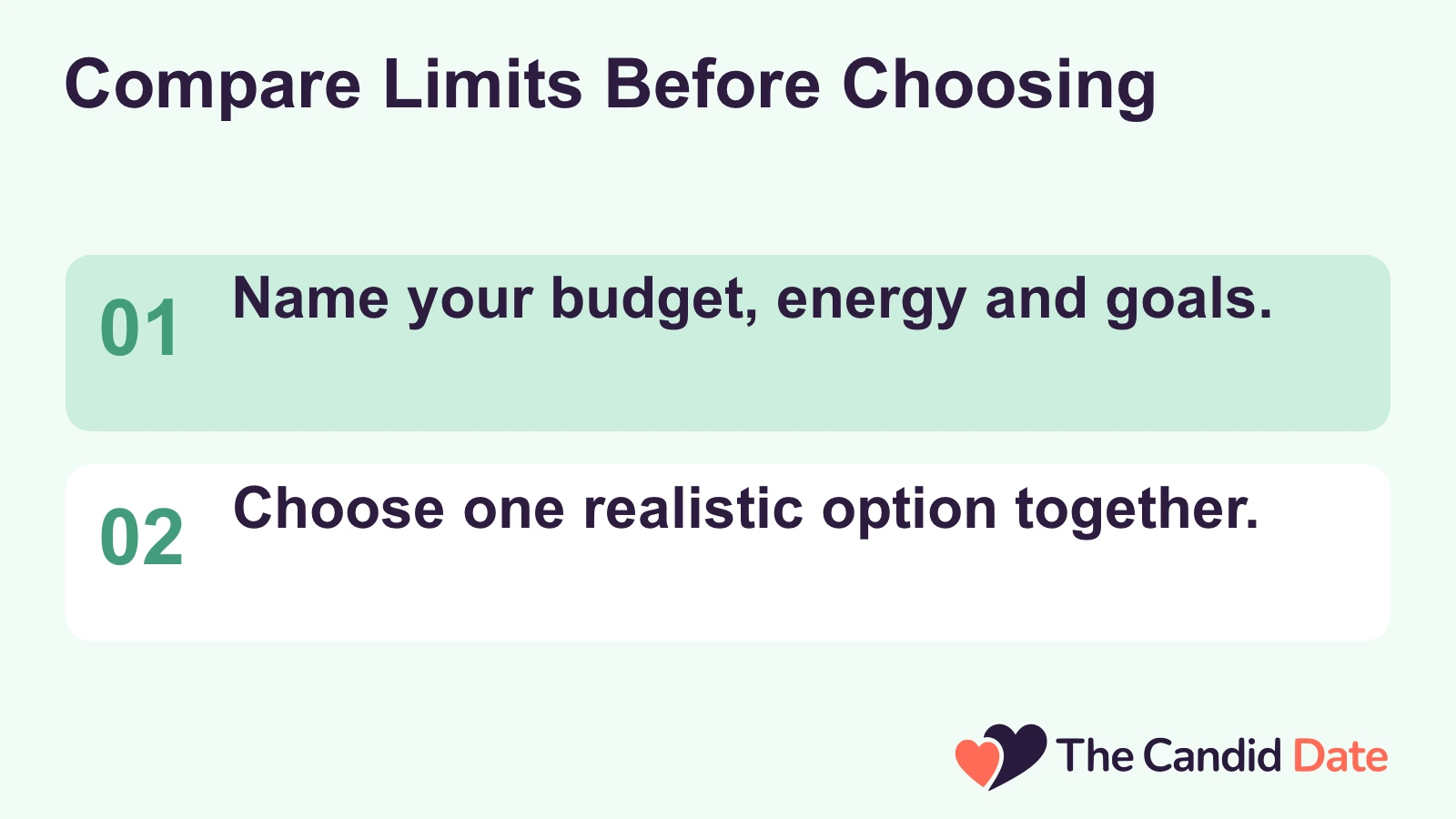
Dinner and a movie persists because budget, energy, and conversation goals stay undefined, not because options are missing.
Pick the dealbreaker factor first: budget tier, energy level, setting, talk versus activity, novelty versus comfort.
Local libraries, observatory public nights, community class listings, and event calendars reveal real options near you.
A one-page worksheet with two candidates, a backup, and an exit rule turns an idea into a plan you can book today.
Searching for fun date night ideas near you usually starts with a scroll through listicles and ends with the same reservation you always make. The problem is rarely a shortage of options. It is that nobody has defined the real constraints: how much money is available tonight, how much energy each person has, and what the evening is supposed to accomplish.
This guide is a decision worksheet, not another list. You will diagnose why your dates feel flat, weigh five selection factors, learn where to find local events without guessing, and fill in a one-page plan with a backup and an exit rule. Two worked examples show the worksheet in action. Later sections cover weather, logistics, first-meeting safety, and differences in preferences.
Bring a pen or a notes app. By the end you should have a specific, bookable plan for this week.
Why your dates keep defaulting to dinner and a movie
Restaurants and theaters survive on exactly this kind of indecision. When two adults are tired at six in the evening and nobody has named a budget or a goal, the path of least resistance wins. Dinner gives you a place to sit and a built-in topic of conversation, and a movie removes the pressure to talk for two more hours.
That is also why the evening feels flat: you are outsourcing every decision to a business. The fix starts with diagnosing which constraint is actually unspoken. Ask each other three questions before any idea gets discussed.
First, what is the real budget tonight, including parking, tips, and a babysitter if one is needed? Second, what is our energy level on a scale from couch to climbing wall? Third, do we want this evening to produce conversation, shared activity, or rest?
Most couples discover that one of these three answers conflicts with the other two, and that conflict is the whole problem. A person who wants deep conversation will find a loud trivia night disappointing no matter how fun the venue looks. A person running on four hours of sleep will resent an activity-heavy plan even if they suggested it last week.
Once the constraint is spoken out loud, most bad ideas eliminate themselves. Write the three answers down before you open any event app, because apps are designed to show you novelty, and novelty is only one of the five factors that matter.
The five-factor matrix that picks the activity for you
Every date idea you will ever consider can be scored on five factors. You do not need a spreadsheet. You need to agree on the range for each factor, then let the combination point at a category of activity.
The factors, in the order most couples should discuss them, are:
- Budget tier: zero dollars, under twenty dollars per person, or a special-occasion splurge you set in advance.
- Energy level: active and moving, lightly active like strolling, or fully relaxed with seats involved.
- Setting: indoors, outdoors, or a hybrid where you can switch if weather changes.
- Interaction style: conversation-friendly, where talking is the point, or activity-focused, where talk happens around a task.
- Novelty versus comfort: trying something neither of you has done, or revisiting a place you already love.
Here is the rule that makes the matrix fast: pick the dealbreaker factor first. If the budget is zero, nothing else matters until you accept it. If one of you is exhausted, energy outranks novelty.
Work through the remaining factors in whatever order feels natural, and you will usually land on one or two categories, such as a free, relaxed, indoor, conversation-friendly evening, or a moderate-cost, active, outdoor, activity-focused one. Categories are enough. The next section shows how to fill a category with something real that is happening near you this week.
How to find out what is actually happening near you this week
Generic lists fail because they describe activities in the abstract. What you need is this week's real inventory, and it is easier to find than most people expect. Start with your public library and community college websites, which publish free or low-cost classes, lectures, and workshops open to adults.
Check whether a nearby observatory holds public viewing nights; many open their telescopes to visitors on a regular schedule. Look at the events page of your city or town, the local tourism office, and the community calendar of a neighborhood newspaper. These sources list actual dates, actual times, and actual prices, which is everything your worksheet needs.
Two habits multiply what you find. First, ask around. Couples routinely poach great date ideas from friends, and a recommendation comes with a built-in review from someone whose taste you know.
Second, take turns acting as the scout. Each person spends ten minutes a month bookmarking two or three local options that fit the other person's preferences, so the night-of decision is a choice between things you already found, not a cold search. Keep a shared note on your phones.
When Friday arrives and energy is low, that note is the difference between a plan and a shrug.
Outdoor Date Ideas: 12 Easy Plans for a First or Second Date
The one-page date night worksheet
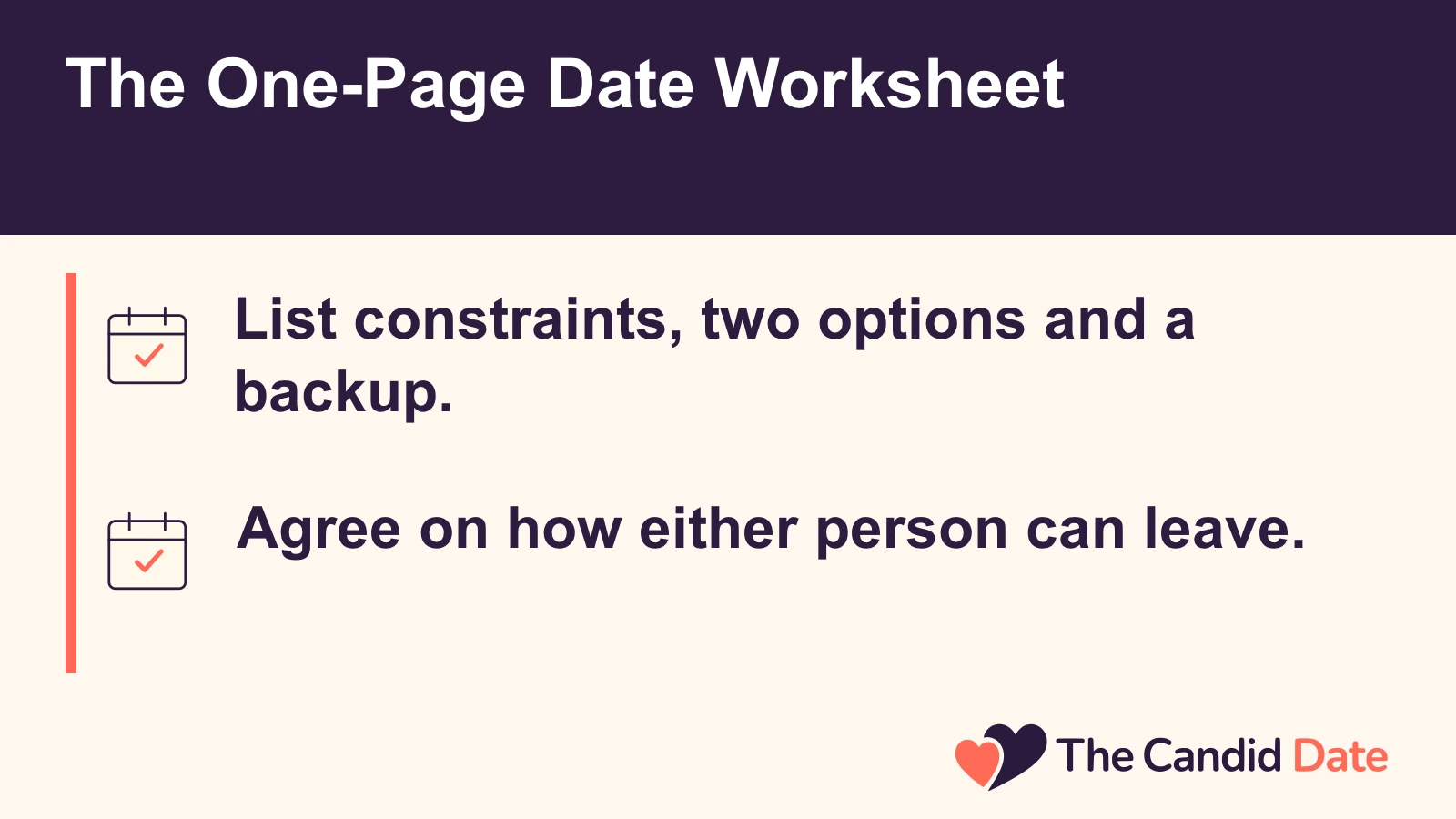
This is the core tool of the guide. Copy these seven lines into a note and fill them in together in about ten minutes. The structure forces you to settle constraints before falling in love with an idea.
- Line one: our budget tier and hard stop, including transport and childcare.
- Line two: our energy level tonight, stated by each person separately.
- Line three: conversation, activity, or rest, and what a good evening produces.
- Line four: candidate A, with the day, time, location, and cost written out.
- Line five: candidate B, filled in the same way, as a genuine alternative.
- Line six: our backup plan if candidate A falls through, chosen in advance.
- Line seven: our exit and change rule, meaning when we are allowed to pivot without guilt.
The last two lines do the heavy lifting. A pre-chosen backup means a cancellation is a switch, not a failure. The exit rule protects honesty: if either person is clearly miserable ninety minutes in, you change plans without negotiating or apologizing.
Many couples find that agreeing on the exit rule beforehand is what lets them take bigger swings on novelty, because the downside is capped.
Two worked examples, from a $0 weeknight to a $60 celebration
These examples are hypothetical, but they show exactly how the pieces connect. Example one: a couple on a Wednesday with zero budget and low energy. Line three says conversation and rest.
The scout notes surface a free astronomy talk at a public observatory that Thursday, with candidate B being a bookstore browse where each person picks a book for the other. Backup: cook a simple dinner together at home. Exit rule: if the talk runs long, leave at the intermission and get the conversation over takeout coffee.
Total cost is zero, and the evening has a clear beginning, middle, and end.
Example two: an anniversary with a $60 total and moderate energy. Line three says activity plus one good long conversation. Candidate A is a beginner dance lesson at a studio that offers a low-cost early class, followed by cheap street food nearby.
Candidate B is a cooking class at the community college. Backup: a drive to a scenic overlook with a homemade playlist and pastries. Exit rule: if the lesson feels awkward, treat the awkwardness as the joke of the evening and move to food early.
Notice that neither example required a ranked list of ideas. The constraints chose the category, and local listings supplied the specifics.
How to Plan a Date Night That Goes Well
When the plan falls apart: four branches and a next action
Plans fail in predictable ways, so each failure gets a rehearsed next action instead of a mood. Work through whichever branch applies:
- Weather ruins an outdoor plan: activate the indoor backup from line six, or move the same activity under cover, such as a market hall instead of an open-air market.
- One person hates the chosen activity: invoke the exit rule without debate, then ask what part they disliked, the activity itself or the surprise, before the next turn.
- Babysitting or logistics collapse: switch to the stay-in fork in the next section rather than canceling the date entirely.
- This is a first meeting with someone new, not an established couple: keep the plan public, short, and easy to leave, and never send money or gifts to someone you have not met in person.
That last branch matters more than the others, so it deserves emphasis. Public places, independent arrival and departure, and a plan that ends naturally after one drink or one lap of a market all keep a first meeting low-pressure and safe. A date that is easy to leave is a date both people can enjoy, because nobody feels trapped into stretching it.
14 Low-Key, Low-Cost Date Ideas
Staying in on purpose, not by default
Staying home fails as a date when it is what happened instead of what was chosen. It works beautifully when it is chosen with the same care as a night out. The signal is structure.
A chosen home date has a start time, a defined activity, and something that distinguishes it from a regular Tuesday. Cooking one new recipe together with the good plates out qualifies. Rewatching a favorite film with deliberate homemade snacks and phones in another room qualifies.
A photo scavenger hunt through your own neighborhood, or taking turns giving each other a tour of your personal book or music collections, qualifies.
Give the evening one marker it would not otherwise have. Light candles, dress a little nicer, or agree that the first thirty minutes belong to a real conversation before any screens appear. Think back to what made your earliest dates feel charged, and import one element of that, such as curiosity questions or a shared challenge.
A home date built this way often produces more actual connection than an expensive night out, because the environment is designed for attention rather than entertainment.
Dry Dating Explained: How the Sober Trend Is Changing Date Night
Taking turns fairly when your tastes are nothing alike
Different tastes are not a bug to fix; they are a resource to schedule around. The cleanest system is alternation with a generosity clause. Each person plans one date in turn, and the planner optimizes for the other person's enjoyment, not their own.
This single rule changes everything, because it converts compromise, where both people half-like the plan, into gifting, where each person gets a fully tailored evening half the time. Add one safeguard: the non-planner gets a single veto, usable for anything truly miserable, and the planner gets to keep the details secret until arrival if they wish.
Two tactics keep alternation fresh. Steal ideas shamelessly from friends and from double dates, where another couple's presence changes the chemistry of an activity you have done before. And revisit your hits on purpose.
If a past date worked, doing it again with small variations is not a failure of imagination; it is compounding what works. Novelty has its own section in the matrix, but comfort deserves equal respect. A relationship collects a short list of shared favorite places, and returning to them is how an evening out becomes yours rather than interchangeable.
Sponsored placement


Looking for adults who share your casual intent?
AdultFriendFinder is an optional adult-focused service for casual connections. Check the available profiles and paid communication limits before deciding whether to subscribe; local availability has not been verified.
- Adult-focused casual connections
- Basic free access; paid communication tools
- Check the current subscription conditions
| User Base | Today’s Deal |
|---|---|
| Adults with explicit casual or sexual dating intent | Free basic access; communication upgrades cost extraCheck the current total charge, auto-renewal and any add-ons before subscribing. A membership does not guarantee a meeting. |
An optional sponsor note for adults exploring casual connections
This section is separate from the planning guide above and is relevant only to adult readers who are single and exploring casual connections rather than planning a couple's date night. AdultFriendFinder is an adult platform where creating an account and browsing profiles can be free, while messaging, advanced search, and added visibility generally require a paid upgrade, and paid subscriptions renew automatically by default unless you change that setting at checkout. Verify current pricing and read independent reviews before paying, and never treat any platform as a guarantee of meeting someone.
This is not a recommendation for established couples, and it is not intended for anyone under 18.
Frequently Asked Questions
How much should we actually budget for a date night?
There is no correct number, only an honest tier. Many strong dates cost nothing: a library lecture, an observatory public night, a bookstore browse, a scavenger hunt you design yourselves. A modest tier under roughly twenty dollars per person covers a class, street food, or coffee and dessert after a free event.
The tier matters more than the amount, because agreeing on it first eliminates most arguments. Set the number before you look at ideas, include transport and childcare in it, and treat a special-occasion splurge as a separate, planned tier rather than the default.
Is it okay to just repeat a date idea we both loved?
Yes, and you should. A repeated date is how a place becomes yours. The matrix includes novelty as one factor, not a requirement, and comfort is a legitimate choice.
If you both loved a particular noodle spot and a walk, returning there with small variations, a new dish, a different route, or a seasonal event nearby, deepens the association instead of draining it. Save novelty for evenings when the matrix says both people have energy and curiosity to spare. Compounding your hits is a strategy, not a rut, as long as the return is chosen rather than automatic.
What if we are not a couple yet and this is a first date?
Run the same worksheet with stricter constraints. Choose a public place, keep the activity short with a natural ending, and make arriving and leaving independently easy. A market, a coffee walk through a busy park, or a free gallery all work; remote trails, shared cars, and expensive prepaid tickets do not.
Tell a friend where you are going, and follow the basic safety rule that applies everywhere: never send money or gifts to someone you have not met in person, no matter how convincing the conversation feels. A good first date plan is one either person can end gracefully.
What to Do Next
You did not need two hundred date ideas. You needed a way to decide. Diagnose the unspoken constraint, run the five factors and pick the dealbreaker, pull this week's real options from libraries, observatories, and community calendars, and commit the result to the one-page worksheet with a backup and an exit rule.
The two worked examples show the whole loop takes about twenty minutes. Do it tonight, book the plan, and put the next turn on the calendar before the current date ends. The couples who never run out of fun date nights are rarely the ones with the best ideas.
They are the ones with a working decision.
About the Author
By: Penelope Torres
Advice Editor
Penelope Torres edits the advice desk at thecandiddate.com and answers reader questions about first dates and texting.
Share the Knowledge!
Our dating experts work hard to show you the best dating sites. Want to show your appreciation? Share this page!