
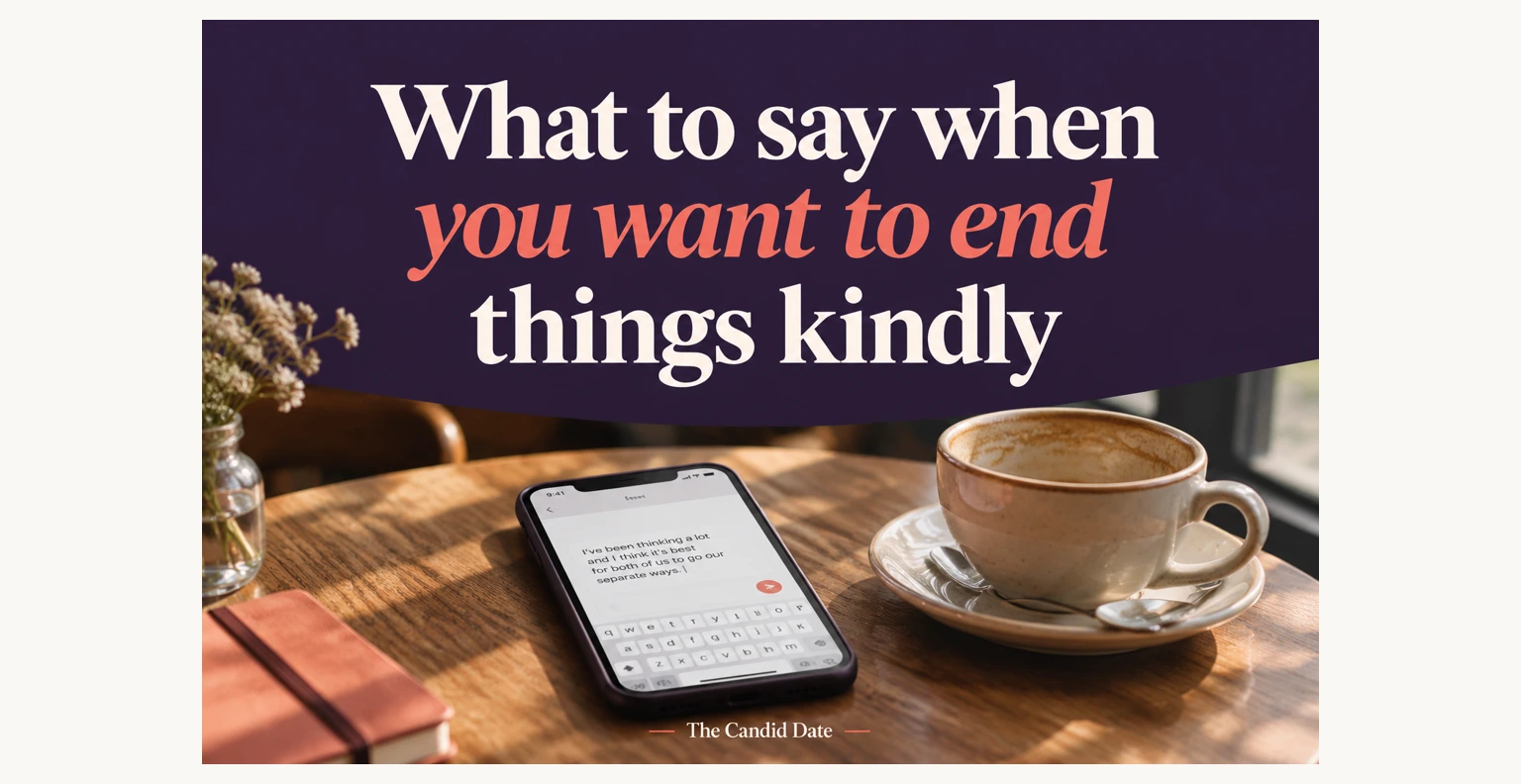
What to say when you want to end things kindly

Key Takeaways
A short, clear, final message beats a long explanation almost every time.
Match the length and channel of your message to how long you have been seeing each other.
Kindness means being direct, not negotiating or leaving false hope.
After you send the message, respond once or twice at most, then step back.
After a few dates, a short, clear message can be an appropriate way to end the connection, provided that doing so is safe in your situation. It should be clear, kind, and final. If you are looking for exactly what to say when you want to end things kindly, start here: thank them for the time, state plainly that you do not see this continuing, and wish them well without adding conditions.
That structure works whether you had one coffee date or several weeks of contact. This guide gives you adaptable wording for each situation, explains when a text is enough and when a conversation is fairer, and shows you how to respond if the other person asks why, pushes back, or keeps messaging. Every script below is an original suggestion you can edit in your own voice.
The Simplest Kind Message You Can Send
The most reusable template has three parts: a genuine thank-you, a clear statement that you are not continuing, and a warm close. Nothing else is required. Here is a version you can adapt: "I've really enjoyed getting to know you, but I don't feel the connection I'm looking for. I didn't want to leave you guessing. Wishing you the best."
That message respects the other person because it answers the only question that matters: whether there will be another date.
If the wording feels stiff, rewrite each part in your normal voice while keeping the three-part shape. Say "I had a good time last week" if that sounds more like you, or "I don't think we're the right fit" if "connection" feels abstract. The goal is that the other person finishes the message knowing it is over, not wondering what you meant.
- Do thank them for their time, briefly and specifically.
- Do state the ending plainly in one sentence.
- Do close with a simple well wish, not an invitation to stay in touch.
- Skip the long list of reasons. Detailed feedback invites debate.
- Never use softeners that reverse the message, like "maybe someday."
Match the Message to How Long You Have Been Dating
One date earns the shortest version: "Thanks for meeting up last night; I enjoyed talking with you. I don't feel the romantic fit I'm looking for, so I won't plan a second date — take care." You owe politeness and clarity, not a postmortem. After two to four dates, add one line acknowledging the time you have shared: "These past few weeks have been fun, and I've liked getting to know you. I've realized I don't see this growing into what I want, so I'm going to step back. I hope you find someone great."
After a couple of months of regular contact, even without labels, a longer message or a short phone call is kinder. Acknowledge what the connection was, name the decision as yours, and give them space to respond once. The deeper the pattern of contact, the more abrupt a two-line text will feel.
You are calibrating effort to investment, not writing a performance review.
A quick sanity check: ask how you would feel receiving this message at this stage. Three months of weekend plans should not end with one clipped sentence, and one pleasant dinner does not need three paragraphs.
What to Say When You Have Simply Lost Interest
Lost interest is a complete reason, and it does not need to be dressed up as the other person's flaw. Honest framings that stay kind: "I don't feel the chemistry I was hoping for," "I've realized we're looking for different things," and "I don't see this turning into the relationship I want." Each describes your experience rather than grading theirs.
Compare that with "you're too intense," which turns a clean ending into a critique they may try to argue or fix.
If the mismatch is neutral, like wanting different commitment levels or living in different cities, naming it once can help them accept the ending. "I've loved our time together, but I want a long-term partner and I can tell that's not where you are" is kinder than a vague fade. State it as your read of the situation, not an accusation.
If you are stepping back from dating entirely, say that plainly: "I've decided to take a real break from dating, and I wanted to tell you directly rather than drift away." Only use this if it is true. A claimed break that turns into a new relationship a week later reads as a lie.
What Celibacy Means When You're Dating
Ending a Casual or Friends-With-Benefits Arrangement
Casual arrangements deserve the same directness as formal dating, because the lack of labels makes ambiguity easy. Boundaries here include how to end things gracefully when feelings change, and that takes an explicit conversation rather than a quiet disappearance. A workable script: "I've enjoyed what we've had, and I want to be straight with you: I'm done with this arrangement. It's not about anything you did. I won't be in touch for a while so this ends cleanly."
The last line matters most, because casual connections often restart by default. One late-night message can revive an arrangement one of you wanted to leave. If you intend to end it, say you are not looking to pick it back up, and decline invitations that restart the physical side while skipping the conversation.
If you might want to restart someday, be honest about that instead of pretending a clean break.
If the other person developed feelings you do not share, acknowledge that with care: "I can see this means more to you, and I'm sorry I don't feel the same. Continuing wouldn't be fair to you." Then stop. Kindness here is ending quickly rather than keeping someone attached to a situation that will not become what they hope.
How Much of a Reason to Give
One honest reason is usually enough, and sometimes none is needed beyond "I don't feel the fit." The test is whether a detail helps the other person accept the ending or mainly relieves your guilt and starts an argument. "I don't see us as long-term compatible" helps.
"Your laugh bothered me" does not. Unsolicited criticism is not honesty; it is feedback delivered at the moment it can help least.
One exception: if the person genuinely crossed a line, naming it briefly can be appropriate. "When you joked about my job in front of your friends, I realized I don't feel respected here, so I'm ending this" is factual and tied to your decision. State the behavior and your boundary once, and do not get pulled into relitigating whether it was really that bad.
Never invent a noble excuse to soften the blow, like claiming you are moving or getting back with an ex. False reasons unravel, and even when they hold, they train you to avoid a truthful sentence. A plain "I don't feel what I hoped to feel" may be uncomfortable to send, and you cannot control the other person’s reaction.
It still communicates your decision more honestly than an invented explanation.
Text, Call, or In Person
Text is acceptable, and often preferable, after one to three dates. You are not close yet, a written message lets them process privately, and nobody sits through an awkward drink pretending everything is fine. Once you have been seeing each other regularly for a month or more, a call or an in-person conversation shows more respect, especially if you have met each other's friends or talked about the future.
If you choose in person, pick a semi-private spot that is easy to leave, like a park bench or quiet cafe, not a long dinner. Open with the decision in the first two minutes: "I asked to meet because I wanted to tell you directly: I don't see this continuing, and I wanted to say it to your face." Then let them react, answer a question or two, and leave while things are still respectful.
Safety overrides courtesy when someone has been volatile, pushy, or frightening. In that case, a brief text followed by blocking is completely appropriate, and you owe no in-person explanation. Trust your read of the situation over any etiquette rule, including anything in this article.
When They Ask Why or Push for Another Chance
Expect follow-up questions, because "why" is the most natural response to an ending. Answer once, honestly and briefly: "There isn't a specific thing you did. The romantic feeling just isn't there for me, and I don't think it's fair to keep going when I know that." If they ask again, repeat yourself in slightly different words, then stop.
Each new round of explanation suggests the decision is still open.
Persuasion is harder. If they argue for one more date or promise to change, restate rather than rebut: "I hear you, and I'm not going to change my mind. I don't want to keep debating it, because that isn't fair to either of us." Do not list their flaws to win, and do not soften "no" into "maybe" to end the conversation.
Agreeing to one more date out of politeness restarts the process at double the cost.
If someone reacts with anger or insults, disengage immediately. You do not need to defend the decision or get the last word. "I'm sorry you're upset. I'm going to step away now" is a complete response.
Their reaction is information, not an obligation to keep managing their feelings.
When Love Turns Codependent: What It Looks Like in Dating
Stay Firm Without Over-Apologizing
One apology for causing disappointment is kind. A string of apologies can obscure your decision and pull the conversation into another negotiation. Notice the difference: "I'm sorry this is disappointing, and my answer is still no" holds compassion and the boundary.
"I'm so sorry, I'm terrible at this, maybe I rushed" invites them to comfort you or keep negotiating. Ending a connection you do not want is a legitimate boundary, not a harm you keep paying for.
Watch for phrases that quietly reopen the door: "let's see how we both feel in a month," "we can still text," "I just need a little time." If you mean the ending, cut these entirely. If you catch yourself writing them, ask whether you actually want a temporary break, because a soft landing you do not mean is crueler than a clean one.
You can be warm and final at once: "You're easy to talk to, and someone is going to be very lucky. That person isn't me, and I wanted to tell you honestly rather than fade out." Compliments that cushion a clear no are fine. Compliments that contradict it are not.
Sponsored placement


Looking for adults who share your casual intent?
AdultFriendFinder is an optional adult-focused service for casual connections. Check the available profiles and paid communication limits before deciding whether to subscribe; local availability has not been verified.
- Adult-focused casual connections
- Basic free access; paid communication tools
- Check the current subscription conditions
| User Base | Today’s Deal |
|---|---|
| Adults with explicit casual or sexual dating intent | Free basic access; communication upgrades cost extraCheck the current total charge, auto-renewal and any add-ons before subscribing. A membership does not guarantee a meeting. |
What to Do After You Send the Message
Once the message is sent, your job shrinks to three things: reply to one reasonable follow-up, resist the urge to check in, and then go quiet. Checking in days later to "see how they're doing" feels caring but reopens the wound and reads as ambivalence. Unmatching after a clean goodbye is fine.
If their posts keep pulling you back, mute or unfollow without announcing it.
If they keep messaging after you have answered once, send one final line and stop: "I've said what I need to say, and I'm not going to keep discussing it. I wish you well." Continued contact after that is a boundary problem, and muting or blocking is a reasonable tool, not a cruelty. If contact becomes harassing or threatening, save the messages and use the platform's reporting tools rather than engaging.
Then take your own next step. If the ending clarified what you want, whether a serious relationship, a slower pace, or a break from dating, let that shape what you do next rather than drifting back to the same apps by habit.
Pick a Dating Site That Fits What You Want From a Relationship
Frequently Asked Questions
Is it ghosting if they never reply to my ending message?
No. Ghosting means disappearing without explanation from someone expecting contact. Once you have sent a clear, kind message that the connection is over, you have done the explaining part.
If they never reply, their silence is the answer, and you do not need to confirm they received it. If they respond days or weeks later, one brief courteous reply is fine, but you are not obligated to restart the conversation or re-explain a decision you already stated clearly.
What if we have mutual friends or will keep running into each other?
Keep the ending message gracious and free of blame, because you may continue sharing a social circle. Tell mutual friends one neutral line, such as "it wasn't the right fit and I ended it kindly," and decline to share details or recruit sides. When you run into the person, greet them briefly and warmly rather than avoiding them or acting overly familiar.
Do not use shared events to check on their feelings about the breakup. Consistent politeness sets a clear example without requiring either person to become friends immediately.
What if I change my mind after I end things?
Sit with the feeling for at least a week before acting, because loneliness after an ending often masquerades as regret. Ask what you specifically miss: this person, or simply having someone. If you genuinely ended things for the wrong reason, reach out once with an honest, low-pressure message that owns the reversal and explains what changed.
Accept whatever answer comes, including silence. Do not reappear with casual small talk hoping to drift back in; that reopens hope without honesty.
What to Do Next
Ending a dating connection kindly comes down to three habits: say it clearly, keep it short, and mean it. Choose wording that fits the time you shared, deliver it through a channel that matches the relationship, and hold your line if the other person pushes back. A direct message may feel uncomfortable to send, but it is far gentler than a slow fade, a pile of excuses, or a maybe you do not mean.
Pick the script closest to your situation, rewrite it in your own voice, and send it today rather than letting another week of dread build up.
About the Author
By: Emily Rodriguez
Lifestyle Coach
Emily Rodriguez is a lifestyle coach and author sharing practical communication and relationship strategies on thecandiddate.com.
Share the Knowledge!
Our dating experts work hard to show you the best dating sites. Want to show your appreciation? Share this page!