

Date Night Ideas: A Clear Decision Guide for Adults

Key Takeaways
Define the exact problem before choosing an activity.
Use must-have criteria to filter options quickly.
Match the plan to the relationship stage and energy available.
Reuse a one-page worksheet and review the result without blame.
A good date night idea is not a prize plucked from a list. It is the result of a decision: what problem are we solving tonight, under what limits, with what kind of attention? For consenting adults, the strongest plan fits energy, budget, privacy, travel, conversation needs, and consent before it tries to impress.
This guide treats date night ideas as a decision process rather than a ranked menu. It defines common problems, sets selection criteria, and ends with a worksheet you can reuse. It is practical, not clinical, and it is not therapy.
Later, an optional advertisement for married or attached adults is clearly separate, because that platform is not a fix for a committed couple and does not replace direct communication.
Start with the exact problem you are solving
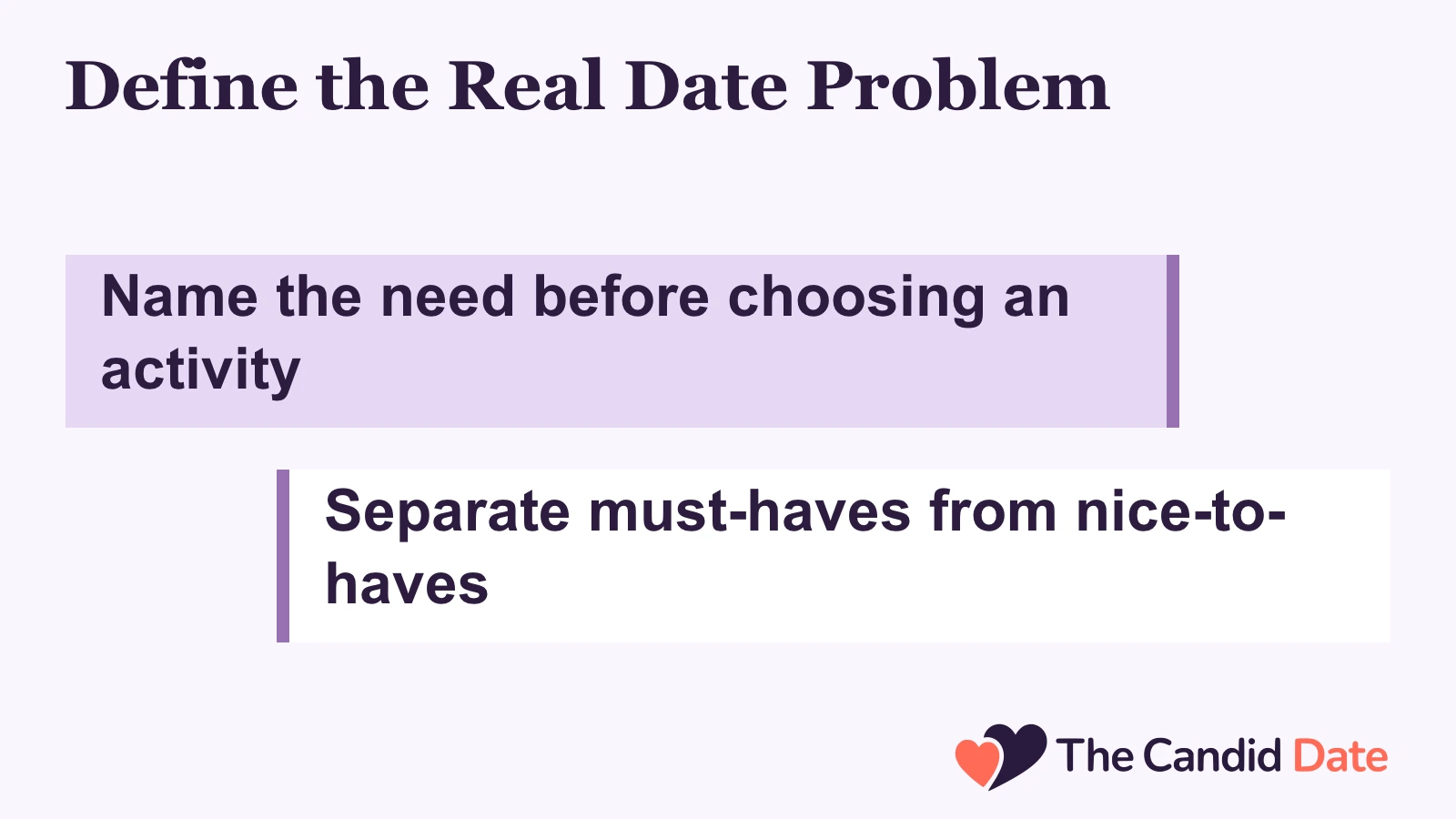
The exact problem usually hides under vague labels like fun, romantic, or different. Translate the label into a need. In one hypothetical sentence: We need a low cost evening that lets us talk without performing, because work has left us both flat.
Another pair might need movement after a sedentary week, or novelty after six months of the same restaurant. Write the sentence before opening apps or maps. Then separate the goal from the format.
Reconnection can happen over tacos, a gallery walk, a repair project, or a train ride; the format is only the container. If the real need is to avoid a heavy relationship talk, say so and choose lighter interaction. If the real need is repair after distance, choose enough structure that nobody has to improvise courage.
A clear problem also protects the planner from perfectionism. You are not trying to create the best date in the city. You are trying to create enough fit that two adults can arrive, participate, and leave feeling more like themselves.
That is why the first worksheet field is a need, not an idea. Names make tradeoffs visible.
How to Plan a Date Night That Goes Well
Set selection criteria before browsing ideas
Selection criteria are filters, not decorations. Start with must haves: total time, budget band, distance, noise level, accessibility, food limits, alcohol preference, and whether private conversation matters. Then add preferences: novelty, learning, movement, scenery, humor, or cozy routine.
Give every criterion a reason. A quiet room is not better by default; it is better when the goal is disclosure, hearing sensitivity, anxiety, or simply fatigue. Public settings are not automatically safer emotionally; they can reduce pressure early, yet they can also make intimacy harder.
Use a simple weighting rule. Must haves eliminate options. Preferences rank what remains.
Keep exit options visible: Can we leave after forty minutes without drama? Can the plan survive rain, a sold out event, or one person arriving hungry? For a first meeting with someone new, favor places where arriving separately is natural.
For an established relationship, favor plans that share labor, because resentment often enters through invisible preparation. The point of criteria is speed. When an idea fails a must have, you stop negotiating with it and move on.
Outdoor Date Ideas: 12 Easy Plans for a First or Second Date
Match the format to the relationship stage
Match the container to the stage. Early dating usually needs low pressure, clear boundaries, and an easy ending; coffee, a market loop, mini golf, or a short gallery visit can work better than a four hour reservation. Established couples may need novelty plus teamwork, so cooking a new recipe, building a blanket fort with a projector, or taking a beginner lesson can refresh attention.
Long distance pairs can share a virtual museum tour, cook the same meal on video, or watch a film with a synchronized start and a shared snack. A couple repairing trust should avoid surprise intensity; choose predictable, bounded plans and discuss comfort first. These are hypothetical patterns, not rules.
A first date can be a long hike if both people know each other well and consent to remote logistics. A married couple can prefer quiet errands plus dessert. The decision question is whether the stage makes the plan feel inviting or exposing.
If either adult would need to fake enthusiasm, shrink the scope before adding sparkle.
Build a one-page date night worksheet
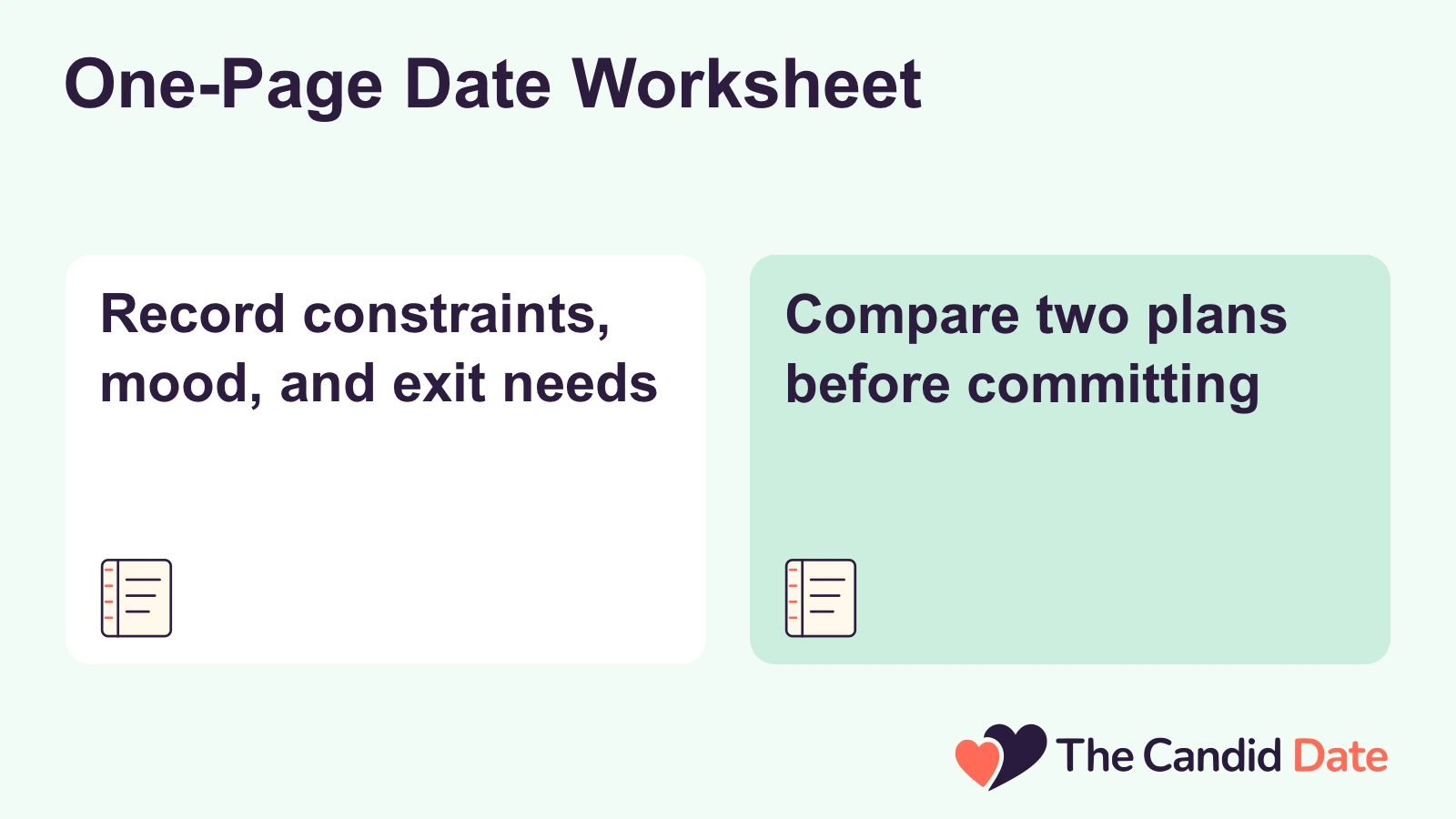
Keep the worksheet to one page so it gets used. Put these fields at the top:
- Occasion or need in one sentence
- Must haves: time, budget band, travel, accessibility, food, alcohol, privacy
- Desired mood and conversation level
- Plan A, Plan B, and the exit point
- Who books, who pays or splits, and what is shared beforehand
- Consent check and any topic that is off limits tonight
Then test two candidates against the fields instead of collecting ten. For example, a hypothetical Plan A is dinner and a comedy show; Plan B is a home tasting menu with three printed courses. Dinner offers novelty but crowds out talk.
Home offers control but requires cleanup. Neither is morally superior. The worksheet reveals which cost you are willing to pay: money, noise, effort, or uncertainty.
End with a repair line: If the plan disappoints, we will adjust the criteria rather than attack each other. That sentence matters because many date nights fail in interpretation, not logistics. One adult hears cheap as careless; another hears elaborate as pressure.
Writing assumptions down keeps the evening in the room instead of inside a guess.
14 Low-Key, Low-Cost Date Ideas
Use idea families, not a ranked list
Think in idea families rather than a ranked list. Table and talk suits catching up, decision conversations, and low physical energy. Moving side by side suits people who open up while walking, biking, bowling, or browsing, because eyes are not locked in interview mode.
Making something suits teamwork: ceramics, bread, a photo walk, a tiny garden, or a playlist built from two histories. Home transformation suits budget limits and privacy: rearrange one room, print a menu, camp indoors, or stage a themed tasting. Micro adventure suits restlessness: a new neighborhood, sunset viewpoint, ferry loop, or last minute matinee.
Shared learning suits curiosity: dance basics, astronomy, a lecture, or a tasting with questions. Cozy screen suits decompression when both adults agree that connection can mean parallel rest. Community events add people watching and low planning, from trivia to markets.
Choose the family by criteria. If talking is the goal, do not pick a loud activity and hope volume will create closeness. If novelty is the goal, change one variable only: new place, new skill, new time of day, or new role where the usual planner gets to be hosted.
Dry Dating Explained: How the Sober Trend Is Changing Date Night
Plan logistics without killing spontaneity
Logistics should carry the plan, not smother it. Confirm the reservation window, ticket release time, parking or transit, weather backup, dress comfort, seating, dietary needs, and the realistic end time. Decide money before the bill arrives: split, treat, or alternate, with a band you both accept.
For first meetings, keep transport independent and tell a friend the public place and expected end. For couples, divide invisible labor by naming it: who researched, who booked, who reminds, who carries water, who calls the ride. Build one graceful pivot.
If the exhibit is closed, the nearby bench and pastry case become the date. If energy drops, shorten without apology. Put phones in a bowl for twenty minutes only if both adults agree; forced digital detox can feel like surveillance.
The best logistical plan is boring from the outside and generous on the inside. It removes tiny frictions so attention can go where it belongs: faces, choices, jokes, pauses, and the shared evidence that time was protected.
Sponsored placement

A separate choice for married or attached adults
Victoria Milan markets dating for married or attached adults. Consider its relationship category and payment conditions carefully; advertised privacy tools do not guarantee anonymity or establish a partner’s consent.
- Built for married or attached adults
- Free registration advertised
- Review privacy and paid access before subscribing
| User Base | Today’s Deal |
|---|---|
| Adults considering an affair-oriented service | Free registration; check current paid optionsFree registration does not establish free messaging. Read current checkout, renewal and cancellation terms. Privacy features cannot guarantee anonymity. |
Keep safety, consent, and expectations adult
Adult safety is mostly clarity before chemistry. Meet new people in public, keep your own way home, and do not let politeness override a boundary. General consumer guidance warns against sending money or gifts to a sweetheart you have not met in person; keep finances private until trust is earned in real life.
Say food restrictions, mobility needs, alcohol choices, and comfort with touch plainly. Consent is specific, reversible, and never implied by a date. If one adult wants romance and the other wants friendship, believe the plainer statement and choose a plan that does not punish honesty.
Avoid using alcohol as the evening's structure; a sober plan can be warmer because nobody is managing impairment. For committed couples, safety also includes emotional privacy: do not turn date night into a surprise cross examination. Agree which topics are parked.
If conflict is high, the brave choice may be a calm walk and an earlier night, not a grand gesture. Fit is protective. A plan that respects limits creates more room for play than a plan that tests them.
Review, adjust, and make the next choice easier
Afterward, run a five minute review while memory is fresh. Ask what fit the criteria, what drained energy, what cost more than expected, and whether conversation flowed or had to be rescued. Keep the result behavioral: we talked more while walking, we fought crowds, we loved having a Plan B.
Archive one repeatable idea per family so future decisions start from evidence rather than mood. Rotate who proposes so taste does not harden into one person's project. Retire ideas without verdicts; a dud may be timing, weather, hunger, or a mismatched stage.
If date night keeps failing, look at the system before blaming romance: sleep, money stress, untreated conflict, over scheduling, or uneven labor. The guide cannot diagnose those issues, and a good worksheet cannot replace direct care or professional help when that is appropriate. But a repeatable decision can lower friction.
When adults know the problem, the criteria, and the exit, choosing the next idea becomes quicker, kinder, and much less theatrical.
Frequently Asked Questions
How do we choose date night ideas when we want different things?
Treat difference as information, not a referendum on taste. Each adult writes one must have and one willingness to try, then trade lists before proposing plans. If one wants quiet and the other wants noise, choose a sequence: a calm first hour and livelier second stop.
Taking turns works when the turn includes hosting duties, not just picking. If preferences repeatedly collide, scale down until the choice is low stakes. The goal is not agreement on everything; it is a plan where neither person has to disappear.
What if our budget or energy is low?
Low resources usually call for subtraction, not decoration. Keep one anchor: soup and bread at home, a park loop with takeaway cocoa, a library visit plus dessert, or a matinee and street food. Share preparation so the lower energy adult is not also the production crew.
Set an end time before you start, and make leaving early a success rather than a failure. If money is tight, say it without apology and choose free or low cost first. If energy is low, protect sleep and pick gentle motion over performance.
Are these date night ideas only for couples?
No. The framework fits any consenting adults planning intentional time together, including new matches, established couples, queer couples, long distance pairs, and friends who want structure. Commitment changes the criteria more than the legitimacy of the outing.
Early connections need clearer public boundaries; established relationships may need labor sharing; casual connections need explicit expectations. Keep every example adult, consensual, and honest about intent, then adapt the worksheet rather than forcing a couple shaped script.
What to Do Next
Date night ideas become easier when you stop asking what sounds impressive and start asking what fits tonight. Define the problem, set must haves, match the stage, use the worksheet, choose an idea family, and review without turning the evening into a performance review. Keep safety, consent, money, energy, and labor visible.
Adults do not need a perfect venue; they need a plan honest enough that both people can relax inside it. The worksheet is the quiet win, because it turns future spontaneity into something prepared rather than something avoided.
About the Author
By: Layla Rivera
Dating Coach
Layla Rivera is a relationship expert and dating coach for thecandiddate.com.
Share the Knowledge!
Our dating experts work hard to show you the best dating sites. Want to show your appreciation? Share this page!