
22% of U.S. Adults Report Never Having Had Sex



Key Takeaways
Men (23%) and women (21%) are nearly identical in their rates of virginity, challenging assumptions that virginity is primarily a one-sided experience.
Social media and dating apps might project an image of sexual openness and positivity, but the “everyone’s having sex” stereotype could turn out to be exactly that: a stereotype.
Over one in five U.S. adults surveyed (22%) report never having had partnered sex, and younger adults are driving that trend. The figures come from “The State of Us: National Study on Modern Love & Dating in 2025,” a survey carried out with the Kinsey Institute.
The result points to a rising wave of sexual abstinence in younger adults. Sex no longer counts as the cultural rite of passage that marks adulthood.
Many young Americans may instead be choosing to put off sexual experiences because of various socioeconomic factors, including mental health, shifting values, financial pressures, or relationships being reprioritized.
Our study looks at how the sexual landscape in America may be changing and what that means for dating today.
48% of Gen Z Adults Are Virgins, and So Are 26% of Millennials
Among younger adults, the long-dominant hookup culture may be fading as virginity grows more common.
According to our data, almost half (48%) of Gen Z adults 18 and older have never had partnered sex of any kind, a sign that sex may not carry the same weight as a universal milestone that it did for earlier generations.
Millennials were notable too. The generation once branded the “hookup culture” crowd reported more virginity than the generations older than them. When asked, roughly 26% of millennials describe themselves as virgins, which shows a readiness to abstain long into adulthood.
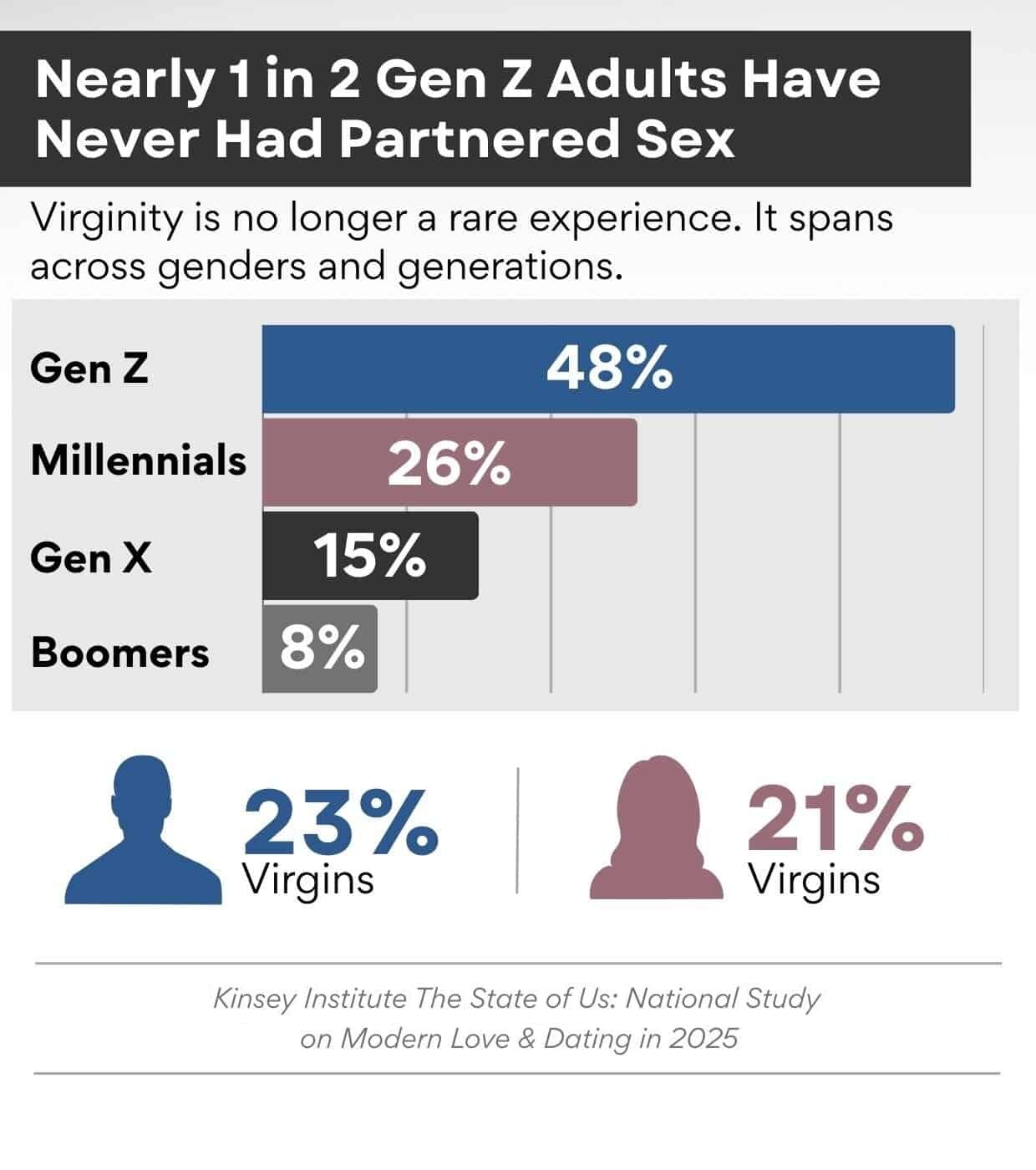
Our findings show virginity cuts across generations. Boomers (7.6%) and Gen Xers (15.4%) in the survey reported it too, just at lower rates. The bottom line: the sexual recession isn’t confined to teens and college-age adults; it’s continuing among respondents in their late 20s and 30s.
It’s worth acknowledging that a complicated social and economic climate could shape the way each generation handles intimacy and connection, which would explain the differences between age groups.
And despite what society tends to think, virginity isn’t lopsided by gender. In our study, men and women reported being virgins at almost the same rate: 23% vs. 21%. That undercuts the old assumption that virginity is more stigmatized, or more common, for one gender than the other.
Would You Date a Virgin? Yes, Say 64% of Men
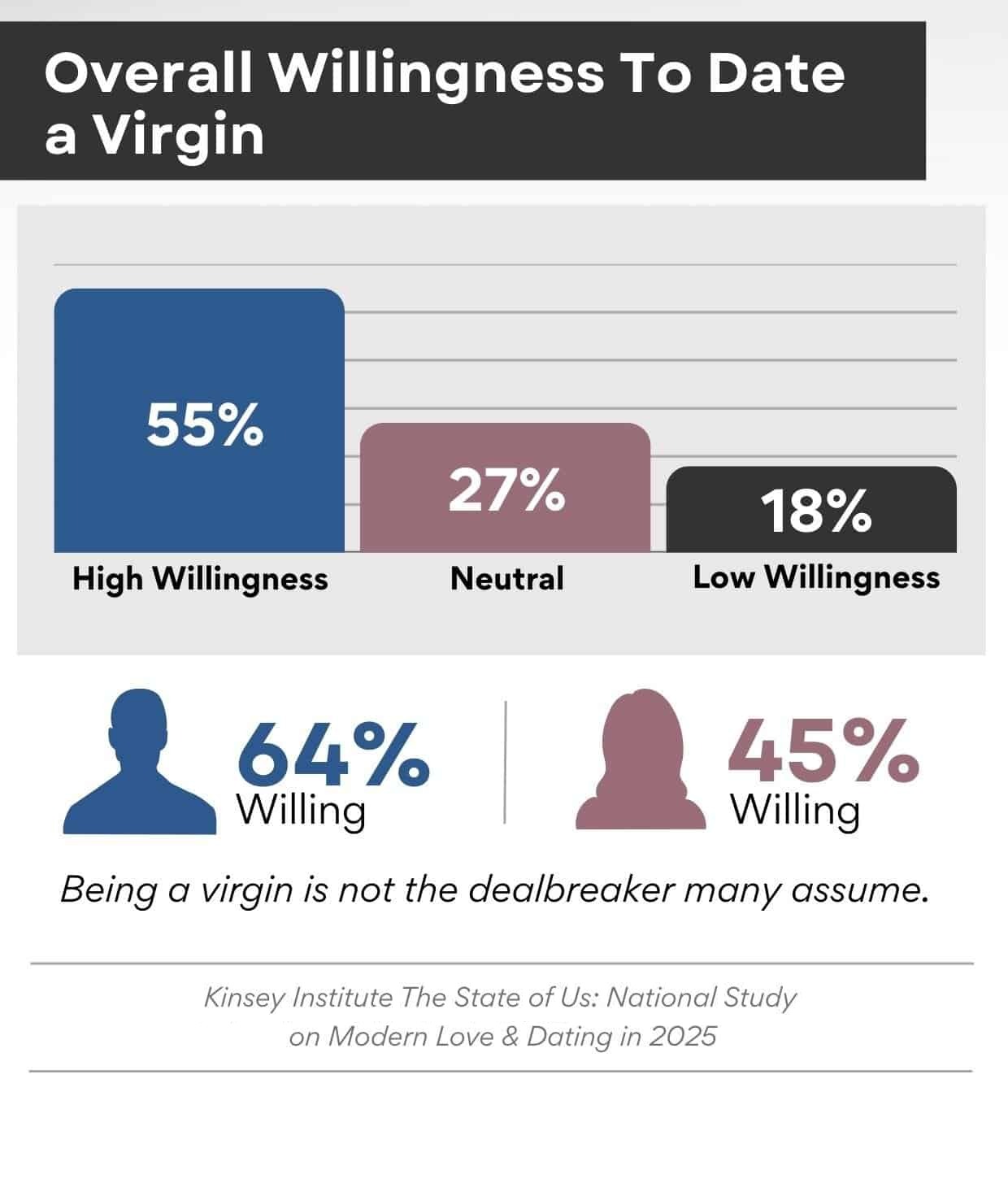
Virginity is less of a dating dealbreaker than plenty of people might think. Over half (55%) of respondents said they’d be highly willing to date a virgin, compared with 17% whose willingness was low.
We did see differences by gender and age, though. Men (64%) were much likelier than women (45%) to be highly open to dating a virgin, a gap of nearly 20%. That suggests men may not see virginity as an issue at all, whereas women may tread more carefully.
Respondents’ age and stage of life also shaped their views on virginity while dating. Not surprisingly, Gen Z and millennials were the most open to dating a virgin, and Boomers held back the most.
Here’s how willingness broke down by generation:
- Gen Z: high willingness from 69%, low interest from 6.7%
- Millennials: high willingness from 60%, low interest from 15%
- Gen X: high willingness from 51%, low interest from 19%
- Boomers: high willingness from 43%, low interest from 23%
The older the group, the lower the interest. Younger respondents showed more acceptance and may have come to see virginity as normal, but older ones were the least inclined to think about dating a virgin. Age, in other words, shapes attitudes toward virginity just as much as gender does.
Recent headlines have framed sexual abstinence as a Gen Z thing, but it isn’t only that. It spans generations and has many layers, driven by a range of factors. For younger adults, sex may have stopped being a universal rite of passage and become a personal decision, molded by changing norms and financial pressures.
Methodology
Researchers at the Kinsey Institute led “The State of Us: National Study on Modern Love & Dating in 2025.” Prodege.com ran the online survey and gathered the data between April 29, 2025, and May 8, 2025, from 2,000 single adults in the U.S., ages 18 to 91, forming a nationally representative sample.
Every sample’s results carry some sampling variation. How large that variation is can be measured, and it depends on how many interviews were done and on the level of the percentages used to express the results.
For this study’s interviews, there’s a 95 in 100 chance that any survey result falls within 3 percentage points, plus or minus, of what we’d have gotten by interviewing every person in the population the sample represents.
About the Author
By: Matthew King
Staff Writer
Matthew King is a research analyst and writer using data-driven insights to guide modern daters on thecandiddate.com.
Share the Knowledge!
Our dating experts work hard to show you the best dating sites. Want to show your appreciation? Share this page!