
The three-message rule for moving from the app to a real date

Key Takeaways
Ask after three substantive messages each, not three texts total.
Make the ask specific: an activity, a day, and an easy way to decline.
Counter a maybe once, clarify a dodge once, and accept a no cleanly.
Move faster for timing windows, slower for comfort; the rule is a ceiling, not a quota.
The three-message rule is simple: once you and a match have each sent three real messages, suggest a specific, low-pressure date with a place, a day, and an easy way out. The point is not a magic number. It is a deadline that keeps a good conversation from dissolving into weeks of small talk that goes nowhere.
This expanded guide keeps the original rule intact and fills in everything around it: what actually counts as a real message, a sample arc from opener to ask, ready-to-adapt templates for coffee, drinks, and a walk, when to move faster or slower, and exactly how to respond to yes, maybe, vague answers, silence, and no, plus a short note on pacing comfort.
What Counts as a Real Message
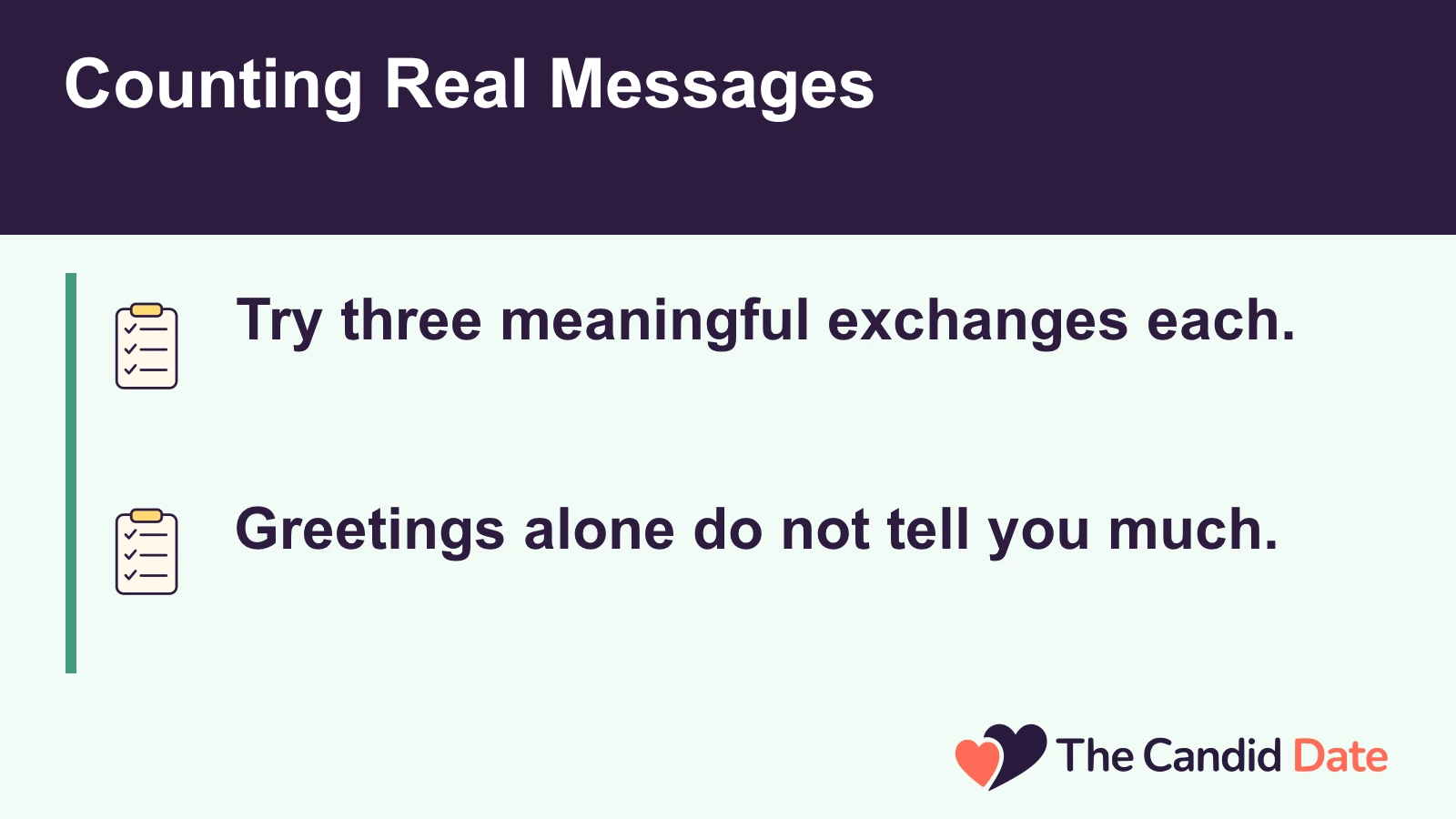
The rule only works if both people agree on what a message is. For counting purposes, a real message does at least one of three things: it responds to something specific the other person said, it shares a concrete detail about you, or it asks a question that takes more than one word to answer. A message can be short and still count.
"That trail is in the Gorge, right? I got lost there last summer" qualifies because it reacts, adds detail, and invites a reply.
What does not count: openers like "hey," reactions like "haha" or a lone emoji, and one-word answers such as "nice" or "same." These are social grease, not conversation. If your thread is twelve messages long but ten of them are filler, you are still at zero.
Count only exchanges with substance, and count three from each of you, so six real messages total before the ask.
- Counts: a reply that references their profile, a photo, or their previous answer
- Counts: a question that needs a real answer, like favorite spots or weekend plans
- Counts: a short story or opinion that gives them something to respond to
- Does not count: hey, haha, thumbs-up reactions, or single emojis
- Does not count: polite one-word answers that end the thread
A Sample Three-Message Arc From Opener to Ask
Here is a hypothetical example of how the arc can look, using made-up people to show the rhythm rather than a script to copy. Message one from you: reference something in their profile and ask an easy question. "Your photo at that overlook is great. Was that a sunrise hike or a regular evening thing?"
They answer with a detail and toss a question back. That is one each.
Message two from you: react to their answer, add a related detail about yourself, and ask a follow-up. "Sunrise people impress me. I have done exactly one sunrise hike and spent it half asleep. Do you go every weekend?" They reply, maybe tease you a little, and share their routine.
That is two each, and the tone is warming up.
Message three from you: play along, then signal you are enjoying this. "Half asleep is generous. I mostly complained. But I would try again for the right view or the right company." They respond warmly.
Three each. The next message you send is the ask, and because the thread has momentum, it lands as a natural next step instead of a cold proposal.
From First Message to First Date: A Message-by-Message Timeline
Ask Templates That Are Specific and Easy to Decline
A good ask has three parts: a specific activity, a specific day, and an easy exit. The activity should be cheap, public, and short by design, around an hour, so saying yes feels small. The day should fall within the next week or so, which keeps momentum.
The exit is a short clause that makes declining costless, which makes it clear that a no will be respected. It does not guarantee a positive response.
- Coffee: "This has been fun. Want to continue it over coffee near you on Thursday after work? No worries if the week is packed."
- After-work drink: "I am enjoying this. Want to grab one drink Wednesday evening somewhere convenient for you? Totally fine if this week is crazy."
- Weekend walk: "You mentioned loving the riverfront. Want to walk it Saturday morning and grab a coffee after? Easy to reschedule if Saturday is bad."
- Casual-intent honesty line: "I like where this is going and I would rather meet than text forever. One drink this week? If your week is full, all good."
Treat these as molds, not lines to paste. Swap in something from your actual conversation, keep the clause that makes declining easy, and suggest a general area rather than naming an exact venue if you do not know their neighborhood yet. Specific beats open-ended because "we should hang out sometime" hands them the planning work.
A concrete offer is easy to accept and easy to decline, and either answer beats another month of small talk.
From Chat to Actual Date: Step-by-Step Scripts for Online Daters
When to Ask Sooner, and When to Wait Longer
Ask sooner than three messages when the window matters more than the count. If they mention they are only in town until Sunday, or you are both talking about a festival happening this weekend, suggest meeting around it. Also ask sooner if they clearly hint at it: "I never know when to suggest meeting on here" is an invitation.
And if the conversation is unusually warm in the first few exchanges, with fast replies and real banter, waiting for a quota can feel like stalling. The rule is a ceiling on dithering, not a mandatory waiting period.
Wait longer when the other person is a slow texter by nature, replying once a day but with substance; the count still works, it just takes more days. Wait through natural gaps like holidays or a stated busy week, picking up where you left off instead of restarting. And wait if anything feels off: answers that dodge basic questions, pressure to move off the app instantly, or stories that keep shifting.
Extra messages cost you nothing and buy information. The rule speeds up normal cases; it never obliges you to meet anyone before you feel ready.
If They Say Maybe or I Am Busy
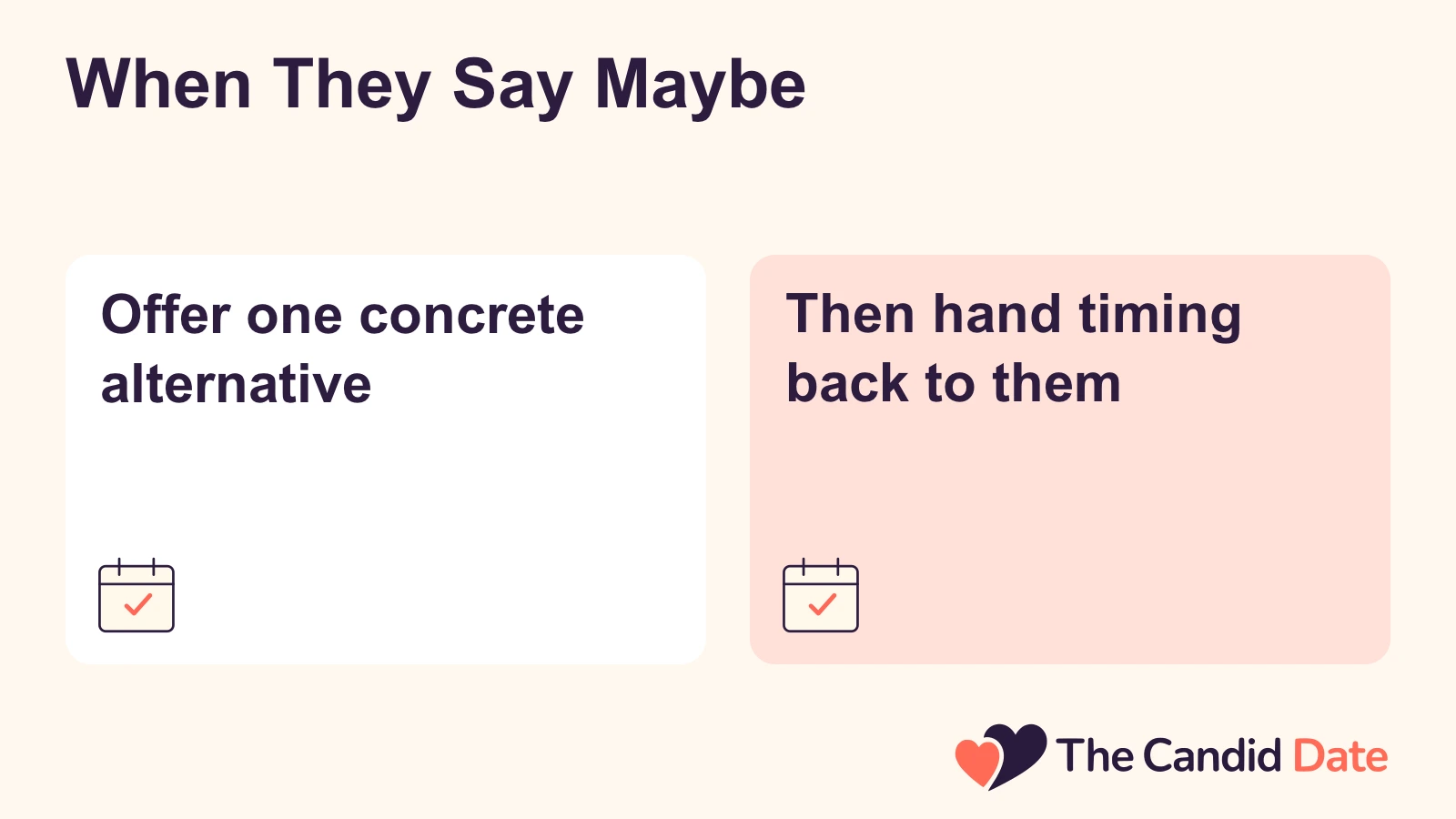
"Maybe" and "I am busy this week" are possible replies; neither establishes interest or disinterest by itself. Offer one alternative rather than guessing whether the issue is timing or interest. Your move is to counter exactly once with a concrete alternative, then hand the timing to them.
One counter shows interest; two starts to feel like pressure.
- If they say "maybe," shrink the size of the yes: "All good. We could keep it short, one coffee near you, thirty minutes. Thursday or Sunday?"
- If they say "busy this week," offer the next window: "No problem. How about early next week instead? Tuesday or Wednesday evening?"
- If they give no alternative back, close warmly: "Sounds like a packed stretch. Message me when your schedule opens up and we will plan something."
That last move matters. Once you have offered two options, stop. If they want to meet, they now have an open door and zero awkwardness walking through it.
If they never come back, you have your answer without a single uncomfortable follow-up.
Vague Answers, Topic Changes, and Silence
Sometimes the reply dodges the question entirely: you ask about Thursday, they answer with a joke about your last message, and the thread rolls on. Give it one clean clarify. "I will take that as a maybe! Are you up for meeting this week, or would you rather keep chatting here for now?"
This works because it names the fork in the road and makes either choice acceptable. Their response may clarify whether they want to meet or keep chatting, and you can decide whether a pen pal is worth your time.
Silence after the ask is the hardest version, but the rule for it is simple: do not double-text the question. Wait about a week. If the conversation was genuinely good, one light restart on a new topic is fine, rather than "so, Thursday?"
If that gets no reply, let it go. Ghosting after an ask stings, but it is information: without a response, you have no agreed meeting to plan around. You do not need to determine their private reasons to move on.
If They Say No: The Clean Exit
A clean no is a gift. It saves you weeks of wondering, and the way you receive it defines how the whole exchange feels in memory. Keep the reply to one or two sentences: acknowledge, wish them well, done.
"No worries at all, I appreciate the straight answer. Good luck out there." Then stop. Do not ask why, do not counter, and do not send a final paragraph about what they are missing.
Persistence after a clear no is not romantic; it tells the other person their answer does not count. The clean exit also protects you. Every hour spent relitigating a no is an hour not spent on the next good conversation.
Treat the rule as a filter: its job is to sort matches quickly into people who want to meet you and people who do not, and both results are useful.
Pacing, Comfort, and a Video Call Before Meeting
The rule assumes both people are comfortable with the pace, and comfort is personal. If you would rather talk on the phone or video chat before meeting, say so the same way you would suggest coffee: specific and easy to decline. "I like to do a quick video call before meeting in person. Ten minutes this week?"
They may agree, decline or suggest a different way to get comfortable. Their answer helps you decide whether there is a plan that works for both of you.
Boundaries are about what treatment and pace feel acceptable to you, and they apply to your own choices as much as anyone else's. If a match pushes to meet faster than you want, or resists a public daytime first meeting, that is useful information, not a challenge to overcome. Meet somewhere public, tell a friend the plan, and arrange your own transport.
The three-message rule is a tool for momentum; your comfort level sets the speed limit, and you can decline any meeting that would require ignoring your own boundaries.
This Video Dating App Helps Singles Find Real Chemistry Fast
Sponsored placement


Looking for adults who share your casual intent?
AdultFriendFinder is an optional adult-focused service for casual connections. Check the available profiles and paid communication limits before deciding whether to subscribe; local availability has not been verified.
- Adult-focused casual connections
- Basic free access; paid communication tools
- Check the current subscription conditions
| User Base | Today’s Deal |
|---|---|
| Adults with explicit casual or sexual dating intent | Free basic access; communication upgrades cost extraCheck the current total charge, auto-renewal and any add-ons before subscribing. A membership does not guarantee a meeting. |
Frequently Asked Questions
Does the three-message rule work on every dating app?
Yes, as a pacing principle rather than a rigid count. Prompt-based apps give you plenty of material, so three substantive exchanges each is realistic. Sparse swipe-app profiles may need one extra exchange to find common ground, and apps with built-in video can substitute a quick call for one round of messages.
The constant is momentum: count meaningful exchanges, then make a concrete offer with a day and an easy exit. Adjust the count to the platform, not the habit of asking.
Should I exchange phone numbers before suggesting a date?
It is not required, and plenty of people prefer to keep planning inside the app until a date is set, then swap numbers for day-of logistics. If a match asks for your number early and you are comfortable, share it. If not, suggest planning in-app and swapping once the date is confirmed.
Treat the number as a preference, not a step in the rule. The ask itself works fine in the app where the conversation already lives.
What if they ask me out before three messages?
If you are interested, say yes. The rule is a ceiling on waiting, not a floor you must reach before anyone is allowed to suggest meeting. If their invitation is vague, add the specifics yourself: "Yes, I would like that. Thursday evening works for me, somewhere near downtown?"
Accepting early is not breaking the rule; it is the rule working faster than expected. The only reason to slow down is your own comfort, which always outranks any message count.
What to Do Next
The three-message rule works because it converts a vague intention into a small, specific offer while the conversation still has energy. Count six substantive exchanges, three from each of you, then ask with an activity, a day, and an easy way out. Counter a maybe once, clarify a dodge once, accept a no gracefully, and let silence close the file.
Adjust the pace for slow texters, travel windows, and your own comfort, including a video call first if that feels better. Momentum plus respect is the whole method. The next time a match makes you smile, do not let the thread become a pen-pal memoir; send the ask.
About the Author
By: Gabriel Roberts
Contributing Expert
Gabriel Roberts is an online dating expert sharing match strategies on thecandiddate.com.
Share the Knowledge!
Our dating experts work hard to show you the best dating sites. Want to show your appreciation? Share this page!