
Why you keep getting stuck in the talking stage


Key Takeaways
A five-question self-check helps you compare your wish to meet with the plans and conversations actually happening.
Different stalls need different words: an app match, a flirty friend, and a plan-dodger each call for their own low-pressure script.
An agreed plan, an unclear answer and no reply leave you with different practical choices; none reveals private feelings.
Exit with one clean message instead of ghosting, and spend your energy on people who make concrete plans.
The talking stage is supposed to be a bridge, not a place to live. If you have been texting or messaging someone for weeks with no date, no definition, and no momentum, something specific is stalling it, and that something has a pattern you can identify. The patterns below can help you choose a low-pressure next step, including when to stop pursuing the conversation.
This guide expands on the classic reasons talking stages stall, helps you figure out which version you are actually in, gives you wording matched to your situation, and shows you how to read whatever reply you get. By the end, you will know whether to advance or walk away, without burning more weeks on a chat that is going nowhere.
Is This Still a Talking Stage, or a Stalled One?
A healthy talking stage has direction. The conversations get more personal over time, plans get suggested and actually happen, and each of you occasionally initiates. A stalled one has rhythm without progress: the messages keep coming, but every week looks exactly like the last.
Before you diagnose the other person, run a quick self-check, because sometimes the stall belongs to both of you. Answer these five questions honestly, ideally by scrolling back through your actual chat history rather than going on feeling.
- Has either of you proposed a specific plan with a day and place in the last two weeks?
- When plans get mentioned vaguely, does anyone follow up, or does the topic quietly die?
- Who initiates conversations, and would the chat exist at all if you stopped starting it?
- Do you know more about this person than you did three weeks ago, or is it the same small talk?
- If nothing changed for three more months, would you feel fine about that or quietly resentful?
If your answers show no concrete plans and you want to meet, you have a practical mismatch to address. This checklist is not a validated test or a rule about how quickly adults should date. Two weeks and three months are illustrative review points.
Ask what you want to happen next, then compare that with what both people have actually agreed. The following sections describe possible patterns and ways to discuss them; they cannot establish the other person’s reasons.
When Neither of You Will Ask
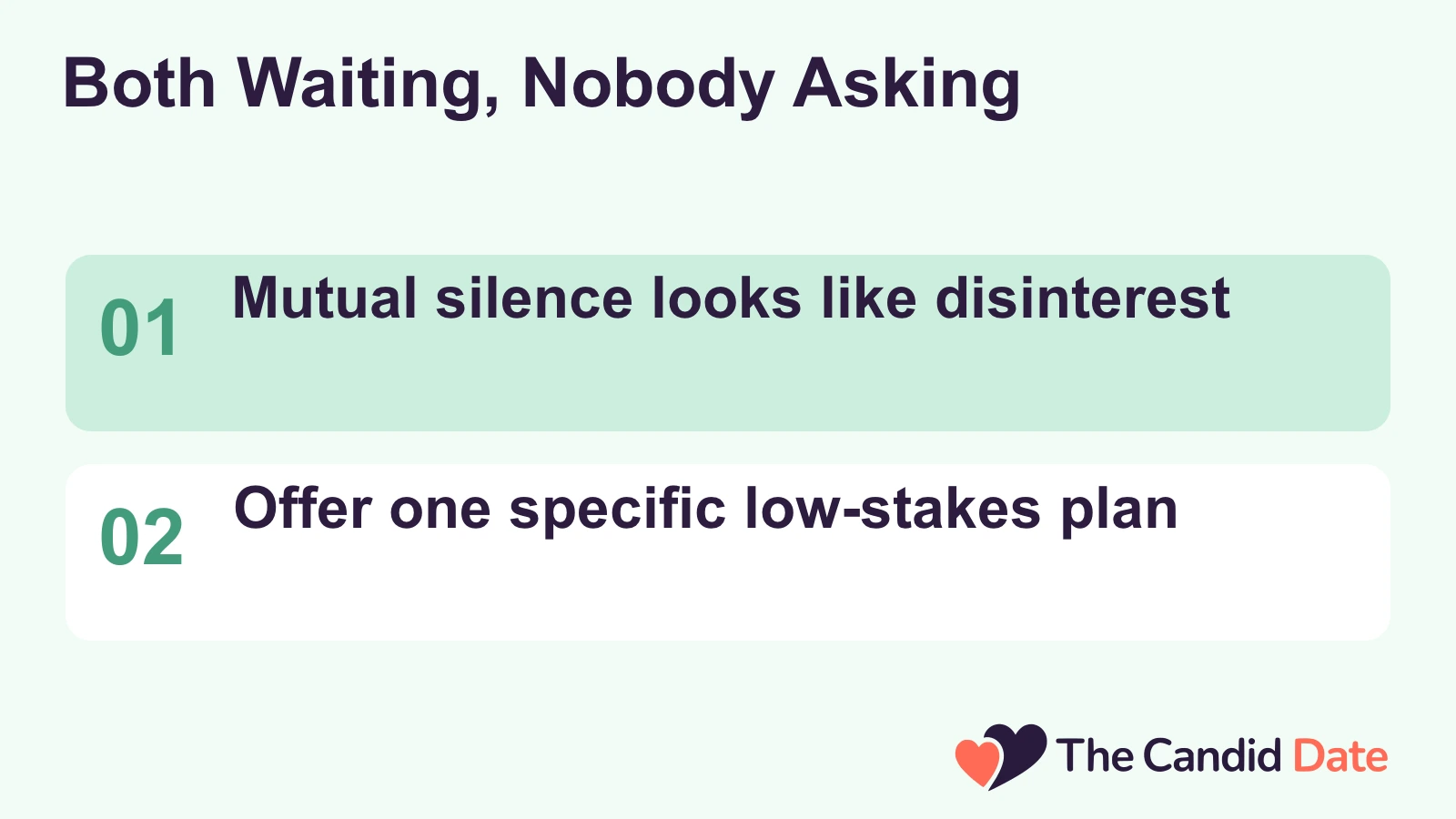
One possible stall is that neither person has proposed meeting. Picture a hypothetical exchange: two adults matched on an app, chat every evening and both wonder whether to suggest coffee. Each may fear rejection, or one may simply enjoy chatting; you do not know without asking.
Read back the conversation and distinguish a specific invitation from a joke about meeting someday. If nobody has asked and you would like a date, you can make one small proposal rather than treating the lack of an invitation as evidence of indifference.
Keep the invitation clear and easy to decline. You do not need a speech: "I enjoy talking with you. Want to grab coffee this weekend and see if this works in person?" A yes still needs practical details, including a mutually convenient time and place.
A no should be accepted. If the answer is unclear, decide whether you want to offer one alternative or leave the next move with them. Asking creates an opportunity to agree on plans; it does not guarantee that the talking stage will end.
When Your Plans Remain Unconfirmed
Another possible pattern is warm replies without an agreed time to meet. In a hypothetical exchange, you suggest Saturday, they say they might have another plan, and by Monday you are chatting again without a decision about the date. They might be busy, unsure, interested in another arrangement, or comfortable with messaging alone.
None of those explanations is established by a warm reply. Your observable problem is simpler: you want to meet and there is still no plan. You can address that without accusing them of keeping you as an option.
If someone mentions other dates, you can ask what that means for your connection rather than interpreting the remark as a ranking. Our advice column discusses a similar question, although your own situation may differ. Try: "I would like to take you out this week. Would Thursday work? It is okay to say no."
If no plan follows, you can stop pursuing one. A clear invitation and your own limit on repeated requests are more useful than trying to prove someone’s motives from hints.
why a date keeps mentioning other people they are seeing
When Texting Has Become the Relationship
Messaging can become the whole connection even when you originally hoped to meet. Daily greetings and late-night conversations may feel meaningful to you, but neither establishes a shared intention to date. You may enjoy the exchange as it stands, or you may want something different.
Separate those two questions: is chatting enough for me, and have we both agreed whether we want to meet? That gives you a concrete conversation instead of requiring a theory about whether the other person is lonely, anxious or avoiding intimacy.
You could suggest a phone or video call if both would prefer that before meeting: "We have been texting a lot. Would you like a quick call this week?" A good call may lead to a date if you both want one, but it need not. If they decline, respect it and decide whether a texting-only connection suits you.
A call does not verify someone’s identity or safety. Keep ordinary precautions for any first meeting, and do not treat a refusal to call as proof of a particular hidden motive.
Fast, Flirty, and Never Available: Reading the Dodger
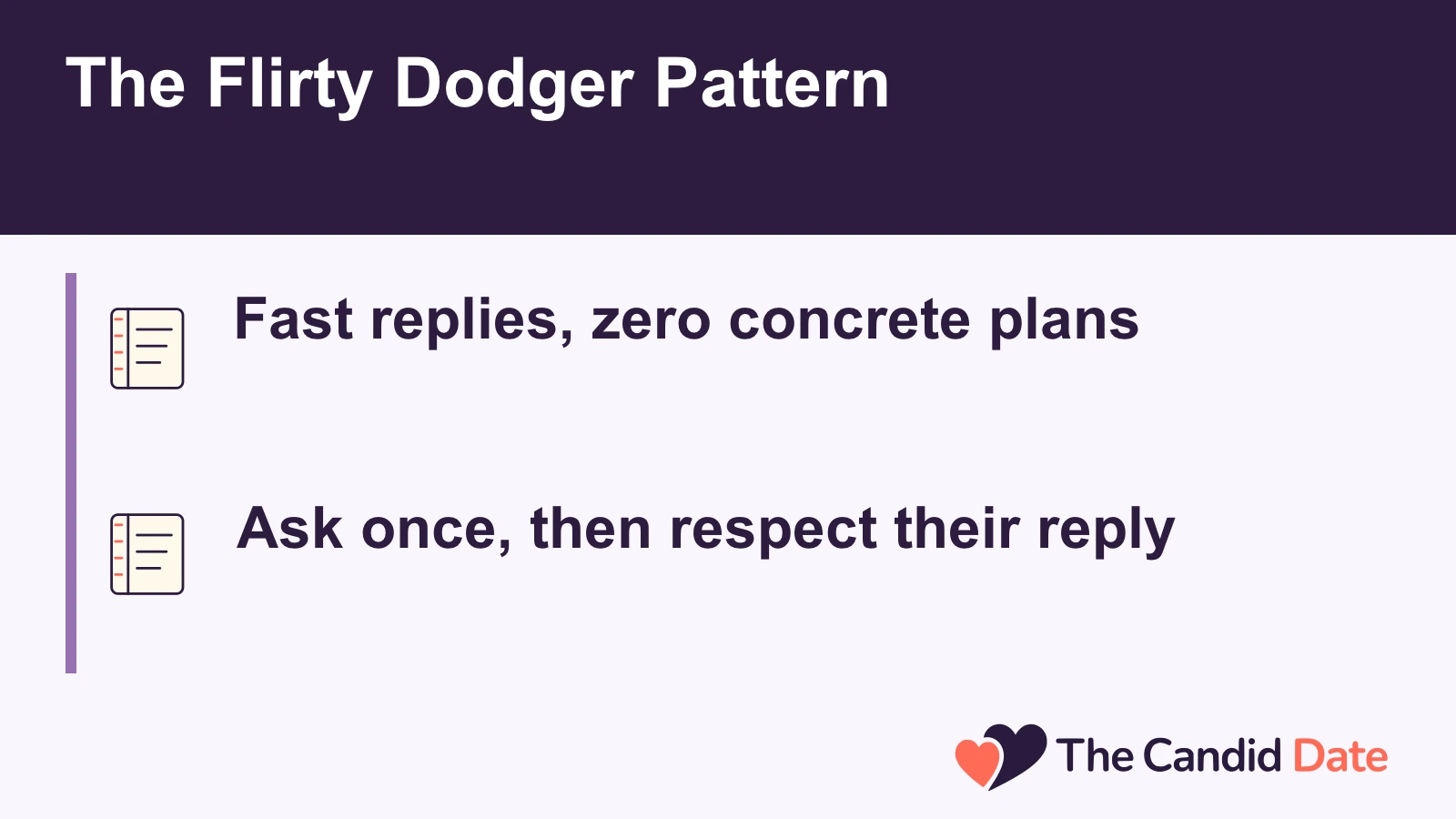
Fast, flirty replies can feel encouraging while practical invitations remain unanswered. Imagine asking about a drink on Thursday and receiving only a joke in reply. You know that the plan has not been confirmed; you do not know whether the joke reflects hesitation, distraction or a preference for chatting.
Compare the messages with what you actually need. If you want to meet, another compliment does not substitute for agreeing on a time. You can enjoy the conversation and still decide that it is not moving toward the kind of dating you want.
- They respond to energy and humor instantly, but logistics messages get ignored or answered late.
- Every plan you suggest gets a warm but slippery reply with no counter-offer of another time.
- They reappear right when you start pulling back, with just enough charm to reset the cycle.
- Weeks pass and you could not name a single plan they personally initiated.
Ask clearly once: "Would you like to meet Thursday at seven? No pressure if that does not work." A counter-offer gives you a possible next plan, not proof of romantic intent. A refusal should end the request.
If the reply remains unclear, you can leave the next move with them or decide to step back. No wording forces an answer, and your decision does not require labeling the other person a dodger.
How to Ask Without Sounding Intense or Demanding
The fear of coming on too strong keeps many people silent, so it helps to have wording that fits your exact situation. The principles are the same: reference something real from your conversations, propose one specific low-cost plan, and leave an easy exit. For an app match you have never met, tie it to shared context: "You mentioned you judge every taco place in town. There is a spot I need a verdict on. Thursday?"
For a friend who has drifted into flirty texting, acknowledge the shift lightly: "Our texts have gotten suspiciously fun lately. Want to make it an actual dinner and see what's going on here?"
Notice what neither script does: apologize, over-explain, or ask for a relationship. You are proposing a date, not a commitment, and framing it that way keeps the pressure low for both of you. One more practical note for app daters: you can review whether your profile accurately shows you and what you want, without assuming it caused someone’s reply.
Our interview with professional photographer Karen Vaisman explains how to choose clearer, current profile photos.
choosing clearer, current profile photos
Send It, Then Read the Reply: What Each Response Means
After you ask, separate the reply from your interpretation of it. An agreed time and place give you a plan to confirm. A vague answer leaves the plan unconfirmed.
No reply gives you no agreement to meet. These are practical differences, not a way to read someone’s feelings. If you do make a date, prepare for an ordinary public first meeting rather than treating an enthusiastic message as a promise about the relationship.
- An agreed time or a concrete alternative: confirm details that work for both of you.
- An unclear answer: you may say "No pressure; let me know if you would like to plan something," then leave the next move with them.
- No reply: you may step back, or send one optional follow-up after several days if you want to account for a missed message. Respect a refusal and stop repeated requests.
Choose your own limit on waiting rather than using a fixed number of days to measure interest. If repeated chats leave you wanting plans that never happen, you can reduce contact or say that a texting-only connection does not suit you. You do not have to prove why the other person is unavailable before making that choice.
The optional follow-up is for clarifying logistics, not for pressuring them into a date.
preparing for a safer public first meeting
When to Cut Your Losses and Exit Cleanly
There is no universal deadline for a talking stage, but there are reliable conditions for ending one. Walk away when you have made one clear ask and received a dodge or silence, when you are doing all the initiating, when weeks of contact have produced zero concrete plans, or when you notice you feel anxious rather than excited about the person. Leaving a stalled arrangement gracefully is its own skill, and it helps to treat your limits as boundaries, which can be emotional, physical, or digital, rather than as accusations the other person has to answer for.
You do not owe a long explanation, but a short message beats ghosting: "I've enjoyed talking with you, but I'm looking for something that's moving toward actually meeting, and this doesn't feel like it is. Wishing you well." Then stop engaging, kindly and completely. Afterward, put the freed-up attention somewhere useful.
If the experience has left you drained, our piece on getting back into online dating after time away covers how to re-enter deliberately, with one app and a clear sense of what you want, instead of numbing out on five.
getting back into online dating deliberately after time away
Sponsored placement


Looking for adults who share your casual intent?
AdultFriendFinder is an optional adult-focused service for casual connections. Check the available profiles and paid communication limits before deciding whether to subscribe; local availability has not been verified.
- Adult-focused casual connections
- Basic free access; paid communication tools
- Check the current subscription conditions
| User Base | Today’s Deal |
|---|---|
| Adults with explicit casual or sexual dating intent | Free basic access; communication upgrades cost extraCheck the current total charge, auto-renewal and any add-ons before subscribing. A membership does not guarantee a meeting. |
Frequently Asked Questions
Is it ever okay to just stay in the talking stage?
Yes, if both people genuinely want a slow pace and there is still visible momentum, such as plans being made and conversations deepening. It also makes sense during real constraints, like a demanding work season or an upcoming move, as long as both of you know the situation and have talked about it. The problem is not slowness; it is a stall that one person is quietly enduring.
If you are content, stay. If you are waiting and hoping, that is a stall, and it deserves a conversation rather than more patience.
What if they say they are not ready for anything serious?
Take the statement at face value and decide what it means for you, not for them. Some people say it because they want something casual, and that is a legitimate choice if you genuinely want the same thing. The mistake is hearing it as a challenge to change their mind by being patient and wonderful.
If you want a relationship that progresses, someone telling you they do not is useful early information. Thank them for the honesty, and either adjust your expectations honestly or step away before the attachment deepens.
Should I send a follow-up if they went quiet after I asked them out?
One optional follow-up after several days can clarify whether a message was missed, provided the person has not declined or asked you to stop. Keep it simple: "No worries if the timing is off; let me know if you would like to plan something." If there is still no reply, stop asking.
Silence does not reveal their private reasons, but it does leave the plan unconfirmed, and you can redirect your attention without a final explanation.
What to Do Next
Use the self-check to name what you want and compare it with the plans actually agreed. If you would like to meet, send one specific invitation with room for a no. Confirm an agreed plan, respect a refusal and choose your own limit when no agreement follows.
You do not need to solve someone else’s motives before deciding whether the connection suits you. The goal is a next step you can take respectfully, not a test that guarantees the talking stage becomes a relationship.
About the Author
By: Scarlett Walker
Lifestyle Writer
Scarlett Walker is a lifestyle writer helping readers navigate healthy relationship communication on thecandiddate.com.
Share the Knowledge!
Our dating experts work hard to show you the best dating sites. Want to show your appreciation? Share this page!