
Red flags that tend to show up in the first two weeks


Key Takeaways
One incident is information; repetition plus a poor response makes a pattern.
Name one concern briefly, then judge the behavior that follows.
You can leave a two-week connection without proving intent or winning a debate.
The first two weeks of dating can be unusually informative because you can compare early plans, communication and responses to limits before you have a long shared history. A single awkward message, reschedule, or clumsy answer is not a verdict. A repeated behavior that costs you time, comfort, or clarity deserves attention.
This expanded guide keeps four early patterns from the original article: moved plans, rushed intensity, sweeping stories about former partners, and resistance to a reasonable boundary. For each one, you will get concrete examples, a fair alternative explanation, and the condition that makes it a pattern. You will also get one low-stakes test, short scripts, a simple decision rule, and a calm way to leave.
Why the first two weeks can be so revealing
Early dating has a useful imbalance: people are trying to make a good impression, yet the practical routines around communication, punctuality, curiosity, and respect still leak through. Later, familiarity can make you explain away behavior because you have shared history. At two weeks, you have less to protect, so it can be easier to compare what someone says with what they repeatedly do.
Treat the window as a prompt to observe, not as a deadline for judging character. Notice whether problems are specific or global, whether they repeat under ordinary conditions, and whether the other adult can discuss them without punishing you. The goal is not to catch someone being imperfect.
It is to learn how they handle normal friction while the stakes are still small.
Write down what was said, what happened, and what followed so one conversation stays factual.
Common Red Flags to Watch for When You’re Dating Someone
A bad week versus a repeated pattern
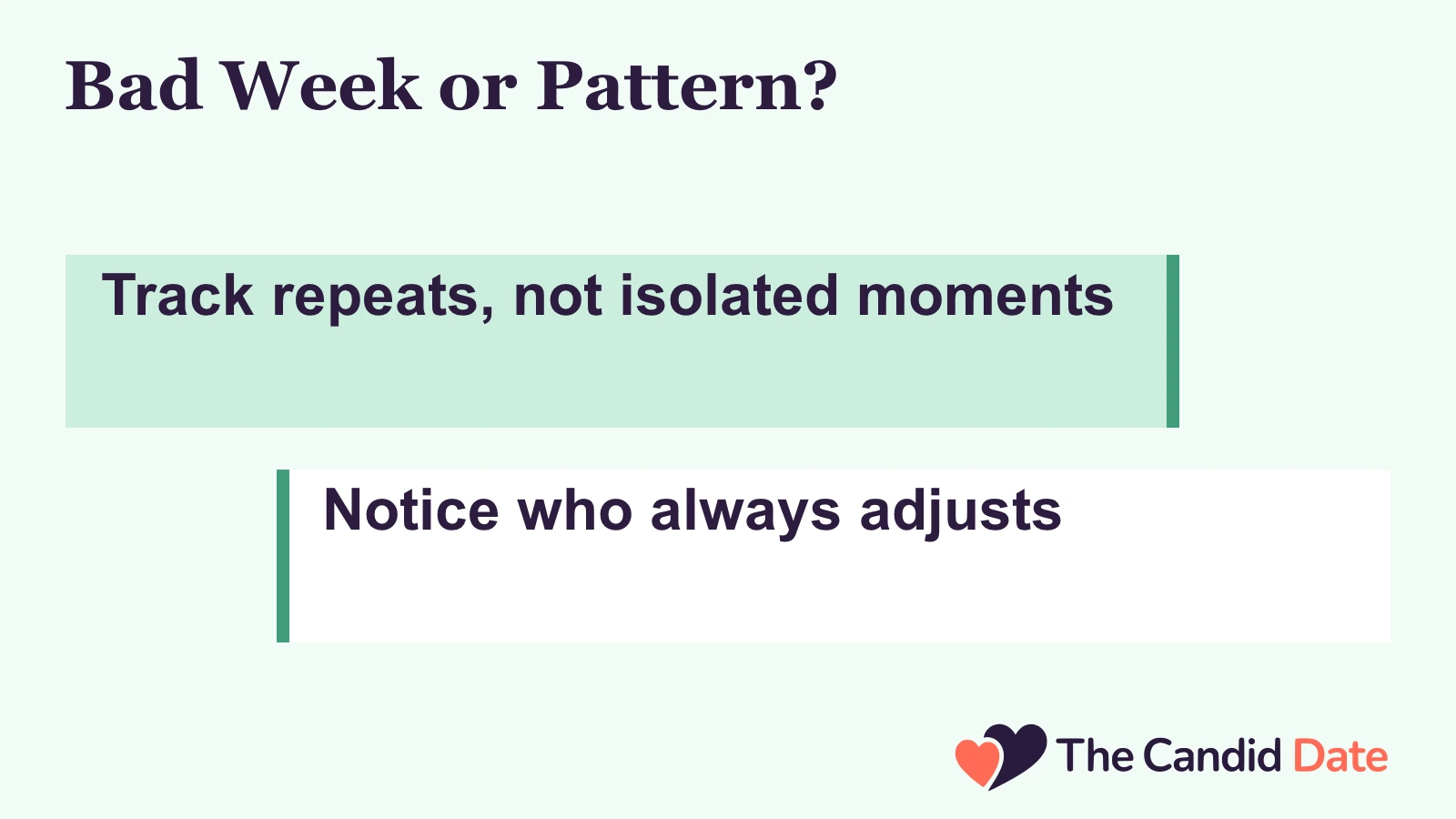
A bad week usually has a specific cause, a proportionate explanation, and some effort to repair the inconvenience. A pattern has repetition, asymmetry, and a poor response when you name it. Frequency matters, but so does direction: if you are always the person rearranging, apologizing, or waiting, the issue is larger than one event.
- One instance: record what happened without assigning motive.
- A fair explanation: specific, believable, and followed by changed behavior.
- A repeat: the same cost appears again, even if the excuse is different.
- A useful response: they acknowledge the impact and offer a concrete repair.
Do not demand proof of intent. You rarely can know why an adult acted a certain way, and you do not need a diagnosis to decide whether the dynamic works for you. Ask a narrower question: after this happened once, did their next choice reduce the problem or recreate it?
Plans that keep getting moved, always by them
Hypothetical example: on Thursday they write, “So sorry, work exploded. Can we move tomorrow to next week?” Once, with a proposed replacement, that may be ordinary life. By the second or third move, notice whether they supply a concrete alternative or leave you to reopen the calendar.
The benign version includes a real constraint, an apology that names your inconvenience, and a new time that they initiate. The concerning version keeps the connection technically alive while making its progress optional. If every adjustment protects their schedule and every repair depends on your flexibility, you are not looking at isolated bad luck.
Respond once with clarity: “I’m still interested, but I don’t want to keep reshuffling. If Tuesday works, let’s confirm; otherwise, let’s leave it here.” Their answer gives you information without requiring an argument. A reliable adult may decline, but will not make you feel needy for wanting a time that holds.
5 Red Flags of a Low-Effort Match (and How to Stop Wasting Time)
Intensity that runs ahead of knowing you
Early enthusiasm can feel flattering, especially if dating has felt slow. It becomes worth examining when the emotional volume exceeds the information they could realistically have about you. Hypothetical messages include “I’ve never felt this connected” after one date or repeated “Where have you been?” when you do not reply quickly.
A harmless version is nervous excitement paired with respect for pace. They can hear “I like this, and I want to go slowly” without sulking, bargaining, or escalating. The patterned version treats your pace as an obstacle: daily pressure for constant contact, immediate future planning, jealousy framed as devotion, or disappointment whenever you have a separate life.
Try naming pace once: “I’m enjoying this, and I’m not ready for daily calls or big labels yet. I’d like to keep getting to know each other.” A considerate answer adjusts. An answer that says you are cold, damaged, or wasting their time turns intensity into control.
When every former partner was “crazy”
One painful breakup can produce a harsh story. The concern starts when every former partner is described as unstable, vindictive, or impossible, while the storyteller never had any part in the conflict. Listen for a complete absence of ordinary complexity: no regret, no lesson, no mismatched needs, and no acknowledgment that another person may remember events differently.
Hypothetical example: they say, “My last three exes were crazy, so I hope you’re normal.” If that becomes their main account of relationship history, the label matters less than the pattern of blame and contempt.
You do not need to interrogate their past. Ask a neutral question such as, “What did that relationship teach you?” or “What would you handle differently now?” A reflective person can usually describe one contribution without performing shame.
Someone who mocks the question or turns it into another attack is showing you how accountability works for them.
7 Green Flags That Your Date Is Emotionally Available
Pushback after one reasonable boundary
A boundary is a statement of what you will do to protect your comfort, not a command designed to control another adult. Boundaries can involve emotional, physical, and digital comfort. A reasonable early example is “I’d rather meet in public” or “I’m not ready to share my address.”
Hypothetical pushback sounds like “Wow, you must have trust issues,” followed by repeated requests after you declined once. Another version is immediate punishment: shorter replies, sarcasm, or withdrawal until you reverse yourself. The problem is not that they feel disappointed.
It is that they try to make disappointment expensive for you.
Watch what happens after a plain restatement: “I understand that is disappointing, but my answer is still no.” A respectful adult may ask questions, offer an alternative, or decide the fit is wrong. Someone who debates your right to have the limit is giving you information you can act on now.
Run one low-stakes boundary test
If you are unsure whether you are overreading a moment, state an actual small preference rather than inventing an experiment. The aim is to communicate what you want, not trick someone into a reaction. You are observing how both of you handle everyday preferences before attachment makes the answer feel costly.
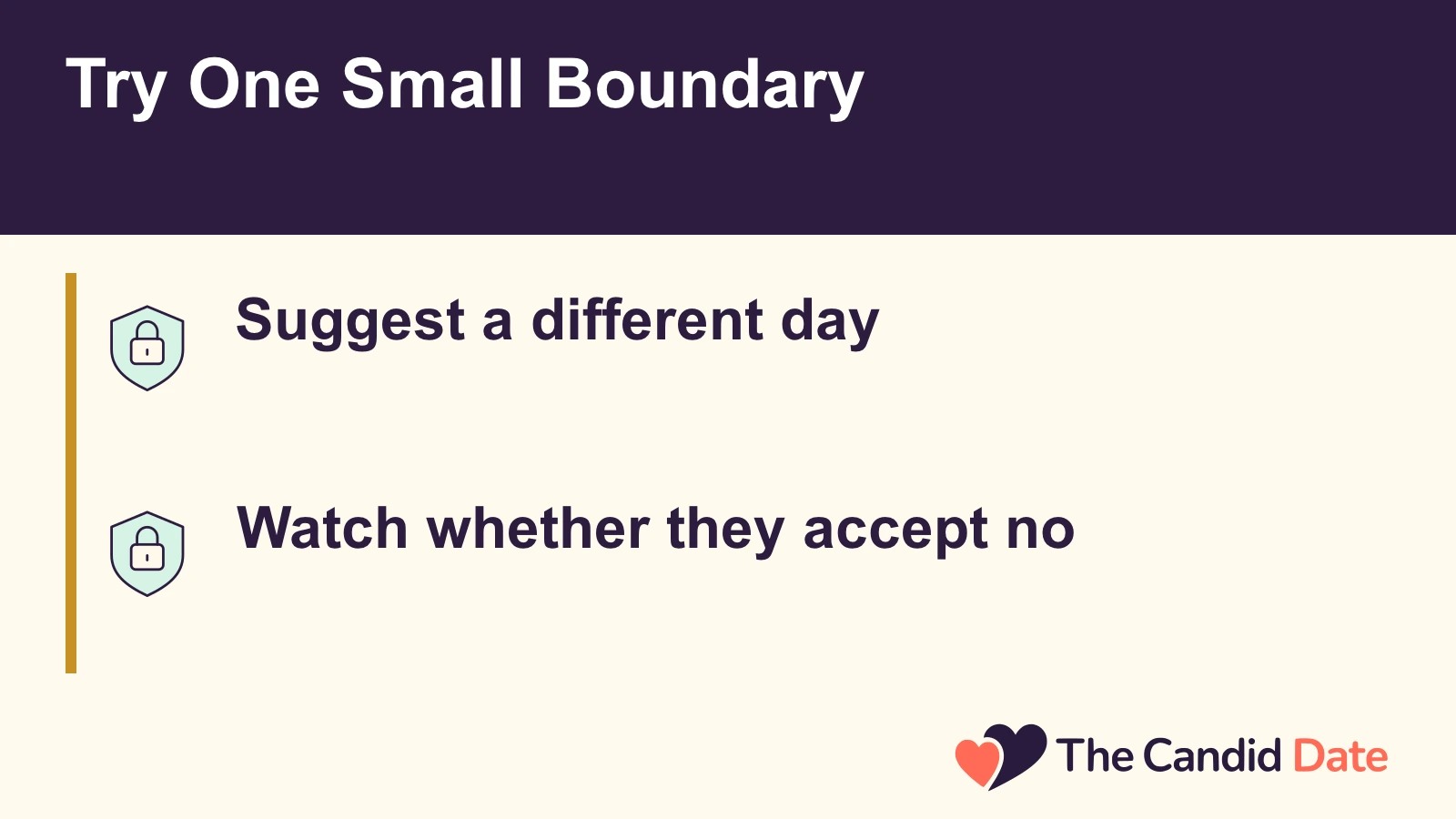
- Suggest a different day instead of accepting a time that does not work.
- Say you prefer an afternoon coffee rather than a late-night visit.
- Decline a phone call and offer a specific time tomorrow.
- Ask them not to tag your location or post your photo yet.
The result is not whether they agree with your preference. It is whether they can tolerate it without ridicule, pressure, or a counterattack. “No problem, Saturday works” is useful information.
So is “Why are you being difficult?” repeated after a simple request. State the preference once, note the response and leave room for an ordinary discussion. Do not use a hidden test to grade someone.
Scripts for naming the concern once
A good early script is brief, factual, and open to explanation. It does not accuse the other person or demand proof. Try: “I’ve noticed our last two plans changed at the last minute. I’m still interested, but reliability matters to me. What can we do differently?”
For intensity: “I like spending time with you, and the pace feels faster than I want. I need more space between dates.” For former partners: “I’ve noticed a lot of contempt when past relationships come up. I’m more comfortable when we focus on what each of us learned.”
A healthy reply may include surprise, embarrassment, or a question, but it should address the specific concern. “I didn’t realize I was doing that. I’ll stop sending so many messages during work” is responsive. “You clearly aren’t ready to date” shifts the burden back onto you.
Judge the next behavior as well as the wording.
How many repeats before you act
Use a simple tally: once, note it; twice, name it; after a repeated pattern or a dismissive response, act on it. Acting does not have to mean a dramatic breakup. It can mean declining the next date, slowing contact, or ending the connection.
The point is to stop investing as though the concern has already been resolved.
Severity changes the rule. If someone threatens you, ignores a clear physical no, or appears uninvited, choose distance and practical safety first. You do not owe another experimental repeat.
For lower-stakes annoyances, fairness may allow a test, but it does not require unlimited chances.
A useful decision sentence is: “I have seen this twice, I described it plainly, and the response did not reduce the problem.” If that sentence is true, you have enough information for your own decision, even if someone else would wait longer. You are allowed to leave over a mismatch, not only over a verdict.
5 Green Flags of a Relationship That Lasts
Leaving calmly after about two weeks
You can end a brief connection without presenting a courtroom case. Try: “I’ve enjoyed getting to know you, but I don’t think the fit is right for me. I’m going to step back, and I wish you well.” If useful, add one sentence naming the repeated issue.
Send it once, then stop negotiating. You do not have to answer every objection, disprove their interpretation, or stay available until they agree with your decision. If they respond respectfully, a brief thank-you is enough.
If they insult, pressure, or bombard you, silence and blocking can be a boundary rather than cruelty.
When you met through friends or share logistics, keep the message factual and avoid recruiting allies. If safety is a concern, prioritize distance and support over politeness. A calm exit is not harsh; it is the purpose of early dating.
You gathered information and left before the cost grew.
Sponsored placement


Looking for adults who share your casual intent?
AdultFriendFinder is an optional adult-focused service for casual connections. Check the available profiles and paid communication limits before deciding whether to subscribe; local availability has not been verified.
- Adult-focused casual connections
- Basic free access; paid communication tools
- Check the current subscription conditions
| User Base | Today’s Deal |
|---|---|
| Adults with explicit casual or sexual dating intent | Free basic access; communication upgrades cost extraCheck the current total charge, auto-renewal and any add-ons before subscribing. A membership does not guarantee a meeting. |
Frequently Asked Questions
What if the behavior only happens when they drink?
Context can explain a moment, but it does not erase the impact. If every reschedule, sexual push, or cruel joke follows drinking, that is still a repeated pattern rather than a random mystery. You do not need to decide whether alcohol caused it.
Notice whether they acknowledge the impact, change the conditions, and behave differently next time. If the same problem returns whenever alcohol is involved, you can decide that this version of dating does not work for you.
What if my anxiety makes me see red flags everywhere?
Separate the observation from the interpretation. Write down only what happened: “They canceled twice,” not “They are probably manipulating me.” Then identify what you need next, such as reliability, space, or clarity.
A trusted adult friend can help check whether the facts match the concern, but they do not get the final vote. If your body feels unsettled even after responsive behavior, slow the pace rather than forcing certainty. You can protect yourself without declaring the other person dangerous.
Do I owe them a reason if I decide to stop dating?
A brief, honest reason is often courteous after several dates, but you do not owe a debate or a detailed defense. “I don’t think the fit is right for me” is complete. If the person has pressured, threatened, or repeatedly ignored boundaries, you may skip the explanation and prioritize distance.
Avoid inventing a partner, lying about moving, or manufacturing an excuse; unnecessary deception tends to invite more negotiation. Say less, stay consistent, and let the decision stand.
What to Do Next
The first two weeks are not a deadline for certainty. They are a chance to observe how an adult handles plans, pace, accountability, and a small no while the cost of leaving is still low. Keep your attention on repeated behavior, not imagined motives.
Name one concern plainly if the connection seems worth clarifying, then watch whether the response reduces the problem. If the same pattern returns, trust the evidence you already gathered. You can decline another date without proving that the other person is terrible.
A calm, early exit leaves your time and confidence available for a better fit.
About the Author
By: Kenji Takahashi
Women's Dating Expert
Kenji Takahashi is a Women's Dating Expert at thecandiddate.com, writing women's dating guides.
Share the Knowledge!
Our dating experts work hard to show you the best dating sites. Want to show your appreciation? Share this page!