Coming out on your dating profile: when and how


Key Takeaways
There is no deadline for coming out on a dating profile; the right choice depends on your safety, outness, and dating goals.
You can disclose through a direct bio line, the app's orientation and gender fields, or a private conversation after matching.
Concrete wording for common situations, plus scripts for the first chat, make disclosure easier to actually do.
Supportive, neutral, invasive, and hostile reactions each call for a different response, and you can change your approach later.
There is no single right time or right way to come out on a dating profile. What matters is that your choice fits where you actually are: how out you already are, how safe disclosure feels in your area, and what kind of connection you want. You have three workable options.
You can say it directly in your bio, you can let the app's orientation and gender fields carry the information, or you can wait and share it in conversation once a specific person has earned your trust. Each route filters your matches differently, and none of them is universally best. This guide walks through wording you can copy and adjust, the conditions that make each approach smarter, how app settings affect who sees your identity, the right moment to raise it in chat, what to do with every kind of reaction, and how to change your mind later without starting over.
Three ways to come out on your profile
Before you write anything, get clear on the three basic routes, because everything else in this guide builds on them. The first is a direct bio line: you state your identity in plain words near the top of your profile, and anyone who reads you knows before they swipe. The second is using the app's built-in identity fields, the dropdowns and tags for orientation and gender that most major platforms now offer.
This signals who you are to the matching system without requiring you to write a sentence about it. The third is private disclosure: your profile stays neutral, and you bring it up in conversation after you match with someone specific. Many people combine these, for example filling in the fields and adding one casual bio mention, or using the fields now and planning a fuller conversation later.
You are allowed to mix, adjust, and experiment.
- Bio line: maximum filtering, maximum visibility, best when you are out and want matches who already know.
- Identity fields: quiet but functional, helps the algorithm show you to the right people.
- In conversation: maximum control over timing, best when safety or privacy is the priority.
Profile lines you can adapt today
The most common sticking point is not deciding to disclose, it is staring at a blank bio box. These examples are original editorial suggestions, written to be short, warm, and ordinary, because your identity reads best as one fact about you rather than your entire profile. Adapt the tone to match the rest of your bio.
- For orientation: "I'm bi and looking to date women and nonbinary people."
- For orientation, lighter tone: "Queer, into hiking, bad puns, and people of more than one gender."
- For gender identity: "I'm a trans woman and open about it. Ask me about my dog instead."
- For gender identity, minimal: "Trans guy, been out for years, here for the same reasons as everyone else."
- For someone still questioning: "I'm still figuring out the right label, but I date men."
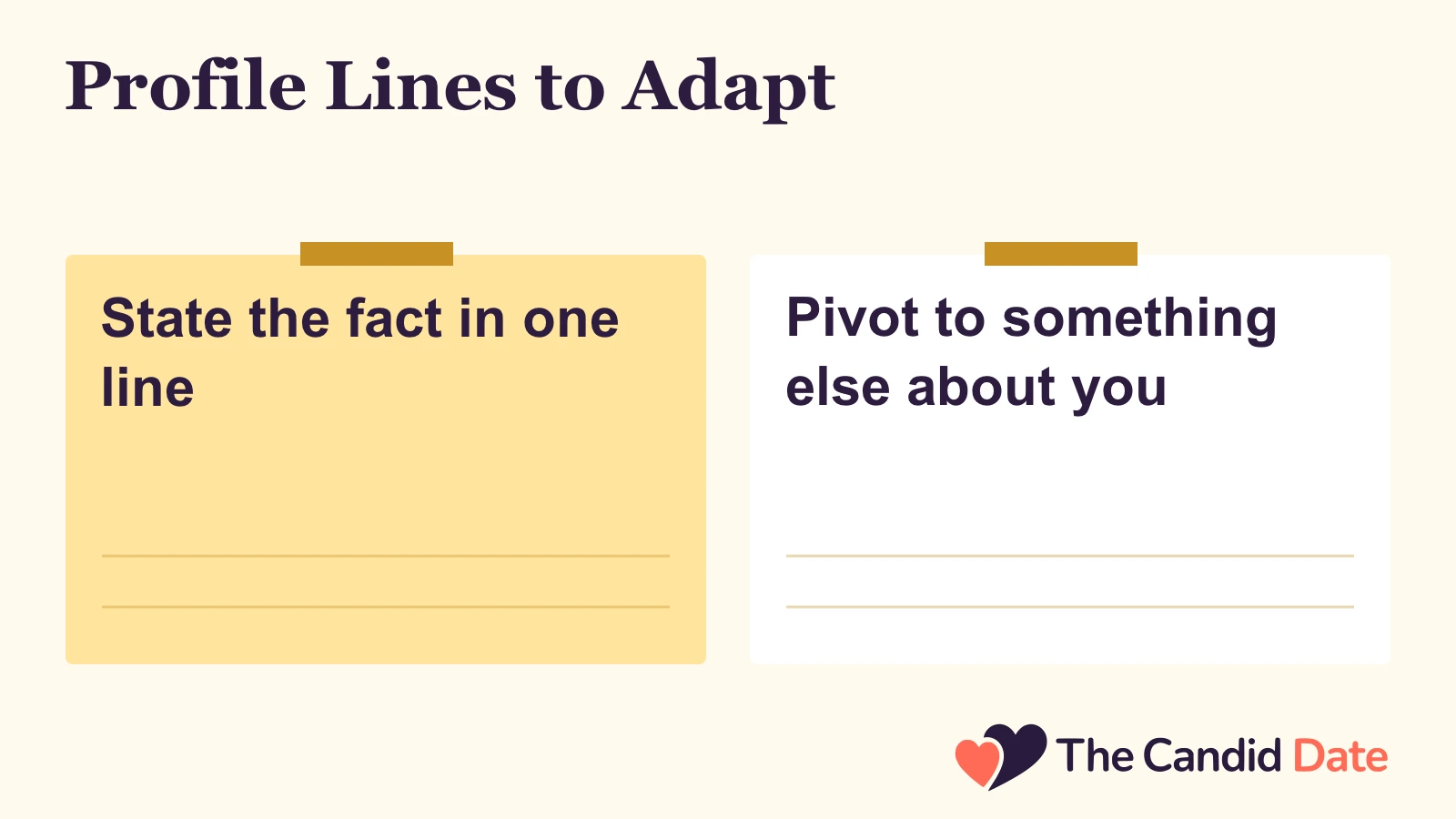
Notice what these lines do. They state the fact, and most of them immediately pivot to something else, which tells a reader that your identity is settled business for you, not a drama you are inviting them into. Avoid apologetic framing like "sorry if this is a dealbreaker" or defensive framing like "if that's a problem, swipe left."
Both signal that you expect rejection, and they make warm, accepting people feel like they are being scolded in advance. If you want to pair your identity with what you are looking for, add one plain clause: "I'm a lesbian looking for something real" works harder than three paragraphs of explanation. For broader profile structure beyond this one line, our full dating profile guide covers bios, photos, and first impressions in detail.
How to Write a Standout Dating Profile: The Full Guide
Choosing how visible to be
Now for the decision itself. Instead of asking "should I come out on my profile," ask five more useful questions and let the answers point you toward a route. There is no scoring system here; these are conditions to weigh honestly, and different answers will suit different people.
- Current outness: If friends, family, and coworkers already know, a public bio line costs you little. If you are out to almost no one, fields-only or private disclosure protects your offline life.
- Safety where you live: In some areas and some workplaces, a searchable public statement carries real risk. Discretion is a legitimate choice, not a failure of pride.
- Dating goals: If you want a relationship with someone fully comfortable with your identity, early disclosure filters faster. If you are dating casually and locally, later disclosure may cost you nothing.
- Desired visibility: Some people find public clarity affirming. Others find it exhausting to be read as a label before being read as a person. Both feelings are valid inputs.
- Pool size tolerance: A direct bio line shrinks your match pool but improves its quality. If you are in a small town where the pool is already tiny, fields-only keeps options open while you vet people individually.
A hypothetical example: imagine someone in a big city, out for a decade, looking for a partner. A bio line makes obvious sense. Now imagine someone in a rural area, newly questioning, whose employer is conservative.
Quiet fields plus in-chat disclosure is not cowardice, it is good judgment. Your answer can also differ by app; you might be fully out on a queer-focused platform and more circumspect on a general one.
How app settings shape who sees your identity
Identity fields and privacy settings do more work than most people realize, and they vary significantly between platforms, so check your specific app rather than assuming. Do not assume an orientation field changes matching or is hidden from readers. Read the app’s current field descriptions and preview your profile before relying on it.
Some apps let you display an orientation or gender tag publicly, keep it visible only to the algorithm, or hide it entirely; these are meaningfully different choices, and the default is not always the one you would pick. A few platforms let you restrict who can see your profile at all, such as only people you have already liked, which is useful if you are worried about being spotted by coworkers or family. Look for the app’s available blocking, reporting and verification tools.
Their availability and limitations vary; no badge or setting establishes that another person is safe. Before publishing, do a quick audit: view your own profile as a stranger would, confirm which fields are publicly displayed, and screenshot your settings so you remember what you chose. If you are building the profile from scratch, our guide to creating an online dating profile walks through platform choice and setup step by step, and the wider dating profile writing guide can help you make the rest of the bio as strong as this one line.
Build Your Online Dating Profile in 4 Simple Steps
Raising it in conversation, at the right moment
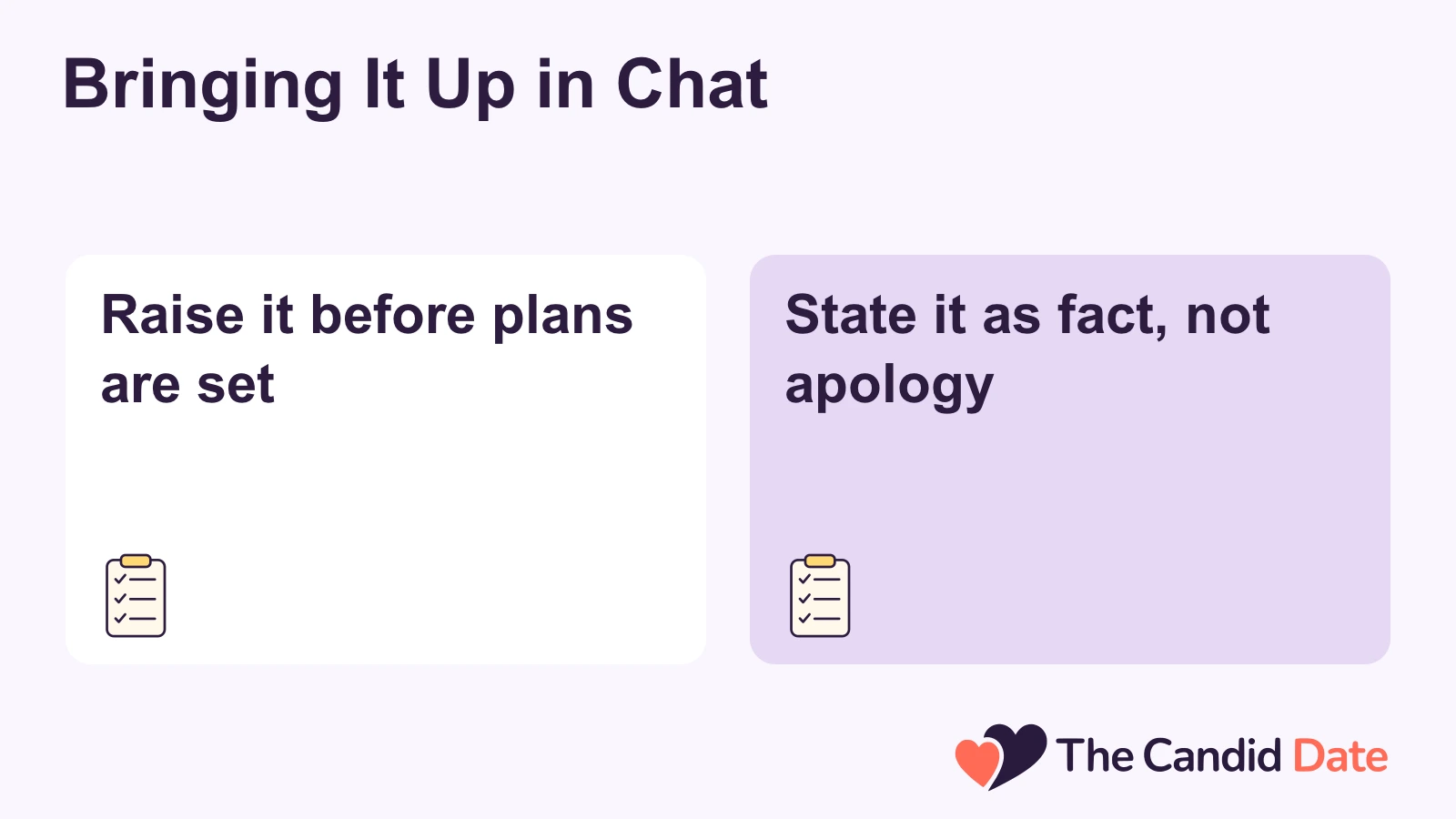
If you choose to disclose after matching, timing matters less than tone, but timing still matters. The sweet spot is after some genuine rapport exists and before emotional investment or a first meeting gets deep. Too early, like the second message, can feel like leading with paperwork.
Too late, like after several dates, can leave the other person feeling that relevant information was withheld, even though you owed them nothing on a schedule. A practical window: once the conversation is flowing and a meeting is being discussed, but before you actually agree on the day. Frame it as information, not confession.
You are sharing a fact about yourself, the same register as mentioning you have kids or travel often for work.
- Straightforward: "Before we meet, I want to be upfront that I'm trans. It's not a big deal to me, and I hope it isn't to you."
- Warm: "Something I like to mention early: I'm bi. Anyway, you were saying about the trail you hiked?"
- Low-key: "Fair warning, I date across genders. If that's new territory for you, no judgment either way."
- For questioning: "Heads up that I'm still figuring out my label, but I know I'm into men. Just like to be honest early."
Notice the shared structure: state the fact, signal that you are comfortable, and hand the conversation back. You are not asking permission to exist. If the topic feels bigger to you than one line, that is fine too; our piece on coming out as bisexual to a date goes deeper on reading the moment and your own readiness.
Coming Out as Bisexual to a Date: When and How
Handling every kind of reaction
Most reactions fall into a few recognizable patterns, and each one has a sensible next move. Planning for them in advance keeps a bad response from ruining your week.
- Supportive and easy: They respond warmly and the conversation continues. Nothing to manage; just notice that early disclosure worked as a filter and enjoy it.
- Neutral or curious: They ask reasonable questions. Answer what you feel like answering. "I'm happy to share some things, but I keep some of that for in person" is a complete sentence.
- Invasive: They ask about your body, your history, or intimate details immediately. You can decline once: "That's not something I discuss before meeting." If they push again, that tells you what you need to know.
- Fetishizing: They treat your identity as a category of experience rather than you as a person. You do not owe education or patience here. Unmatch and move on without a closing statement if you prefer.
- Hostile: Any insult, mockery, or threat. Do not engage, do not defend yourself. Screenshot if you want a record, block, and report through the app. Your boundaries about acceptable treatment are yours to enforce, and ending a conversation that violates them is always allowed.
The pattern across all five: a supportive reaction may make you comfortable continuing, while any other reaction is an opportunity to choose your own limit. You never have to argue anyone into accepting you. The apps give you blocking and reporting tools precisely so that one person's bad behavior stays one person's bad behavior.
If a string of rough reactions is wearing you down, stepping back from the apps for a week, or tightening your disclosure to fields-only for a while, is a reasonable adjustment rather than a defeat.
Safety checks before you share more or meet
Coming out on a profile or in chat is one layer of trust; sharing personal details and meeting in person is the next one, and it deserves its own checklist. These habits are standard online dating practice, and they matter a bit more when your identity could make you a target for a hostile person; this guide does not establish how often hostility occurs.
- Keep identifying details vague until trust is built: neighborhood instead of address, industry instead of employer.
- Do a quick reverse image search or video chat before meeting, to confirm the person matches their photos.
- Meet in a public place, arrange your own transport, and tell a friend where you are going and when you will check in.
- Keep early dates in daylight or busy venues, and leave whenever you want without needing a reason.
- If you are not publicly out, think through photo choices so your profile does not out you to people you know, and use any visibility controls the app offers.
None of this is about fear. It is the same practical caution as locking your door: you do it once, it costs nothing, and it lets you relax the rest of the time. Digital boundaries count as real boundaries, and comfort levels about what you share, when, and with whom are yours to set and to change.
Sponsored placement


Looking for adults who share your casual intent?
AdultFriendFinder is an optional adult-focused service for casual connections. Check the available profiles and paid communication limits before deciding whether to subscribe; local availability has not been verified.
- Adult-focused casual connections
- Basic free access; paid communication tools
- Check the current subscription conditions
| User Base | Today’s Deal |
|---|---|
| Adults with explicit casual or sexual dating intent | Free basic access; communication upgrades cost extraCheck the current total charge, auto-renewal and any add-ons before subscribing. A membership does not guarantee a meeting. |
Changing your approach later
Your disclosure choice is not a tattoo. People move, come out to more of their offline world, change what they are looking for, or simply get tired of one approach, and any of those is a fine reason to revise. Editing is simple: update your identity fields first, since they feed the matching system, then rewrite or remove the bio line, then decide what, if anything, your active matches need to hear.
For matches you have only exchanged a few messages with, no announcement is required; the next version of your profile will speak for itself. For someone you have been seeing, a short honest note works: "I've updated how I present myself on the app, and I wanted you to hear it from me." Going the other direction, from public to private, is equally allowed.
You might pull the bio line during a job search or a move, then restore it later. Treat your profile as a living document that reflects your current life, not a statement you have to defend forever. The only rule that does not change is the one you started with: the right choice is the one that fits where you are now.
Frequently Asked Questions
Will putting my identity on my profile reduce my matches?
There is no reliable answer for your specific account. Responses depend on the platform, location, wording and other users, and disclosure does not guarantee kinder matches. Decide first how much visibility feels safe and useful to you.
If you compare profile versions, note your own experience rather than treating a change in matches as proof of how every user thinks. Identity fields are not automatically private, and their matching effect needs checking in the app.
What if I am not out to my family or coworkers?
Then disclosure deserves extra thought, because both public profiles and private chats can be screenshotted and shared. Practical options include filling in orientation fields without a bio statement, using apps that let you limit who sees your profile, choosing photos that do not appear on your other social accounts, and disclosing only in private conversation. Protecting your offline life while you date is a legitimate choice, and you can become more public whenever your circumstances change.
Do I owe a match an explanation if they react badly?
No. You owe a match honesty about relevant facts at a reasonable time, and that is the whole obligation. A hostile or invasive reaction ends any further debt immediately: block, report, and move on, with or without a closing message.
A neutral or curious reaction invites only as much explanation as you feel like giving. Declining to answer a personal question is not rude; it is a boundary, and people worth dating will respect it.
What to Do Next
Coming out on a dating profile is a decision about fit, not a test of courage. Choose a route that suits your life today, review what your app displays, and revise the wording when your preferences change. You control the timing of your own disclosure.
About the Author
By: Charlotte Harris
Lesbian Dating Expert
Charlotte Harris is a relationship coach and dating expert specializing in lesbian and LGBTQ+ dating advice on thecandiddate.com.
Share the Knowledge!
Our dating experts work hard to show you the best dating sites. Want to show your appreciation? Share this page!