
Does an AI Boyfriend or Girlfriend Count as Cheating? Survey Results



Not so long ago, lots of people feared robots would take over the world. These days, some sincerely warm to having an AI girlfriend or boyfriend, and 31.26% of our survey participants said they’d be fine with their partner ‘dating’ an AI bot.
So what’s different now? And what could it mean for traditional relationships down the road?
In 2024, as AI gets better and more common, people are starting to welcome it into their lives. On paper, AI partners require little upkeep, never get jealous, and don’t cause any real conflict.
Yet as awareness of the technology grows, Reddit users have started asking whether someone is cheating if they begin to “date” an AI partner while having a real-life one. How are people in committed relationships striking a balance, and is balance even possible?
To get answers, we polled 1,011 US citizens between the ages of 18 and 40 who are in a relationship or currently dating, asking how they’d feel if their significant other had an AI boyfriend or girlfriend during a committed relationship.
Key Takeaways:
- 56% don’t want their partner to have an AI boyfriend or girlfriend, including 59% of the women we surveyed. Gen Z women in relationships push back hardest, at 71%.
- 31% say they’re open to AI in their love lives. And 40% of Gen Z singles, notably, would accept an AI boyfriend or girlfriend in a future partner’s life.
- 30% of millennials consider AI partners cheating, while just 15% of Gen Z agree. Interestingly, 17% of Gen Z men believe AI partners can keep people from cheating.
- Among Gen Z men in relationships, 46% liken AI dating to watching porn. Overall, AI dating seems like watching porn to 17% of Gen Zers and 21% of people ages 35 to 40.
- Among 18- to 24-year-olds, 15% fear their partner could dump them for an AI bot, versus only 7% of millennials.
We broke down the survey’s main findings to show who welcomes AI coming between two people and who doesn’t, who sees dating an AI bot as cheating, and who thinks it might improve the relationship.
56% Object to a Partner’s AI Affair
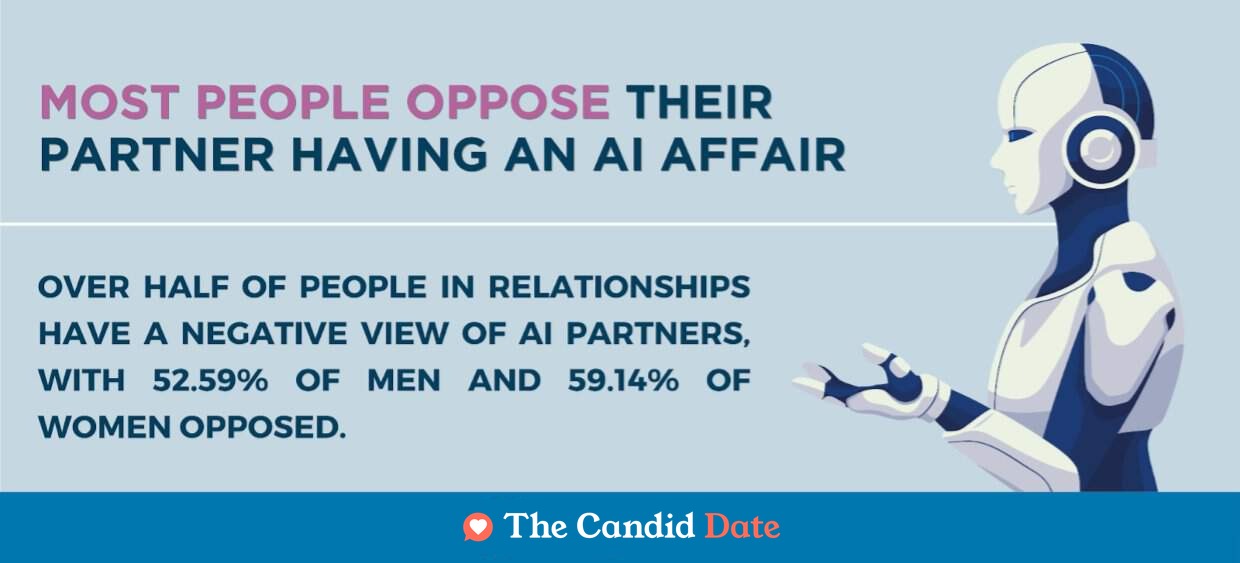
More than half of the daters and partnered people we surveyed view AI partners negatively. Among men, 52.59% said they don’t want AI involved in their relationship, and 59.14% of women felt the same way.
So both sexes generally oppose AI partners. Still, over a quarter of women (25.34%) consider it cheating, compared with only 18.53% of the men surveyed.
Even so, not every answer amounted to a flat no. Many respondents had specific worries that might be possible to address.
Men, for instance, were more likely than women to raise concerns about secrecy (19.25% versus 14.94%). That hints these men might be fine with a partner keeping an AI boyfriend around on the side, as long as they got reassurance about openness and transparency.
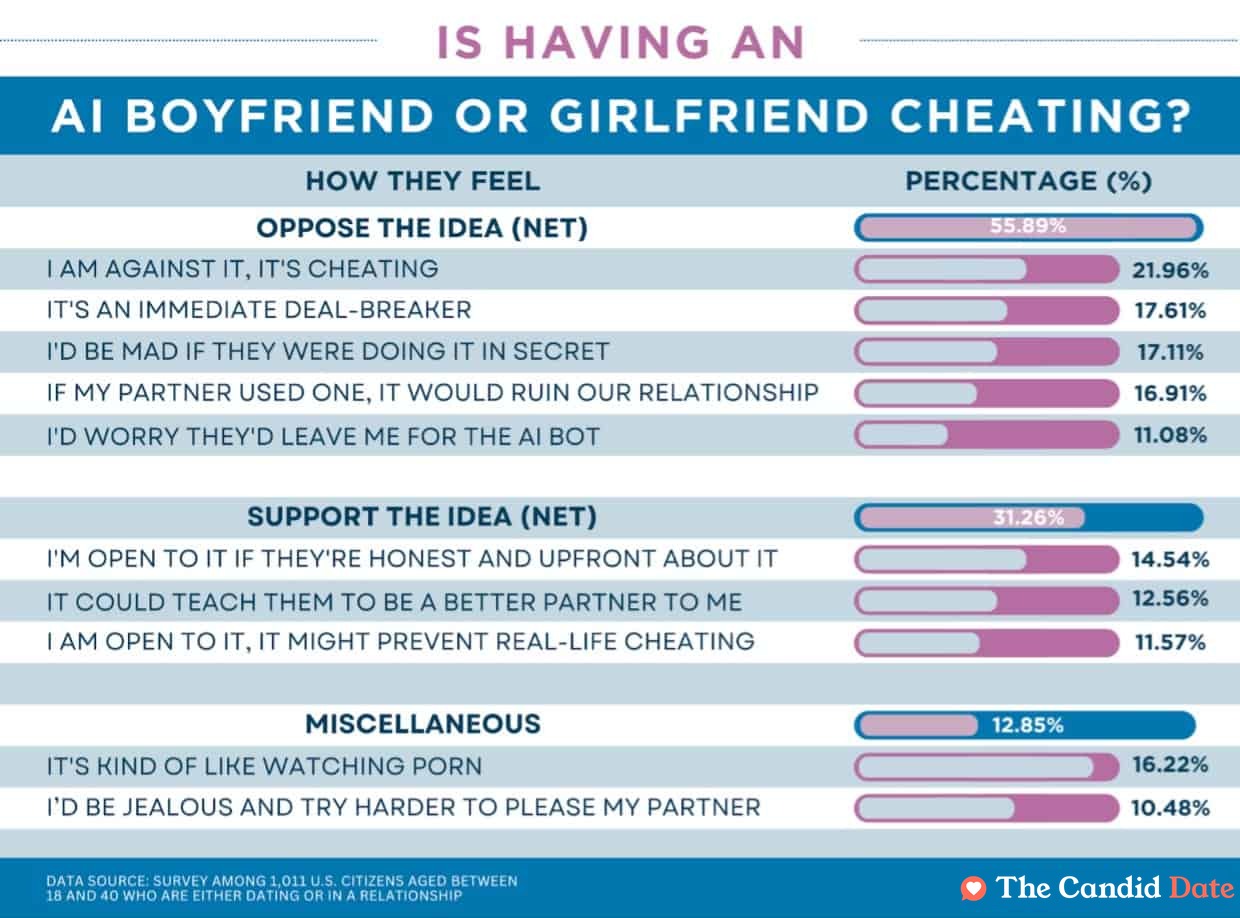
Put another way, AI partners could be acceptable, but only when the partner is open about dating an AI bot.
Meanwhile, 17.61% of respondents called an AI partner a dealbreaker. They’d end it on the spot if a partner said they wanted an AI bot to date, or if someone new admitted to currently seeing an AI partner.
31% Welcome the Idea of a Partner With an AI Boyfriend or Girlfriend
Over half of respondents might have doubts about AI partners, yet comfortably more than a quarter said they’d happily consider dating AI bots even while in a relationship.
Across all our survey participants, 31.26% welcomed the possibility of an AI partner.
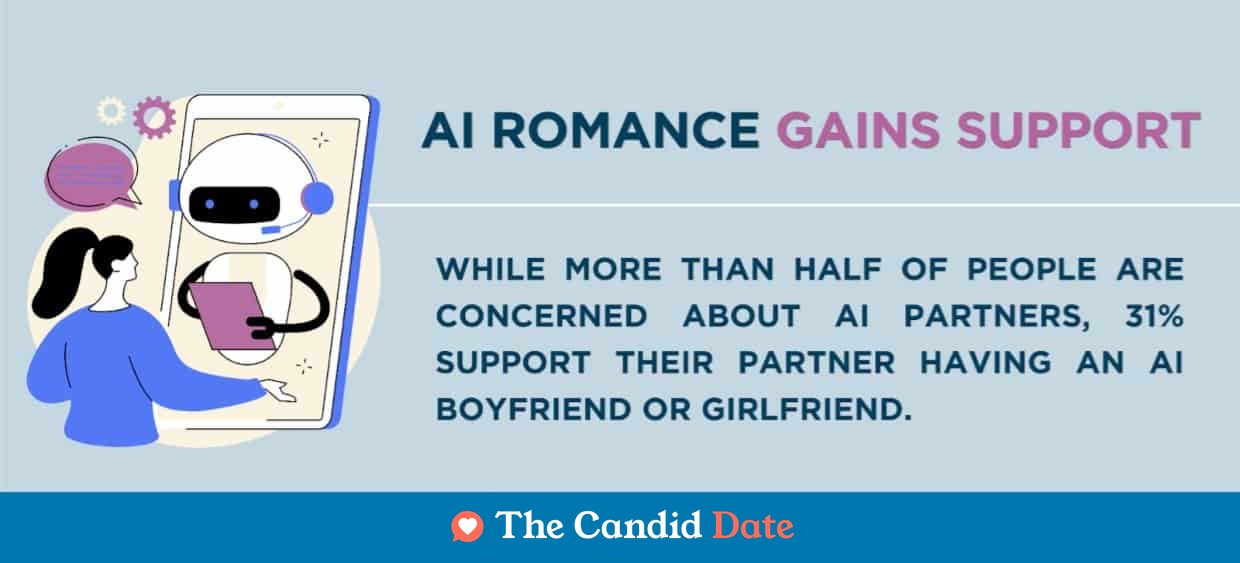
Of course, as with starting a polyamorous relationship, AI has to be brought in the right way. In fact, 12.56% of respondents think generative AI could make a relationship better, as long as it’s introduced properly.
On top of that, nobody can physically cheat with a robot. AI could instead offer both partners emotional support and advice, which could end up making their relationship stronger.
Honesty, the survey found, is crucial. Although 31.26% of people back the idea of an AI partner, 14.54% would back it only when their human partner is honest and upfront about their plans for the technology.
15% of Young People Fear Their Partner Could Run Off With an AI Bot
Part of why younger people worry about AI partners is the fear that their human partner might leave them for the bot.
It may sound more like a Black Mirror episode than real life, but the worry is real, since more people, including those in relationships, are spending time trading messages with AI bots.
Where might that go? That’s the big question, since people could grow emotionally attached to their AI boyfriends and girlfriends.
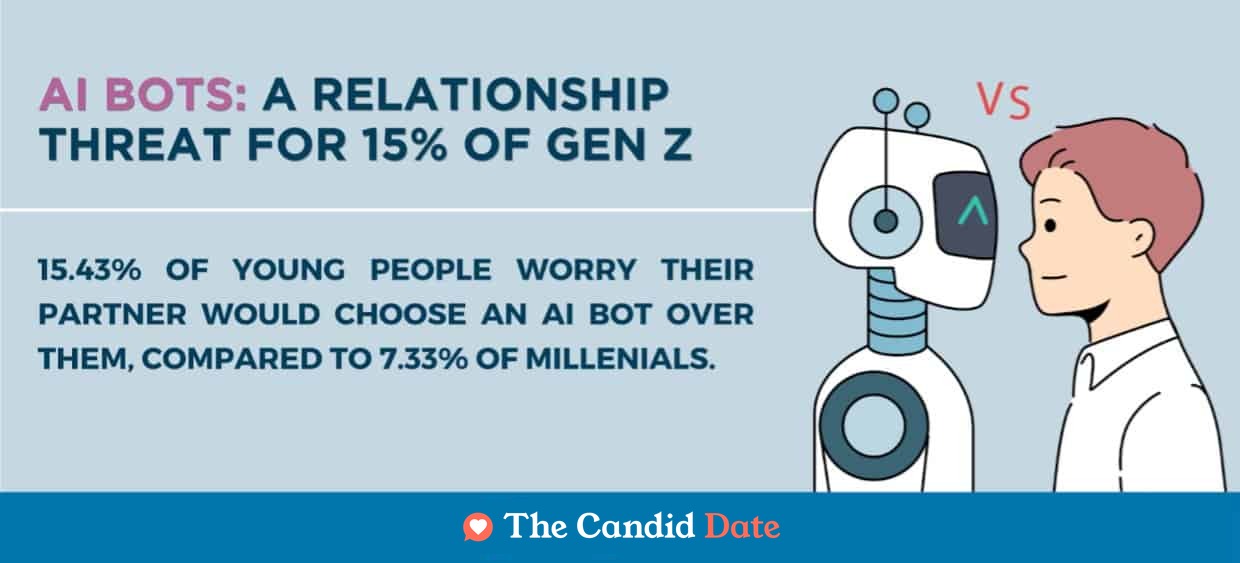
Our research found that among 18- to 24-year-olds, 15.43% fear their partner might someday prefer an AI bot over them, compared with 7.33% of those ages 35 to 40 who saw this as a real concern.
Maybe older daters are less aware of the possible risks tied to this growing technology, or maybe they just trust their partners more.
Younger daters, who tend to know the newest AI trends better, may be warier of how convincingly an AI bot can imitate human conversation, which raises the odds of being abandoned for a digital companion.
Nearly 40% of Gen Z Singles Would Accept a Future Partner’s AI Boyfriend/Girlfriend
Perhaps unsurprisingly, single people are readier than married ones to welcome an AI bot into a relationship down the road, since married folks are already happy with the status quo.
Even less surprising, maybe, is that Gen Z is out in front here.
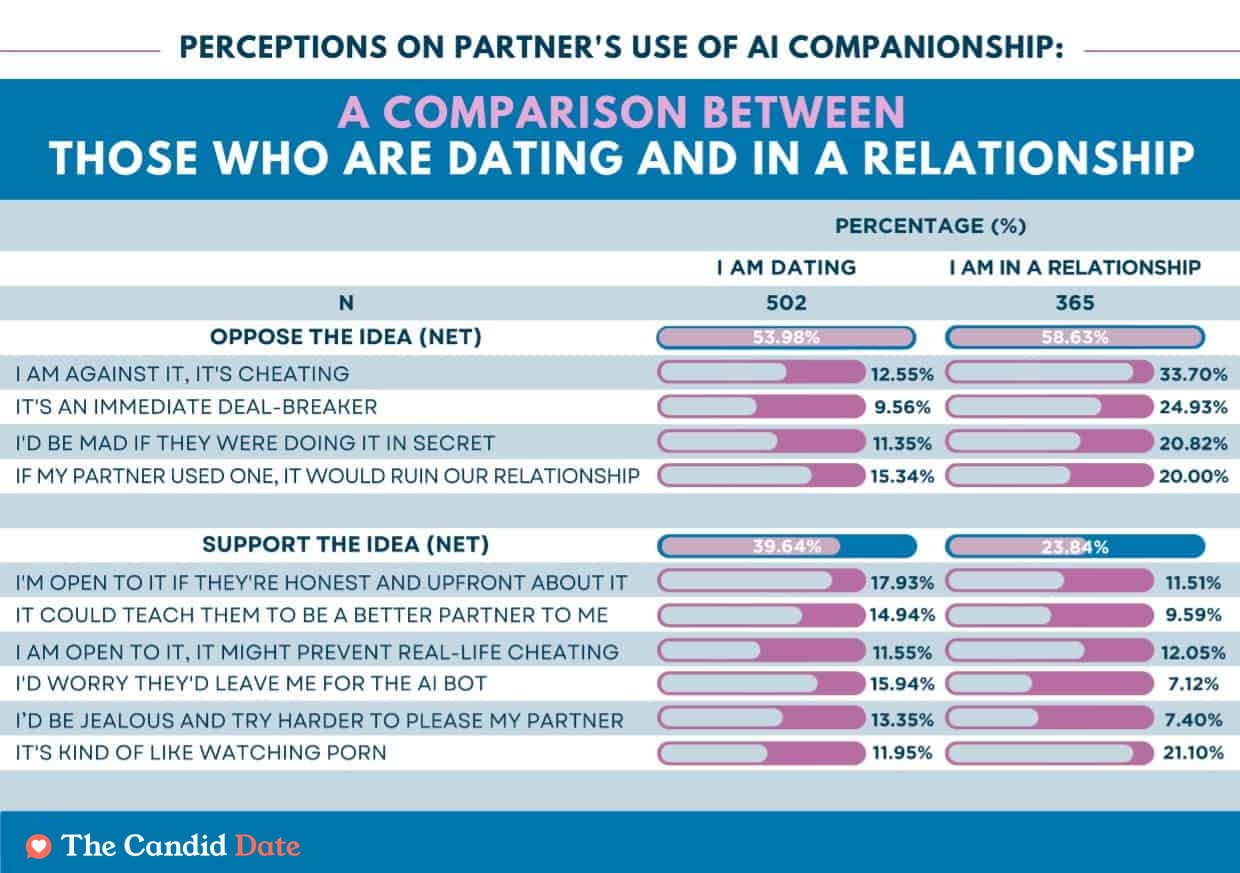
A bit more than 39% of the Gen Z singles we surveyed said they’d back the idea if a future partner dated an AI bot too, while among married people, 23.84% would be eager to add an AI partner to their marriage. That hints the traditional marriage values we’ve held for years could be eroding.
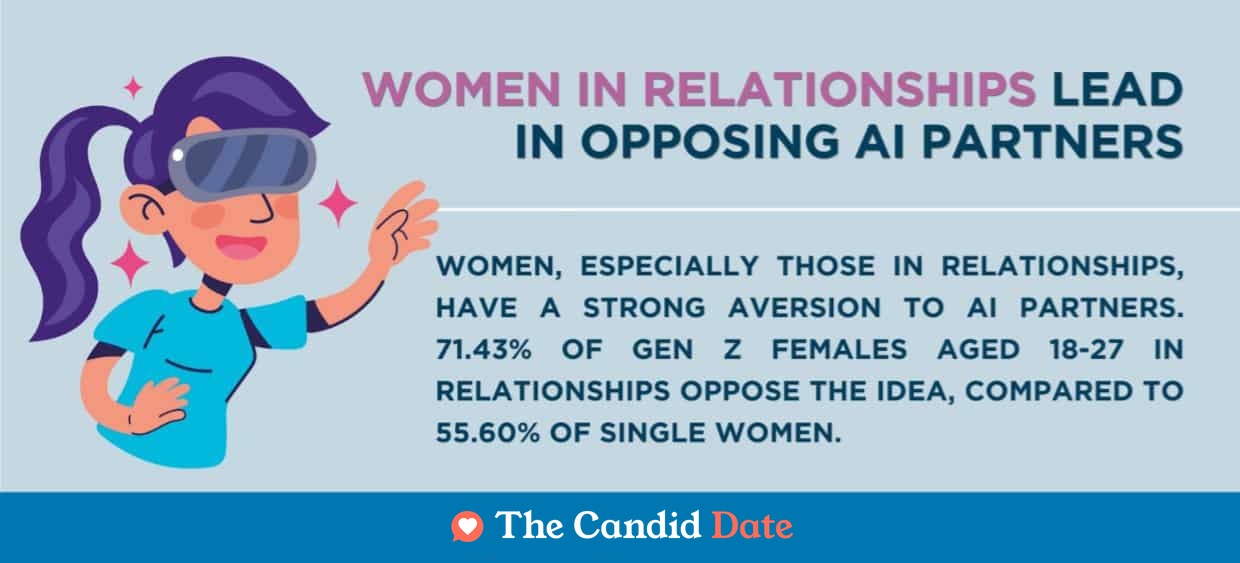
Meanwhile, 55.60% of women ages 18 to 27 who are dating oppose letting an AI bot into their current relationship, and that figure jumps to 71.43% among those in a committed relationship. It suggests that once exclusivity enters the picture, more people don’t want AI partners disrupting the balance.
All in all, these results show that dating itself is shifting, with younger people shaping how we think about connection. Instead of settling for a relationship with one person, singles, who for now needn’t worry about a partner’s feelings on AI coming between them, are eager to try new ways of dating.
Would that still hold once they were in a relationship with someone? Possibly not.
Older Respondents Are Likelier to Call AI Partners Cheating
Can something as impersonal as technology be a way to cheat on your partner? Our survey says millennials answer with a resounding ‘Yes,’ while Gen Z appears set on reshaping what a happy relationship can be.
With AI in the mix, the meaning of cheating may be starting to shift. Another human being is no longer the only way to cheat on your partner; getting too close to a bot could also get you accused of it.
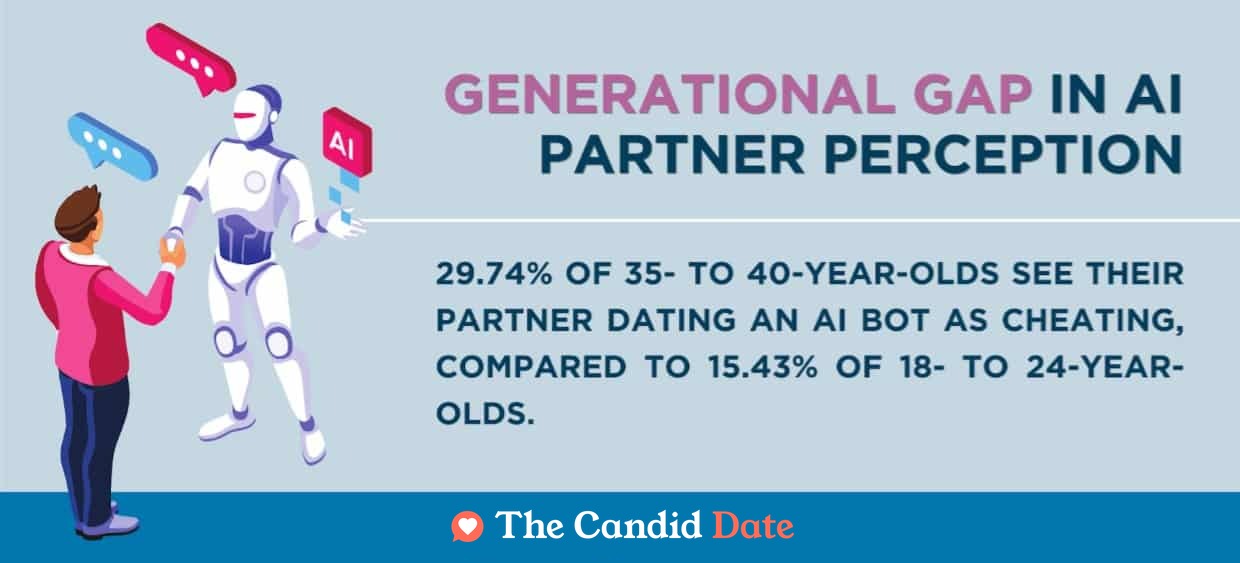
That’s how millennials see it, anyway. Gen Z respondents were more open-minded about AI and cheating. Among committed 18- to 24-year-olds, just 15.43% would feel cheated on if their partner got romantically involved with an AI bot, whereas almost twice as many people ages 35 to 40 (29.74%) called it cheating.
It’s perhaps logical that millennials are more likely than Gen Zers to view AI partners as cheating. Gen Z has grown up alongside technology, and some of its members are nearly as old as the first iPhone.
More Men Than Women Believe AI Can Help a Relationship
Over 16% of single men ages 18 to 27 think AI partners could genuinely make a relationship better by showing them, or their partners, how to improve.
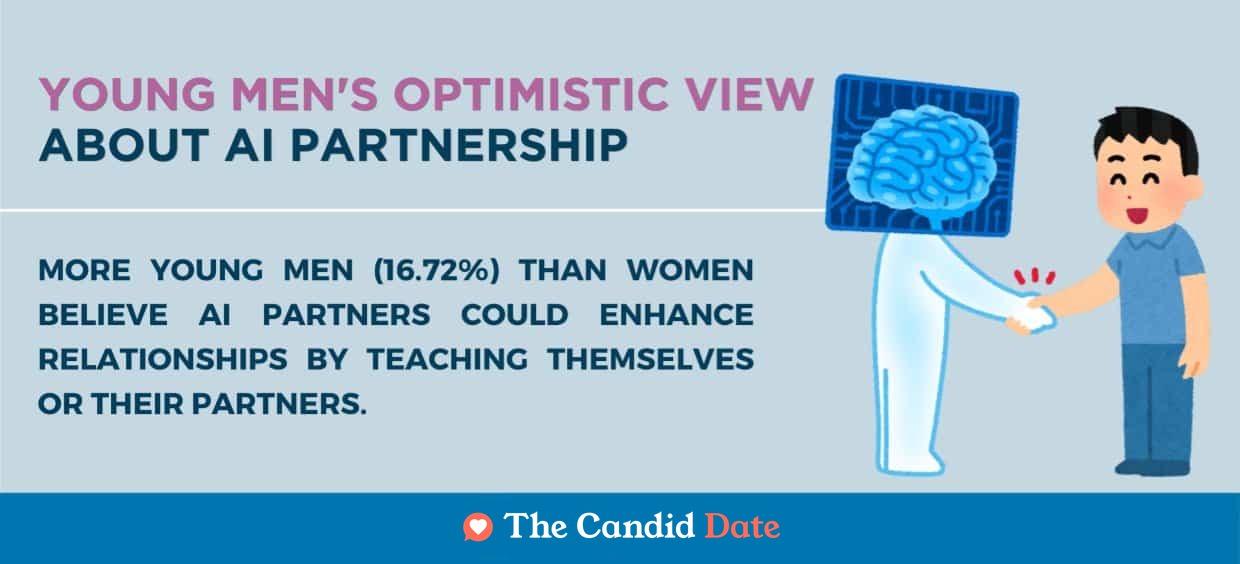
Among single women ages 18 to 27, the figure is similar (13.60%), but it plunges for those in committed relationships.
In fact, no men ages 18-27 in our survey who had a partner said AI could make things better for them or their partner, and only 3.17% of women said so.
That suggests exclusive couples worry more about outside influences hurting their relationships than singles do, since singles may lack the relationship experience to judge how intrusive AI software could be.
Women, Especially Those in Relationships (71%), Are the Most Averse to Bot-mance
According to the data, 71.43% of Gen Z women ages 18-27 who are in relationships reject the idea of AI partners, well above the 55.60% of their single peers. Digging deeper, 49.21% of these women consider it cheating, and 42.86% see it as an instant dealbreaker. By comparison, just 33.33% of men in relationships call it cheating, and 25.00% call it a dealbreaker.
Across the board, 25.34% of women consider AI dating flat-out cheating, versus 18.53% of men. Women were also likelier to call it an instant dealbreaker, at 21.22% compared with 13.94% of men, though a few more men (15.74%) would accept AI dating as long as a partner is honest about it.
Meanwhile, Nearly 12% Think AI Can Prevent Cheating
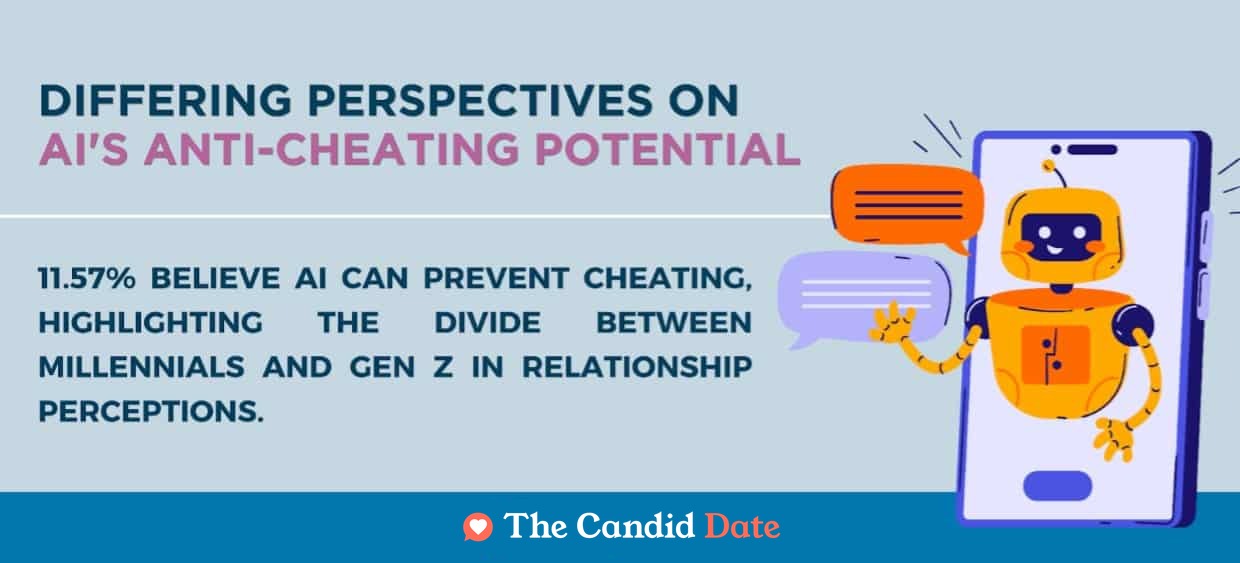
As shown above, plenty of millennials believe an AI partner counts as cheating. Yet 11.57% of respondents say AI might really prevent cheating, a sign of how differently millennials and Gen Zers view relationships.
So how could AI boyfriends and girlfriends stop cheating?
It comes down to the boundaries a couple sets. If two people agree that infidelity means only sexual intimacy with another person, then dating an AI bot at least guarantees that a partner won’t be having physical relations.
What’s more, an AI partner gives someone another person to talk to. Talking things over with the bot might reveal what’s lacking in their relationship, helping them work through problems with their partner so they can move forward as a couple.
Some may view an AI partner as a kind of emotional cheating, but it at least gives a couple the chance to figure out why one of them turned to an AI bot before anyone turns to physical cheating.
45% of Gen Z Men in Relationships Liken AI Partners to Watching Porn
Some people see AI partners in a negative light because they consider them similar to watching porn, and one group held this view more than any other.
When we asked how respondents felt about AI playing a part in a relationship, just 16.67% of people ages 18 to 24 said it’s a bit like watching porn. Among those ages 35 to 40, the figure was 21.12%, and they fear the bot could get too sexual.
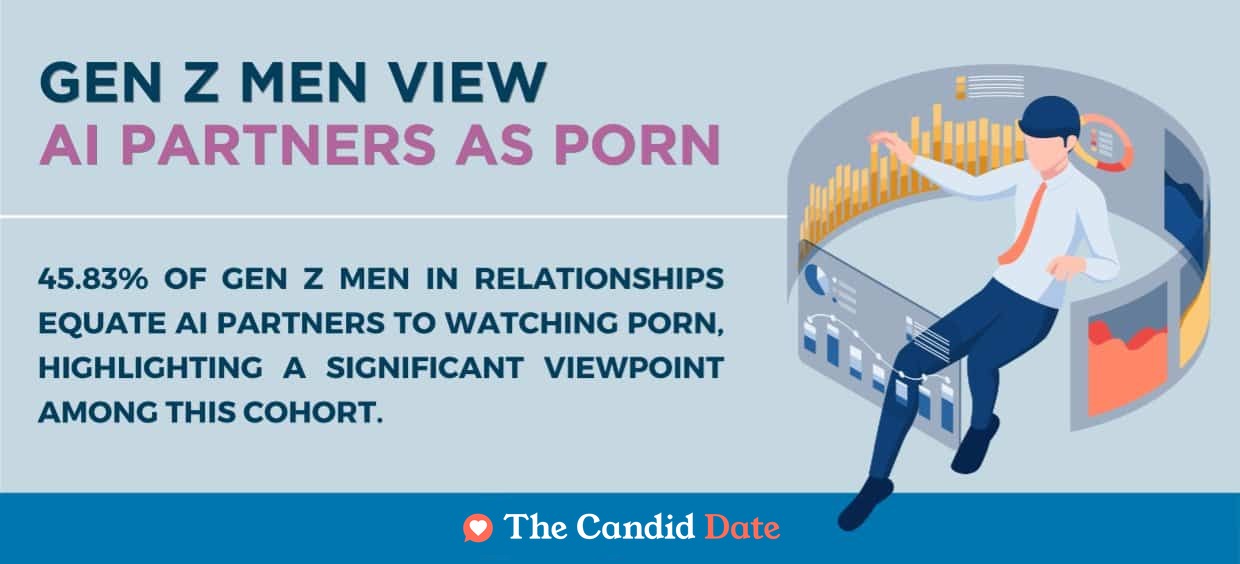
The biggest gap is between people who are dating and people in committed relationships. Just 11.90% of dating men ages 18 to 27 compared AI partners to watching porn, but among men in relationships the number shot up to 45.83%. That shows how our views and behavior shift once we commit to someone; 23.81% of women in relationships felt the same.
Of course, several factors come into play. AI bots differ, and some are more openly sexual than others. Intent matters as well. Using an AI bot for gratification and/or sexual role play can be similar to watching porn.
As a rule, it comes down to what you think your partner gets from the AI boyfriend or girlfriend in their life and, if it’s sexual gratification, how much that will affect your relationship.
An AI bot, unlike a real person, won’t judge anyone’s curious sexual interests, and that can be a big part of the appeal. But if it’s hurting your own sex life, it’s time to tackle the underlying problem.
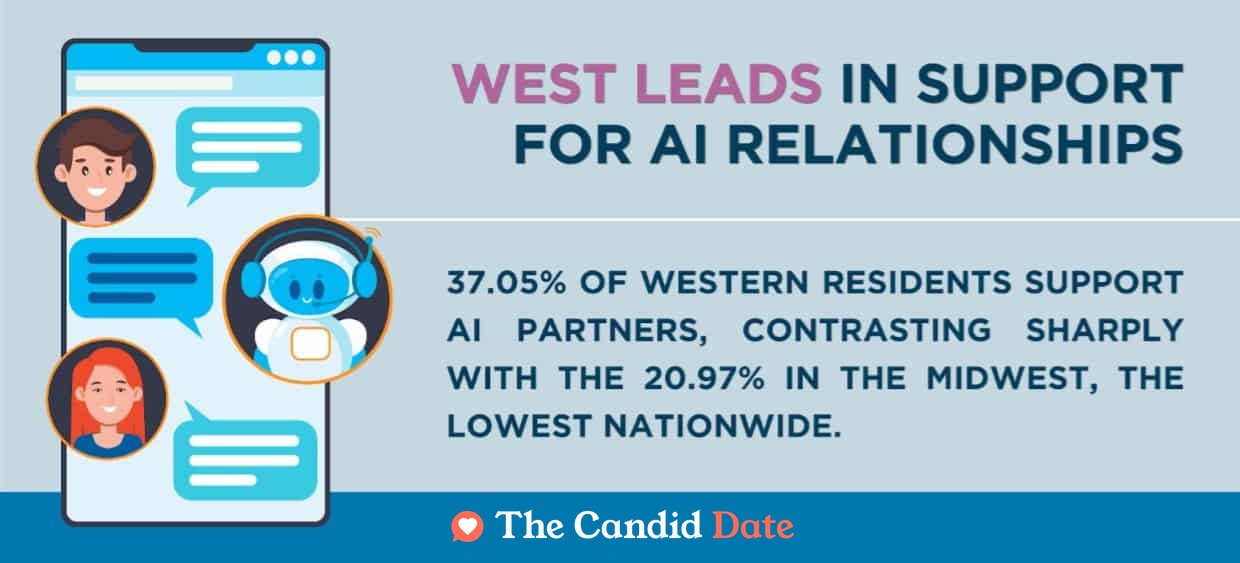
37% of Westerners Back AI Romances
Breaking results down by region, 37.05% of people in the Western U.S. back AI partners. That runs against the overall trend and far outpaces Midwesterners, just 20.97% of whom support AI, the lowest share in the country.
These results suggest people in Western states like California are more open-minded about technology, while those in other parts of the US, especially the South, see AI as a bigger danger to relationships rooted in traditional values.
The divide is nearly as wide on whether AI dating counts as cheating. Among Midwesterners, 29.03% see it that way, while just 16.07% of Westerners would feel cheated on if their partner began seeing an AI bot.
Interestingly, residents of Los Angeles generally break from the Western consensus: 62.50% of them say they oppose AI partners.
Most cities share that view, though Houston goes slightly against the grain, with 45.16% of residents opposed to AI dating.
In Memphis, 37.50% said AI dating would be OK as long as their partner didn’t hide it. By comparison, 25.81% of Houston residents said they’d accept AI dating provided their partner is upfront about what they intend, the highest figure anywhere in the United States.
The Bottom Line
Most people, it turns out, would refuse to let their partner have a side relationship with an AI bot; they’d rather keep human relationships, well, human.
Still, the data shows more couples warming up to AI partners, a hint that as the technology improves and acceptance grows, more AI relationships may take shape. Some people are sincerely open to AI dating, as long as their partner comes clean about it from day one. Many also see upsides an AI partner could bring to a relationship, like stronger bonds built through outside guidance.
One thing is clear: dating and relationships are evolving right along with this fast-growing technology, and we’re only at the first frontier. What comes next for love? Our only answer: stay tuned.
About the Author
By: Emma Wilson
Editor-in-Chief
Emma Wilson is the Editor-in-Chief at thecandiddate.com. When she was growing up, her family teased her for being 'boy crazy,' but she preferred to think of herself as a budding dating and relationship expert. Emma brings her tireless wit and relatable experiences to thecandiddate.com.
Share the Knowledge!
Our dating experts work hard to show you the best dating sites. Want to show your appreciation? Share this page!