Is AI Wrecking Romance? Looking Back and Ahead at Tech in Dating



When I coach singles, I often tell them dating blends biology, sociology, psychology, and anthropology.
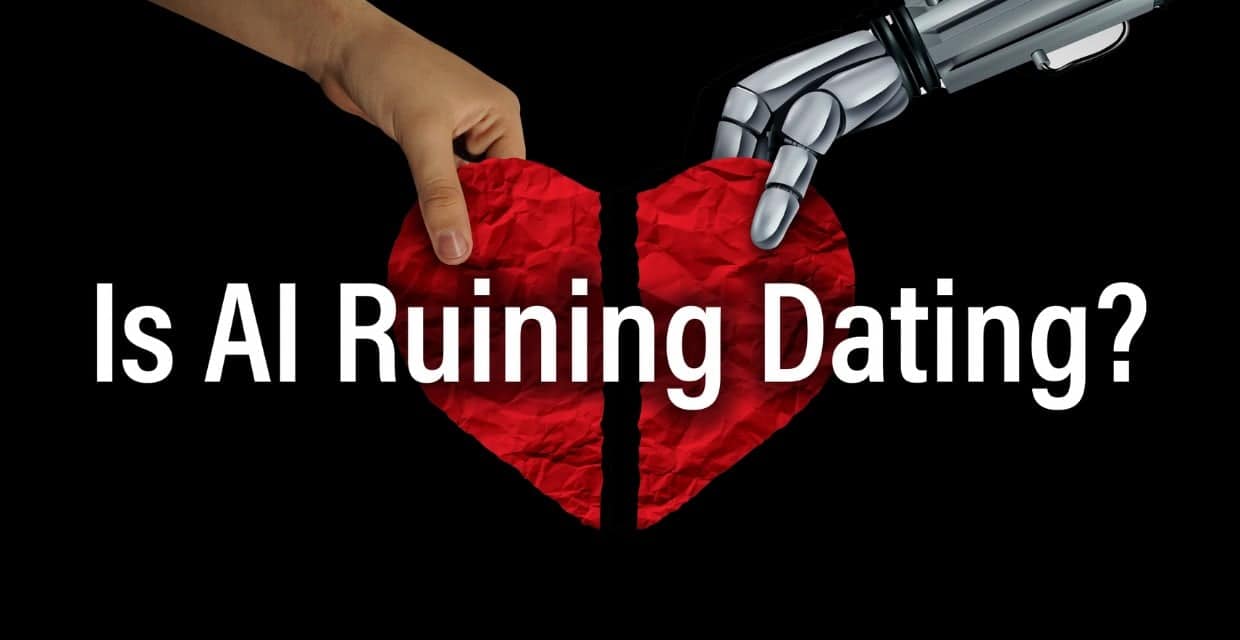
These days, it’s about technology too. With AI on the rise, it’s working its way into nearly every corner of our lives, dating and relationships included.
So I wanted to offer a sort of “state of the union” piece on what AI is doing in my corner of the industry. I’ll give some technology background for helpful context, then get into what I learned from interviewing experts in the field.
A Little Background on Tech in Dating
To start, here’s a quick history of technology, catfishing, and AI before we dig into the perils of Robot Love.
This PSA arrived from 25 years back AND from a future 1,000 years away, courtesy of Futurama.
All jokes aside, people are making the very same arguments today!
Older generations have been knocking new technology for literally thousands of years. In 250 BC, Plautus, writing in Rome, took aim at, of all things, the sundial:
Hungry Parasite
“The gods confound the man who first found out
How to distinguish hours! Confound him too
Who in this place set up a sundial
To cut and hack my days so wretchedly
Into small portions! When I was a boy,
My belly was my sundial: one more sure,
Truer, and more exact than any of them.”
Next came the printing press and its supposed evils. A Benedictine monk writing in the 1500s cautioned, “They shameless print… material which may, alas, inflame impressionable youths.”
Skip ahead a few centuries, and Buddhism is condemning the telephone as “the devil’s instrument.”
Allow me to quote from the Seventh World of Chan Buddhism. “Ideally, anyone on the Path should have his telephone disconnected, with a special ceremony performed as the line is severed. Had the device been around in Siddhartha’s day, the 6th Precept would have been non-telephoning.”
There’s Nothing New About Catfishing
Today, AI’s catfishing potential tops the list of worries about it in dating. Singles won’t be able to tell what’s real, or who’s a genuine date and who’s a robot messenger.
The word “catfishing” comes from a 2010 documentary that shares its name. In the film, the director is told that catfish were added to tanks of live codfish to keep the cod fresh: an outsider posing as an insider.
The word may be fairly new, but this kind of fraud has been around for ages. Here’s some context.
In the 1660s, the fearless Mary Carleton faked letters and official certificates to swindle wealthy dupes out of their hearts and their money. She drew on a whole deck of charming identities, from an orphaned German princess to a virtuous virgin heiress.
In Shakespearean times, the bed trick was a go-to plot device, in which one person secretly swaps in for another in the middle of a sexual act. Eat your heart out, ye online catfish pikers.
An 1880 book, “Wired Love: A Romance of Dots and Dashes,” put it this way:
“There certainly is something romantic in talking to a mysterious person, unseen, and miles away!’ thought Nattie, as she put on her hat.”
In 1897, playwright Edmond Rostand released “Cyrano de Bergerac,” a memorable, timeless tale that still wins over many hearts today. Cyrano, a gifted fighter and clever poet, puts his talents to work wooing his distant cousin, Roxane.
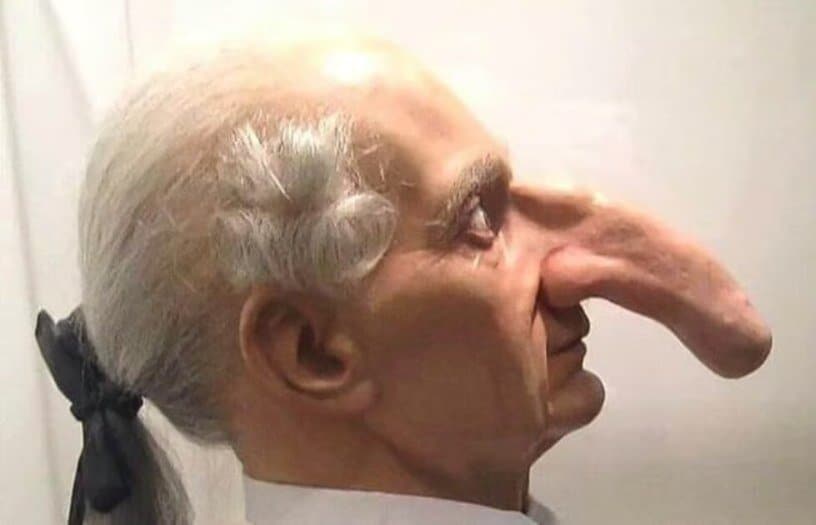
People with low self-esteem can end up catfishing.
Insecure about his nose, Cyrano hands his poems to Christian, a good-looking soldier Roxane has her eye on. She falls for Christian’s looks and Cyrano’s clever words. Poor catfishing Cyrano ends up friendzoned, in modern terms.
Rostand probably drew his inspiration from Thomas Wedders and that man’s enormous schnoz. Thomas lived in Yorkshire during the 1700s.
“Quite early in life, George Tracy discovered that if he were to be reasonably happy and prosperous, he must pretend.” That’s the opening line of a captivating 1913 psychological novel from Charles Marriott.
The story of George’s lifelong fixation on Mary, an elusive frenemy who holds “the key to the side door of his nature,” went out of print long ago. People mainly remember it for its title: The Catfish.
As the 20th century wound down, the Oscar-winning film “Some Like it Hot” was built around catfishing (to say nothing of crossdressing). Who could forget this famous line?!
Lying about who you are to win over a crush is a story as old as time. AI just means fewer wigs and less makeup.
AI Isn’t All That New, Either
That brings us to the roots of AI, which go back further than you’d expect.
The term “artificial intelligence” debuted in 1955 when John McCarthy ran a workshop at Dartmouth. He’s credited with turning it into a field of study.
It didn’t appear out of thin air. “Automatons” turn up all through history.
A passage in History of the English Kings, William of Malmesbury’s treatise from 1125, describes Pope Sylvester II using his knowledge of astrology to cast a statue’s head that could reply to any yes/no question it was asked.
“The head of a statue, by a certain inspection of the stars when all the planets were about to begin their courses, which spake not unless spoken to, but then pronounced the truth, either in the affirmative or negative.”
By the 1800s, the Industrial Revolution and the arrival of electricity had people imagining their lives differently. Fiction soon filled up with depictions of artificial intelligence: Samuel Butler’s “Darwin among the machines,” Mary Shelley’s Frankenstein, and Edgar Allen Poe’s “Maelzel’s Chess Player.”
Science fiction then collides with science fact in the 1900s, giving us real computing, IBM’s Deep Blue, and Alan Turing.
In 1966, MIT professor Joseph Weizenbaum built ELIZA, the first chatbot.
Watson, Siri, ChatGPT, and others arrived in the 2000s. At the same time, dating apps such as Tinder, OkCupid, and Hinge started relying on matching algorithms that keep getting more sophisticated.
Which brings us to today. What’s happening with AI in dating right now?
Three Day Rule’s Adam Cohen explains how he’s bringing AI into his company.
AI can substantially improve how we experts predict compatibility and make sense of dating behavior. Naturally, it comes with downsides as well.
The better the technology gets, the better the fakes get. Right now there’s an arms race in the dating world to put AI to use in every way imaginable. Companies are appearing and vanishing at a rapid clip, so I’ll offer a snapshot of where things stand today.
As of this writing, here are a few companies applying AI to dating services:
Iris Dating
Iris Dating, a new dating app, boasts that AI does its matchmaking. You may be thinking every dating app works that way, and that’s fair. What sets Iris Dating apart is that it learns from physical markers in photos specifically.
While you swipe through headshots, you’re teaching the app your type, no long questionnaires required.
In the Iris Dating team’s words, “With our AI dating app, you can start your new journey together from a place of mutual attraction.”
YourMove.AI
Its homepage declares: “YourMove AI perfects your profile and puts your texting on cruise control.” Not bad at all.
It uses AI to turn your topics or ideas into three personalized openers you can copy and paste to romantic interests online. Think of it as a modern-day Cyrano.
Volar
Okay, Volar sits a bit further out on the cutting edge. It uses AI avatars as stand-ins that singles can dispatch on a virtual first date to test the waters before they actually put on shoes and head outside (shudder).
“The new app is just one example of how generative AI has seeped into the dating scene over the past year, with both app developers and people seeking soulmates adopting the technology.” -Amanda Hoover, WIRED
They resemble the practice dates dating coaches such as myself run with clients. The difference is that singles can then read the transcripts of their pretend conversations and decide whether any seem interesting enough for a real chat.
The team says, “By allowing AI avatars to handle initial interactions, Volar reduces the awkwardness and fatigue often associated with online dating. This enables users to gauge compatibility and interest before engaging in real conversations, fostering more meaningful connections from the start.”
Rizz
Rizz, another high-tech tool, aims to recreate Cyrano’s knack for feeding good lines to hapless romantics.
Here’s how Roman, Rizz’s founder, explains exactly what it does:
It reads screenshots and offers quick, witty replies tailored to that particular conversation. At a loss for words? Just ask Rizz!
Aragon.ai
AI-generated photos are showing up more and more on dating profiles. Think Instagram filters on steroids. All of a sudden, everybody looks poised, posed, and flawlessly lit. Can’t beat ’em? Just hand Aragon.ai a selfie, and its algorithm will produce a polished, professional-looking photo.
The site says, “Turn your selfies into studio-quality headshots in minutes. Save hundreds of dollars and hours of your time.”
SciMatch
SciMatch says all it needs is one selfie to predict relationship compatibility. Intrigued? The AI has a range of interesting use cases, such as using a celebrity’s photo to track down a local match with a similar look.
Co-Founder Vicktoria shared more about the concept and the hopes behind this AI-powered app:
Naturally, the AI is just making educated guesses, as every app has done from the start. It’s simply a fun way to shake things up.
Replika
Over the past year, an AI companion named Replika picked up 10 million users. People are essentially falling for a souped-up ELIZA, the first chatbot, which Weizenbaum built in 1966.
Billed as the “AI companion who cares,” Replika lends a sympathetic ear to lonely hearts who need someone to talk things through with.
Amori
Last but not least, Amori offers dating coach avatars trained to deliver personalized dating advice and matchmaking support. Well, not exactly personalized… robotized?

Going from left to right, there’s Christie the Blunt Bestie, who dishes out “sassy, frank advice that’s straight to the point.” Or you can turn to Ethan the Wingman, who promises “spot-on dating tips and make it all a good time.”
Tabitha the Wise Aunt supposedly dispenses wisdom that “feels like learning and getting a hug at once.” Meanwhile, Sonya the Love Scholar holds a “Ph.D. in the science of dating.” Having such a range of perspectives can help with all kinds of dating and relationship questions.
Amori pitches these avatars as a helpful, judgment-free resource for singles who may be reluctant to ask people they know for advice.
We’ll Be Watching for the Next Big Thing
There’s so much happening! How can you even sort through it all to figure out what to use and how to use it? By following us, naturally!
Stay tuned, because we’ll keep tracking the trends and exploring the good AI is doing to help people, along with the potential pitfalls I hope we can steer clear of!
About the Author
By: Evelyn Garcia
Men's Dating Expert
Evelyn Garcia is a dating and relationship expert helping men build confidence and lasting connections on thecandiddate.com.
Share the Knowledge!
Our dating experts work hard to show you the best dating sites. Want to show your appreciation? Share this page!