How Online Dating Algorithms Work



These days, it can feel like algorithms are running everything. Got a question? Google it. Feeling hungry? DoorDash or UberEats will suggest a restaurant and bring your favorite dishes to your door.
So when you’re searching for love, can an online dating service send your soul mate straight to your inbox?
Here we’ll look at online dating algorithms from every angle: how they pick matches for you, where they fall short, how to work around those limits, and some dependable apps worth a try. Let’s get started!
The Basics
On dating apps, algorithms act as the maps that guide couples toward each other. They sort promising matches from incompatible profiles in advance, so the swiping game doesn’t leave you making wrong turns and running into dead ends.
Algorithm Defined
Each dating app has a carefully built matchmaking process designed to get its users the best possible outcome.
A simple matching algorithm could:
- Use your profile information (location, age, interests) as its main input.
- Account for what you want in a partner (location, interests, age range, and so on).
- Review other members’ profiles using that input.
- Check your profile and preferences against everyone else’s.
- Identify people who fit your criteria.
- Give you a list of possible matches.
Dating apps aren’t magic; they run on math. That’s what makes online dating a numbers game: the bigger the user database, the better the results.
A dating site with little popularity and a small user base tends to deliver a disappointing experience.
My own experience is a good example.
I live in Jakarta, where Bumble is much more popular than Coffee Meets Bagel (CMB).
I spent a while on CMB. In the beginning, the profiles looked impressive: lots of people with good jobs and degrees from abroad.

The algorithm behind a dating app studies your profile, weighs your preferences, and surfaces people who might suit you. The process isn’t romantic, but it works.
My gut said, “Why don’t I meet these kinds of people in real life? Like, a guy who claims to be an MIT graduate and works only a few blocks away?”
Eventually, it dawned on me that most of my CMB chats were with scammers.
Once I switched to Bumble, the profiles it suggested were all people I could run into offline. Their faces, schools, and jobs resembled those of my coworkers, friends, and mutual friends.
I’ve gone on in-person meetups with three guys from Bumble. None of them has turned out to be the one so far, but I can say with confidence that, in Jakarta at least, most Bumble users are real people.
How It Upgrades Traditional Matchmaking
The majority of people marry someone within their own social circle. Where you live, your religion, your family, and your school or campus can all shrink your dating pool.
Online dating flips that on its head. You choose your preferences and the algorithm serves up profiles that meet them, all within seconds, because the computer handles the heavy lifting.
Stick around on a dating app long enough, though, and you’ll keep meeting the same people under different names and faces, having the same conversation again and again. No wonder so many users hit online dating burnout and delete the apps altogether.
Advantages & Limitations
What do Keanu Reeves, Zendaya, and Barack Obama share?
They have interracial parents.

Barack Obama’s mother came from Kansas, while his father was African.
Zendaya’s mother is German-Scottish, and her father is African-American.
Keanu Reeves comes from a mixed background: his mother is English, and his father has Hawaiian-Chinese, English, Irish, and Portuguese roots.
Love brings differences together and adds color to our lives.
Dating apps don’t work that way, though. Your preferences usually end up boxing you in.
Filter for Latino matches only, and that’s all you’ll get. The same happens even without set preferences if you just keep swiping on dark eyes and olive skin. That leaves love very little room for happy accidents.
To get around these limits, switch up your search filters every so often. Dating apps, for their part, should train their teams in inclusivity, build algorithms that treat every ethnic group equally, and teach users about the effects their preferences have.
What Happens Behind the Scenes
Online dating can seem mysterious, since most companies aren’t very open about how their matchmaking algorithms function. Still, the patterns and results that show up in the interface let us draw some conclusions.
Types of Data Collected
Ever mentioned to a friend that you wanted a dress from a particular brand, only to start getting ads for that exact dress?
Nowadays we’re never truly alone. The algorithms are always listening.

Dating apps work the same way.
The algorithm watches your messages, your behavior, and what’s on your profile. After figuring out what you like, it shows you more people similar to those you’ve liked before, all to put the most promising, engaging matches in front of you.
This is an attention economy, and whoever grabs people’s attention wins. In online dating, every extra minute you spend swiping left and right is good for business.
Analysis by Machine-Learning Tech
These algorithms rely on sophisticated machine learning to evaluate user data and recommend matches, and every app has its own secret weapon for pairing people up well.
eharmony, for example, relies on its patented 32 Dimensions Personality Assessment, a psychological test with dozens of questions on someone’s goals, hobbies, likes and dislikes, and dealbreakers.
The questionnaire is long on purpose, since that keeps casual daters away. eharmony then suggests nearby profiles that score high for compatibility.
The goal is to connect you with the right partner, not just any partner.
If you’re more in the mood for casual fun, Tinder could be the better fit. Its easy swipe interface turns getting dates into a game, a formula that has produced 97 billion matches, a number that keeps climbing.
Tools That Work: Some Examples
Online dating has produced plenty of success stories. Married couples, long-distance partners, and many others owe their happiness to an algorithm. Below are real examples from a few of the industry’s biggest players.
Match
To begin looking for love on Match.com, register on the website or grab the free mobile app. After you fill out your profile, Match’s algorithms trim your dating pool using the lifestyle choices and preferences listed on your profile and on those of possible matches.
Over 30 years in online dating, though, Match learned that what people actually want doesn’t always line up with what their profiles claim.
So Match runs two algorithms, Mutual Match and Reverse Match. With Reverse Match, one person fits what the other is looking for; with Mutual Match, the interest goes both ways.
That setup lets you reach people even when they don’t “Like” you. How much you can use it depends on your account: free plans come with restricted messaging, while paid members enjoy unlimited messaging.
Paying members can also power up their profiles with add-ons like Reply for Free, Private Mode, Email Read Notification, and matchPhone. That last one is especially smart: it gives you a number generated by Match for calling and texting matches, so your real phone number stays private.
Tinder
Tinder proves an algorithm can reshape people’s lives. Anyone who dates online knows how it works: swipe right on a profile you like, and swipe left to pass.
Its algorithm serves up profiles whose location settings, photos, or bios resemble yours, and it also factors in the number of right swipes you’ve received.
In practice, the algorithm can resemble a popularity contest. Plenty of “right swipes” signal that plenty of people like you, so the algorithm favors your profile and puts it in front of more users.
Tinder keeps tabs on your behavior too. Swipe right on lots of people with camping photos, for example, and it’ll send more outdoorsy types your way.
For better results, avoid swiping right on everybody. Doing that tells the algorithm you aren’t picky, and Tinder will then show your profile to people whose own profiles are low-quality (incomplete bios, for instance). When someone doesn’t appeal to you, swipe left; that teaches the algorithm which profiles you prefer.
Sadly, Tinder offers no filters for social status, ethnicity, or religion, which can be a deal breaker if those things matter to you in a partner.
Zoosk
Back in December 2007, Zoosk was a Facebook application. Today it’s a worldwide dating site with millions of members, popular with a fairly young crowd in more than 80 countries and available in 25 languages.
Zoosk gives you several ways to find a match.
If you love swiping, you’ll like the Carousel feature. It shows you the ages and photos of other Zoosk singles, and you tap a quick “yes” or “maybe”. The algorithm then lets that member know you’re interested.

Not feeling it? Just pick “no” and keep going. When you both choose “yes”, you become a Mutual Match, and the person appears in your Connections.
Prefer to cut to the chase? SmartPick is made for you. Here, the algorithm picks out someone special for you, so you don’t need to browse through piles of matches.
SmartPick judges compatibility using preferences and profile details, and it learns from what you like and dislike to improve its recommendations over time.
Bumble
Bumble made its name as the dating app that let women take the wheel. At first, women were required to send the opening message, so random guys couldn’t flood them with chats.
After 10 years, Bumble saw that plenty of women found it a burden to come up with an opener and keep the chat alive. On top of that, social norms still expect men to make the first move, whether for dates, marriage, or sex.
So, Bumble is taking a different approach.
These days, women can put prompts on their profiles for men to answer. In same-sex matches, either person can create and reply to these prompts, which are called Opening Moves.
With Opening Moves, you pick a question to kick off the conversation. Examples include “What’s your ideal first date?” and “How many episodes of a series is it acceptable to watch in one sitting?” Or you can come up with your own.
When someone answers your Opening Move, it means they’re curious to learn more about you. Their profile lands in your chat queue, and the match expires unless you reply within 24 hours.
eharmony
eharmony takes a different approach from most dating apps. You can’t hunt for matches yourself; the algorithm chooses a handful of profiles and sends them to your inbox every day.
So how does it decide who to send?
It relies on a personality quiz of more than 80 questions covering your personality traits, how you communicate, your views on love, your boundaries in relationships, and more. The algorithm pulls all your answers together into your Personality Profile.

Each of you will see a number from 60 to 140 on the other’s profile, which is your compatibility score. Anything above 100 on the compatibility score scale is better than average and suggests the two of you could be a good fit.
Every new eharmony member has to complete the test, and you can only retake the compatibility quiz when renewing a premium membership.
Your matches come from the algorithm, but free and paid filters let you tailor the results. The free ones cover age, height, whether someone smokes, and preferences about children; the paid ones cover education, income, ethnicity, and religion.
Where Online Dating Is Headed
The dating world never stands still, which is both good news and a challenge. Singles have to keep up with trends, especially online ones, to build the strongest strategy for success.
AI Can Upgrade the Process
Every new app comes with a learning curve. A good experience depends on knowing how the app functions, and that means seeking help when questions come up.

Since most people like to keep their online dating to themselves, asking someone face to face can feel intimidating. AI-powered chatbots are useful here.
Put a question to a chatbot and you’ll get an answer right away; if that’s not enough, it’ll pass you along to customer service.
AI can also help with the conversations themselves, suggesting an icebreaker prompt or some catchy questions to get things going with a new match.
Real-Life Coaches Can Also Play a Role
Dating platforms shouldn’t lean on algorithms alone to pair people by profile and behavior; they ought to think about bringing in real-life coaches to refine those algorithms. A coach can pick up on what an algorithm may overlook, like body language, personal tastes, and the subtle nuances of human behavior.
Put simply, human coaches can give the algorithm a more human touch.
The idea isn’t new: eharmony already builds psychological principles of attraction into its algorithm. The payoff? According to the data, eharmony accounts for 2% of U.S. marriages, and those marriages have a divorce rate of just 3.86%.
Data Privacy & Ethical Considerations
Signing up for a dating app means handing over personal details like your age, legal name, and personal email. Worse still, the algorithm can see your chats, your videos, and every small secret you might reveal in your DMs.
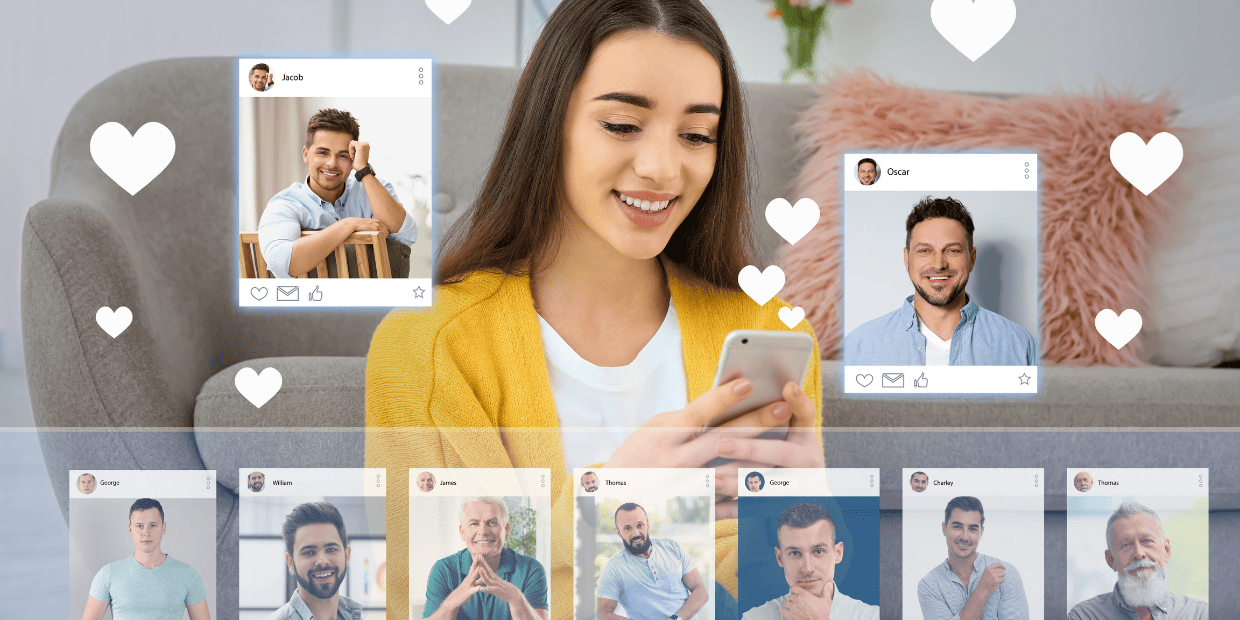
If personal security concerns you, find out whether the company shares or sells user information.
So what happens to all that data? A company might sell it, share it, or put in only minimal effort to protect it.
Apps such as Tinder and Grindr claim they gather your precise geolocation only “with your consent,” yet they won’t function unless you allow it.
How can you keep your privacy intact? A few suggestions:
- Set up a phone number and email address just for dating, kept apart from the ones you use every day.
- Share only the details and pictures you wouldn’t mind the whole world seeing.
- Skip third-party logins, and keep your social media accounts unlinked from your profile.
- Use your device settings to restrict what the app can access (your camera roll, address book, location, and so on).
Online daters also face the ethical puzzle of keeping dating and work separate. In my experience, once I hand my number to a match, they store me as “Sebastian Bumble” or “Sebastian Tinder.”
That seems harmless until a client runs your number through an app like Get Contact and finds out you spend time on dating apps.
Matchmaking Tech Keeps Evolving
For online dating beginners, knowing how the algorithms operate is a real head start.
Whatever you’re hoping to find, dating apps are a shortcut to meeting new people. Pick the right ones and they’ll work in your favor, whether you want something casual or a long-term partner.
Just remember that no algorithm can fix every one of your relationship problems. When you finally meet someone face to face, success comes down to how you handle things and build rapport. Good luck!
About the Author
By: Evelyn Garcia
Men's Dating Expert
Evelyn Garcia is a dating and relationship expert helping men build confidence and lasting connections on thecandiddate.com.
Share the Knowledge!
Our dating experts work hard to show you the best dating sites. Want to show your appreciation? Share this page!