
Fake Dating Profiles: Who’s Behind the Catfish



What do MTV’s “Catfish,” “Gossip Girl,” and “The Secret Life of the American Teenager” share? I hate-watched all of them as a teen. Each in its own cringey way, those stories were like car wrecks along the highway: tragic, yet impossible to stop staring at.
Of all of them, “Catfish” is the one that stayed with me, thanks to its (for want of a better term) realness.
I’m sure a lot of the storylines and character quips were staged, but the people on the show are real, and so is the pain they suffer at the hands of shady online characters, better known as catfish. People lose money, trust gets betrayed, and lives get turned upside down.
Since 2012, the hosts of this iconic series have been stopping crafty online scammers cold, yet this virtual crime keeps claiming victims all over the world: 20,000 Americans each year, in fact.
We’d rather you not become one more statistic, which is why we wrote this guide. Keep reading to arm yourself with what you need to know to keep an internet catfish’s slimy wrath at bay.
What Is a Fake Profile?
A fake profile is pretty much what it sounds like: an account built on false information. It might be a social media profile, an Instagram account, or a dating profile featuring stolen photos and made-up personal details.
Depending on the situation, a person’s reasons for making a fake profile can run from harmless game-playing to malicious crime.
Here’s a harmless example: my friend Charlie once set up a fake email account, complete with a made-up name and birthday, just so he could take the Pottermore Sorting Hat quiz again. Clearly, Hufflepuff wasn’t working for him.
I’d guess most people see that as harmless, victimless fun. Not everyone has such pure intentions, though (or such a burning need to be a Gryffindor).
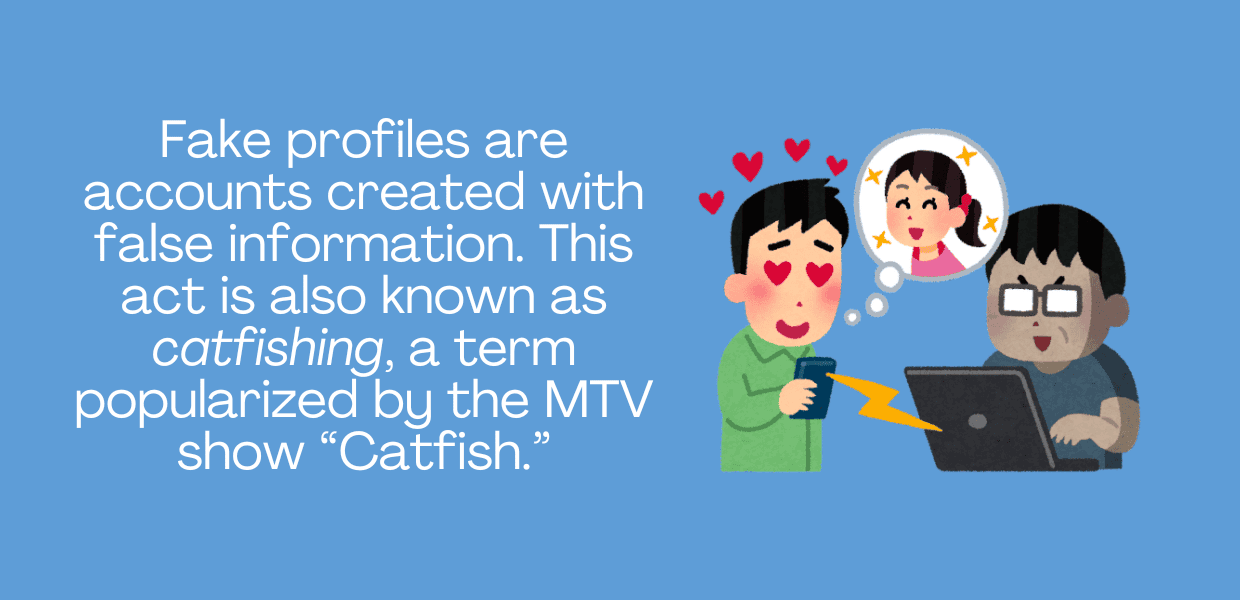
Fake profiles, or catfishing, come down to deception. Typically, whoever is behind the fake profile wants money, revenge, or simply some fun.
Some catfish invent an identity to swindle you out of cash, others to trick and manipulate you out of revenge, and others just to amuse themselves.
Another kind of catfish just wants an escape. Maybe their home life is hard, or they feel insecure about parts of themselves (their looks, social skills, or economic class). Catfish like these care less about hurting anyone and more about connecting with matches they think would otherwise have no interest in them.
We’ll dig into this more later, but typical warning signs of a fake profile include profile details that don’t match across platforms, blurry photos or photos that seem “too good to be true,” odd or evasive replies when you ask something personal, and the biggest red flag: an unwillingness to do a video call or meet in person.
The Risks
Someone named after a freshwater fish might not sound threatening, but plenty of romance scam victims would disagree. Catfishing leaves a hole, financial or emotional, that can be hard to climb out of.
1. Financial Scams
Money, or the lack of it, drives people to do wild things, scamming strangers online among them.

Catfish chasing their bag set up fake profiles, strike up online conversations, and sooner or later say they urgently need cash.
Every year, this cash-hungry catfishing scheme costs victims $600 million worldwide, including $100 million in losses in the U.S.
According to FTC data, “For cases involving victims between 20 and 29 years old, the average amount lost was $3,679. The average amount lost in cases involving people 80 or older was far larger: $30,448.”
2. Emotional Manipulation and Exploitation
Losing money can be crushing and heartbreaking on its own, but many catfishing victims find that the emotional harm their online scammers cause lasts the longest.

When all is said and done, these victims gave their trust (and often their love) to someone who then betrayed them.
Trauma like that can cause psychological distress. It may even set off changes in neurochemistry.
According to Talkspace therapist Catherine Richardson LPC, “Being catfished may create new brain pathways that cause people to distrust what that person, and future partners, say and do. That can make people more vulnerable to paranoia and pessimism.”
3. Risks to Personal Safety and Privacy
Dealing with deceptive online characters puts you at risk of identity theft.

Cybercriminals use private details about your life to make money.
That might mean having your identity stolen, getting blackmailed, or seeing your nudes leaked (in other words, revenge porn).
Meeting strangers online always carries risk. Whatever privacy settings and protections online dating apps provide, keep in mind that things online may not be what they seem.
Spotting a Fake Profile
According to recent statistics, roughly 23% of dating app singles say they’ve been catfished at least once. Deceitful little bottom-feeders seem to be everywhere, but nothing says you must be the next one they fool. Watch for these warning signs of a fake profile.
1. Look for Inconsistencies
Catfish aren’t always obvious at first glance. Still, with a bit of digging and some cross-checking, you might be surprised by the lies you turn up.
Say someone you met online casually mentions two siblings one week, and a month later they claim to have three.
Or maybe their LinkedIn profile lists Missouri as their birthplace while their Instagram bio says NYC.
The trick is to take mental notes (or real, physical ones) on whatever strangers share with you online, so you can look back at them later.
2. Analyze Photos (Reverse Image Search Is Your Friend).
Fellow hate-watchers (and regular viewers, no judgment here) know that every episode of “Catfish” includes a reverse image search.
Nev and Max, who host the show, take pictures of the person suspected of using a fake online identity, paste them into Google’s search bar, and press Enter.
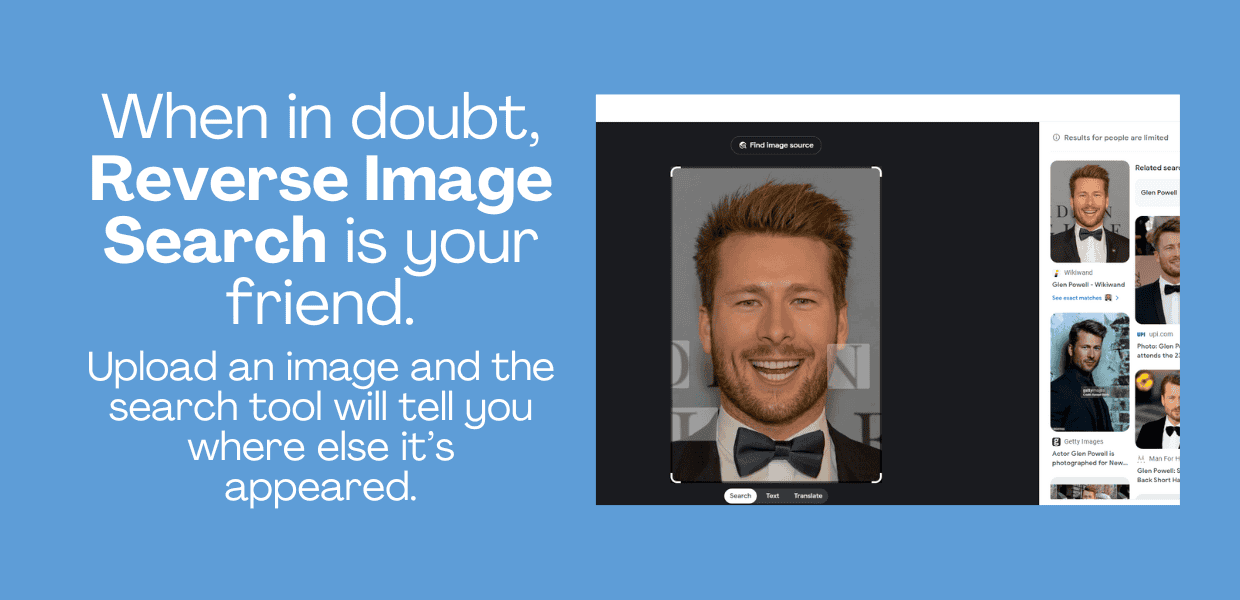
Here’s a photo of Glen Powell as an example. Google showed me similar images and where this one is posted.
The search engine brings up related images, which Nev and Max then comb through to track down where they really came from. You don’t need to be an MTV producer to use this trick; you can look up your match’s photos yourself and see what turns up.
3. Be Wary of Vague Answers
Getting to know someone online, particularly on a dating app, means asking questions and answering them too.
If a person makes this feel weird or keeps tiptoeing around their answers, that may be a warning sign that they aren’t who they claim to be.
Suppose you ask where someone works and they tell you “In an office” without naming the company, or answer “in Louisiana” when you ask about their college. They could be hiding something.
4. Trust Your Instincts
You know that sense you get when someone behind you is staring, even though, of course, nobody can see what’s behind them? That hard-to-explain gut feeling is your intuition.
And it’s nearly always right.
So if an online profile sets your spidey senses tingling, pay attention.
4 Tips for Steering Clear of Fakers
Getting through the first few rounds of catfish detection doesn’t mean you’re totally in the clear. Add these tips to your investigation strategy for an extra layer of protection when you’re interacting with people online.
1. Meet in Person (or Via Video Call) ASAP
Pop quiz: What’s the fastest way to find out whether someone is really who they say they are? Simple: meet them.

Whether your first date happens at a coffee shop or over a video call from home, set it up, and set it up quickly. There’s no point in stalling!
Someone with a fake profile won’t be able to meet you face-to-face.
If their excuses for why they can’t never stop coming, and they’re probably a bit ridiculous (think “the camera on my phone AND computer are broken” or “I’ll be really busy with work for the next couple of months”), chances are you’re talking to a liar.
2. Do Research on Social Media
Whenever a guy and I match on a dating app, I promptly look for him on social media.

Partly that’s because I want more than the handful of grainy (or wedding-related) photos on his dating profile. But I also want proof that he’s legit.
Once you find someone new on social media, compare what’s there with anything they’ve told you in private chats.
You can also look for mutual friends and even suss out whether they’ve been in a relationship recently (by looking at tagged photos).
3. Don’t Give Out Personal Details
Asking which university you attended is fine; asking for your credit card details or home address is a whole different matter.

Catfishers running romance scams try to extract personal details from vulnerable people, then put them to shady use.
Conversations on dating apps should focus on who you are, not on your bank or your mother’s maiden name.
Until you’ve met this person a few times and confirmed they’re genuine, we suggest keeping personal details such as your income and address close to the vest.
4. Never Send Money to a Stranger Online
Kindhearted people can struggle to say no to someone in need. Wanting to help a person who’s down on their luck is a natural instinct.
But trust me on this: Wiring cash to someone you’ve never met is just asking for trouble.
If you’d rather not add to the $600 million catfish take worldwide, read up on the lies romance scammers most often tell online.
Common ones: they’re in the hospital, they need airfare to come see you, or they need bail money for themselves or for a relative who was wrongly accused.
What to Do When You Run Into a Fake Profile
Recent statistics suggest bots and catfish make up 10% of all profiles on online dating platforms.
If you’re single with an active dating profile, there’s a decent chance you’ll run into one eventually. If and when that happens, here are the steps we recommend:
1. Report Suspicious Accounts to the Platform
Most apps (the good ones, at least) now let you easily flag fake profiles and have them taken off the platform.
Note: A determined offender may still find a way back onto the site or app, but this at least makes it harder for them.
Reporting a bad profile could save the next person from being scammed or losing time to a catfish, which makes it well worth doing.
2. Block Communication
This person has no business keeping access to you, so block them on whichever platform they first reached out on, and do the same on any social media accounts they have.
And if they gave you their phone number, block that as well.
3. Damage Control (If Necessary)
Sometimes the conversation is so fun that a few personal details slip out before you realize there’s a catfish on your hook.
If that happens, don’t panic, but do move fast. Change your passwords, keep a close eye on your email and bank accounts, and freeze your credit cards if needed.
Leave the Fakes Behind and Meet Someone Real
Fellow rose-and-thorn people, let me wrap this up in a way you’ll appreciate: The internet’s thorn is that, by its very nature, it makes it easy to lie, cheat, scam, and pose as someone you’re not. Without some caution, that can mean bruised feelings and bruised wallets.
The rose? The World Wide Web has put us in touch with people and communities we’d never have come across otherwise.
Using the tips and tricks in this guide, you can steer clear of the fakes and connect with lots of beautiful, genuine, real people, the kind who won’t rob you or put your nudes up for sale online. Stay safe, keep yourself informed, and always listen to your gut!
About the Author
By: Camila Wright
Feature Writer
Camila Wright brings a unique storytelling voice and marketing background to feature stories on thecandiddate.com.
Share the Knowledge!
Our dating experts work hard to show you the best dating sites. Want to show your appreciation? Share this page!