Personality Quizzes and Their Role in Dating



Personality quizzes aren’t just something to kill a few free hours with on a weekend. Each one is a set of searching questions built to measure the individual traits that add up to a whole person.
They run the gamut from psychological assessments grounded in science to lighthearted compatibility tests. A quiz can confirm what you already knew about yourself (yes, I really am an introvert), or it can point out sides of your personality you’d never considered (apparently, green peppers would be my pizza topping).
Some singles include the results of a certain personality quiz in their dating profile. You may have come across profiles that label the person “ISFJ” or “ESFP”, for example, a nod to their Myers-Briggs personality type. Those four letters are worn like a badge of honor and hint at the person’s sensitivity and character.
Here’s a look at the kinds of personality quizzes available and the ways they can boost your dating life.
Kinds of Personality Quizzes
Plenty of people find personality assessments like Enneagram types or MBTI results useful for self-discovery. Singles, though, can also use a quiz to step up their dating game.
A quiz can shed light on who might make a good match. Below is a quick guide to well-known quizzes that tend to pop up in eharmony profiles or Tinder bios.
Myers-Briggs Type Indicator (MBTI)
Drawing on the work of the psychoanalyst Carl Jung, the MBTI is one of the best-known personality assessments around. The Myers-Briggs assessment relies on a long questionnaire to place each person in one of 16 personality types.
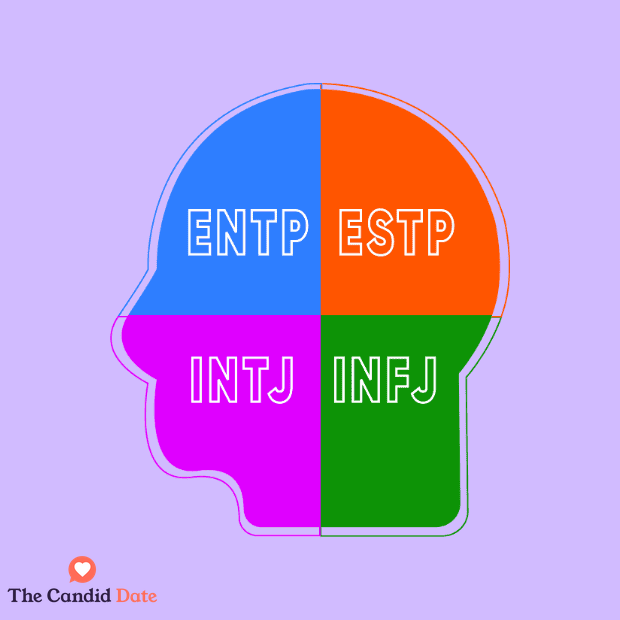
It measures people along four dichotomies: Extroversion/Introversion, Sensing/Intuition, Thinking/Feeling, and Judging/Perceiving. How you answer determines which of the 16 personality types you land in, each one represented by four letters.
For instance, someone who is introverted, sensing, feeling, and perceiving is an ISFP, also known as The Adventurer. Marilyn Monroe, Kurt Cobain, and Brad Pitt are believed to share this type.
Big Five Personality Traits
Another well-known framework in personality psychology is the Big Five model, sometimes called the Five-Factor Model (FFM).
This test measures people on five dimensions: Openness, Conscientiousness, Extraversion, Agreeableness, and Neuroticism (OCEAN).
Professor Noam Shpancer looked at what the Big Five model means for dating. In his words, “The data suggest that those looking for a partner for enduring love and sex need not fixate on finding someone similar to them in personality. Rather, they’d benefit from looking for a partner who’s agreeable, conscientious, and emotionally stable.”
Enneagram
The Enneagram lays out nine personality types, each defined by a person’s fears, motivations, and beliefs.
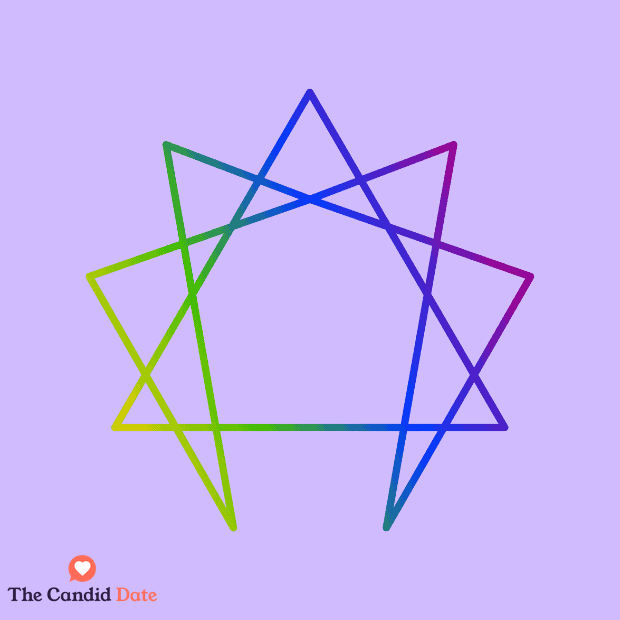
Type one on the Enneagram, for example, goes by The Reformer and is described as purposeful, principled, perfectionistic, and self-controlled. Type two goes by The Helper, whose traits include being caring, generous, possessive, and eager to please.
Speaking with Mind Body Green, the author and certified Enneagram coach Stephanie Barron Hall described how your Enneagram type can help in relationships. “The point of using the Enneagram for relationships is not to figure out who you can rule out of the dating pool but to learn how to use this tool as a path toward growth and deeper connection,” she explained.
Fun Quizzes
Online, you’ll find no shortage of fun quizzes that sort people into groups. Which Disney character are you? Which pet matches your personality? There are even quizzes that will tell you if you’re weird.
Quizzes like these can be great fun, and posting your results on social media or your dating profile can get plenty of conversations going.
One small caveat: online quizzes aren’t very scientific, so don’t treat the results too seriously.
Dating or Relationship Compatibility Quizzes
In my opinion, this is the best time ever to give online dating a shot. There’s so much help out there, from the advanced compatibility matching at eharmony to the never-ending quiz questions on OkCupid. Lots of apps offer sophisticated personality quizzes that reveal things about your love life.
Compatibility quizzes can give you and an online match plenty to talk about. You might ask why they picked a certain answer, or you could line up your answers side by side and look for common ground.
Sure, you can swipe on apps armed with not much more than a photo, but lots of dating sites and apps now nudge singles to go further with personality quizzes that work out how compatible two people are.
How Personality Quizzes Work
Personality quizzes can seem like a mystery, but they follow fairly predictable rules. Here’s a look at the psychology and mechanics behind online quizzes.
Question Formats
Quizzes use a range of question formats to pin down the main features of the test taker’s personality. Among the formats you might see:
- Multiple-choice questions: People pick the answer that fits them or their preferences best. One example: “Which of these best describes you?” with choices such as “Confident and bold,” “Compassionate and sweet,” “Curious and innovative,” and “Passionate and creative.”
- Likert scales: People rate how much they agree with a statement on a scale (one to five, say). Take “I like it when friends come to me for advice”, where you’d pick one for strongly disagree, two for disagree, three for neither agree nor disagree, four for agree, and five for strongly agree.
- Forced-choice questions: People have to pick one of two options, which shows what they prioritize. Daters can learn plenty from a question such as, “Would you rather spend a cozy night in watching a movie with your date or go out dancing together until the sun comes up?”
- Open-ended questions: Some personality quizzes on dating apps include short-answer questions to gather more nuanced details. Online daters may be asked to answer something like, “Describe your perfect first date.” It’s a chance to talk about the kind of setting or activities you’d like for a first date.
Providing Insights into Compatibility
The results of a personality quiz can help you judge compatibility. Maybe you’re browsing answers to quiz questions on OkCupid and notice someone says they enjoy how beer tastes. If you share that, you could message them about your favorite local brewery. A bolder dater might even suggest meeting up for a beer as a first date.

The better you know a potential match, the smarter your decision can be.
A Washington Post story on why people add their Myers-Briggs types to Tinder profiles included college student Marguerite Franco, an ESFJ. She explained that she put her type in her bio hoping to draw in other extroverts.
Facilitating Self-Awareness
Personality quizzes do more than measure compatibility. They also help you understand yourself, which is hugely valuable when you’re dating.
Lean into the growth. Because they get you to explore your values, interests, and preferences, personality quizzes can sharpen your self-awareness.
Once you understand yourself and what you’re after, it gets easier to tell who is or isn’t a good romantic fit.
Potential Pitfalls and Limitations
Personality quiz results can be helpful, but don’t build your whole approach to dating around them.
A person’s MBTI or Enneagram type definitely tells you something about them as a potential date, but it doesn’t tell you everything.
You might discover that you click better with someone whose quiz results suggest you’d be a poor match. Sometimes opposites do attract. A happy, healthy relationship depends on so many things that a personality quiz can’t really measure compatibility in full.
How Online Dating Has Evolved
In dating, personality quizzes do important work, raising the level of conversation and speeding up connection. Over time, quiz questions have been fine-tuned to zero in on what today’s daters care about most.
Early Days on Match
Launched in 1995, Match is the longest-running U.S. dating site. Nearly 30 years later, it’s still a hugely popular dating platform, with over 15 million active users.
From the start, Match let people sign up at no cost and browse profiles near them that met particular date criteria. Back in the 1990s, that was a revolutionary way to bring people together. Match built its matchmaking around personality from day one, posing nuanced questions to gather what its algorithm needed to deliver daily match suggestions with a real shot at sparking relationships.
Naturally, Match has changed a lot since 1995, and its team has refined the relationship questionnaire to suit what today’s users want. Profiles on Match now include a section for pets, political views, religious beliefs, and family values, with filters for each of those date criteria too.
OkCupid’s Shift toward algorithm-based matching
OkCupid debuted in 2004, and in 2011 it was bought by Match Group (the owner of Match, Tinder, Hinge, and lots of other dating sites and apps).
OkCupid earned a name as a no-cost platform for singles who want serious relationships, thanks partly to how it handles algorithm-based matching. It uses in-depth questionnaires and mathematical algorithms to suggest the most compatible matches.
According to a blog post on its website, “OkCupid is the only dating app in the world that matches people on what matters to them through in-app questions that power our algorithm.”
OkCupid’s early success showed that insight into personality would become a core part of online dating on other platforms, too.
App Explosion in Popularity
Once smartphones were everywhere, dating apps were too. Established dating sites like Match, OkCupid, and eharmony started rolling out app versions in the 2010s.
At the same time, newer apps like Tinder, Bumble, and Hinge racked up millions of downloads and transformed the way singles date.
Every dating app handles matching a little differently. Even so, nearly every dating app runs on algorithms that size up profiles to judge compatibility.
Certain algorithms factor in behavioral analysis, weighing how quickly users respond, how often they send messages, and how they interact to gauge compatibility and interest.
Importance & Impact
Thanks to the move toward algorithms that match people using personality assessments, millions have found happy relationships on online dating apps.
Candace and Michelle took the personality test on OKCupid and met there. Writing in a post on the platform’s blog, Candace said, “Online dating can be intimidating, but connecting on OKC was simple. We got to see and read a little about each other, message back and forth, and eventually meet in person! That one message was life-changing. It led us to start dating, move in together, get married, and just welcomed our first child in 2021!”
“We clicked on a level that I had not thought possible.” –Jen, a former Match user
Another success story belongs to Jen and Michael, a couple that met on Match in 2019. Jen shared her story on the website of Match Group: “Since [our first date], we have only been apart for a few days at most. We clicked on a level that I had not thought possible. I see things in Michael that I have never seen before and I am so incredibly happy. Thank you SO MUCH for running such a reputable and amazing platform.”
Over on the Bumble blog, Aakriti and Viraj described what it was like to meet on the algorithm-driven app. “I liked that it asked specific questions and I could filter out the people who were only looking to find something casual,” Aakriti explained.
The first thing that stood out to her in his profile: he put a high value on communication, both in his own life and in a partner. Being a communications major herself, she was sure a right swipe was in order! The two have been married since January 2022.
What’s Next for Personality Quizzes and Dating
Lots of dating apps are eager to innovate, so expect some intriguing progress in personalized user engagement and smart matchmaking tools over the next few years.
Transparency in Data Usage
Every dating app gathers personal data, though some gather more than others. If you want to know how the apps you use handle your data, check the privacy policies in their terms of service.
Under Apple’s privacy rules, apps must list those policies on the App Store. A Cybernews analysis found that Apple makes developers state whether their app gathers any of 35 kinds of data or privacy points. Developers have to be upfront about whether they gather phone numbers, contacts, location, photos or videos, and audio.
Dating apps are clearly here to stay, but as users grow more aware of privacy issues, we’re hoping to see apps become more transparent about how they use data.
Integration of AI and Machine Learning
Whether you like it or not, AI already figures into how you date on the apps. Bumble uses an AI tool, for example, to detect unwanted lewd images and protect users from them.
Tinder offers a feature that lets people update their bios using AI. And in 2023, Match Group, which owns a number of dating apps, set up a new team dedicated to generative AI.
Many daters have started turning to AI to write their bios, open conversations with matches, and fine-tune their profiles so they’re more likely to get a date.
As machine learning and AI keep improving, dating apps will probably build more sophisticated algorithms for bringing people together.
Expect to find AI-written conversation starters and more sophisticated personality quizzes built into dating apps.
Personalization and User Engagement
If dating app questionnaires have felt like a chore, here’s the good news: they keep getting better. Down the road, they could become more interactive and engaging, with game-like features or questions that adapt based on how you answered earlier ones.

A blog post from RipenApps recommends that dating app innovators figure out how to make the user experience personal to each individual.
Nobody who dates online wants to feel like just a number in the swiping game. The more personal an app can make the experience, the better its odds of keeping users around and fighting burnout.
Making Sense of Personality Quizzes
Personality quizzes are an enjoyable way to learn about yourself and the people you might date. They’re useful enough that plenty of apps have worked quiz questions into how they make matches.
Dating sites and apps keep evolving and coming up with fresh ways to build personality quizzes into the experience. The payoff is profiles that say more and conversations that mean more.
Still, it’s tough to boil down a person’s essence and lived experience into one simple quiz. The Enneagram has just nine personality types, but most of us would agree the world holds more than nine kinds of people.
Personality quizzes can make a great icebreaker and a handy tool for getting to know yourself or the person you’re dating, but treat them as the opening of the conversation, not the final word.
About the Author
By: Abigail Robinson
News Writer
Abigail Robinson is a professional writer and editor covering news, lifestyle, and modern dating trends for thecandiddate.com.
Share the Knowledge!
Our dating experts work hard to show you the best dating sites. Want to show your appreciation? Share this page!